
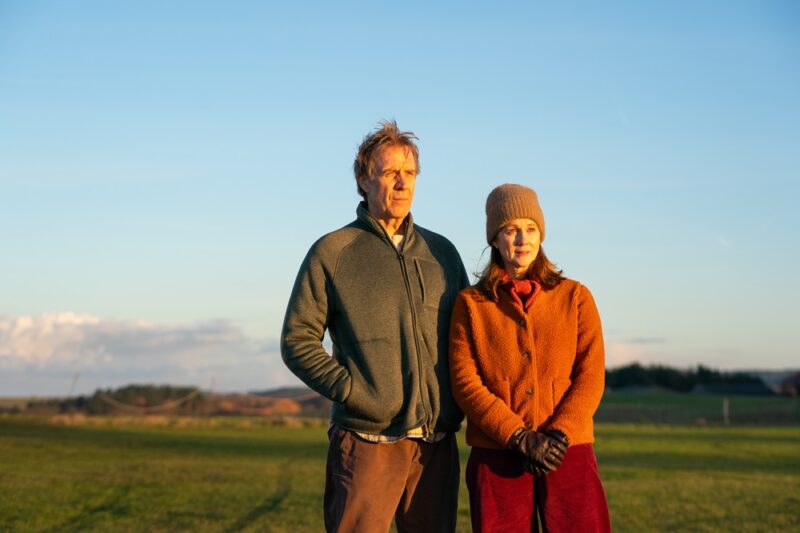
Diagnosed with the same degenerative disease, at the same clinic, on the same day, Tony (Rhys Ifans) and Emma (Laura Linney) may suddenly find themselves bound by Parkinson’s, but Onwards and Sideways is far more interested in everything that makes their experiences entirely their own. For Oscar-nominated director John Madden (Shakespeare in Love, Proof), that simultaneous diagnosis proved the crucial dramatic breakthrough in Paul Mayhew-Archer’s screenplay, transforming what could have been a story of one character guiding another through illness into something far more uncertain, intimate and profoundly human.
Refusing to turn the film into what Madden describes as a “medical lesson about Parkinson’s,” Onwards and Sideways instead finds its emotional centre in two people trying to reconcile an unpredictable future with an equally unexpected connection. Ahead of the film’s TIFF premiere, our Peter Gray spoke with Madden about reshaping the screenplay alongside Mayhew-Archer, preserving the individuality of Tony and Emma’s experiences, the extraordinary physical precision Laura Linney and Rhys Ifans brought to their performances, and why sometimes the most important thing a director can do is build the world, trust the actors, and simply let a moment unfold.
John, I was fascinated to learn that an earlier version had Emma already living with Parkinson’s and effectively guiding Tony through it, whereas you suggested they should receive their diagnoses simultaneously. Was the breakthrough there realising that Emma couldn’t be Tony’s answer – that for their relationship to really work dramatically, they both had to enter it without knowing what came next?
Yeah, I think that’s right. At a certain point it was actually negating itself, because Paul (Mayhew-Archer, screenwriter) was using Emma to tell Tony everything. It became a kind of lesson. When I read a very early version of the script it was, in a funny kind of way, a boy-meets-girl story. It was a tough thing, because you’d basically stay on this plateau. It’s not that things didn’t happen, because they did, but when (the script) came back to me some eight-years-later, I knew a lot more, and I was intrigued in that the script had been developed.
It still had this hole in the middle, so I had this idea that they should actually be both diagnosed in the same moment. It makes them think about each other. That seemed like a really interesting point of detonation, and it took (Emma) off in a different direction. Paul was very intrigued with that idea. We had about 5 or 6 different consultations throughout the film with the doctor, so this helped with alternating those consultations between Tony and Emma, and they should be consulted by the same doctor.
Paul is not a natural screenwriter, and I don’t mean that in any kind of derogatory way at all, but it took a while to get where we wanted. There were a lot of unusual ideas, but it started to take its proper shape, but (Paul and I) spent a lot of time with (Rhys and Laura) as the script started to play itself.
That decision also creates an interesting contradiction: medicine has to diagnose Tony and Emma with the same condition, but drama has to show us why that label is completely inadequate in explaining either of them. Was that tension – medicine needing categories while storytelling needs individuality – something you became increasingly conscious of as you developed the film?
I think I knew where I wanted it to go. And also that was an idea that was developed between 2018, when I first read the script, and 2023, when I next read it. That idea of structuring it like episodes. That was an incredibly useful thing. Those two characters just happened to bump into each other. Emma, originally, just walked into his life, and then said, “Good luck.” And, of course, she walks back into his life, but then he exits hers. That dynamic worked because they had then formulated their own response to the condition that has been thrown at them.
The story then became about this very, very profound sense of love. I was interested in (the story) emotionally. It wasn’t mawkish. I didn’t want it to be a medical lesson about Parkinson’s.
Yeah, because watching it, it’s easy to go into it with this preconceived notion of “Parkinson’s means tremors,” but this film shows that isn’t necessarily the case for everybody. And as you were saying about that Paul was writing things that were unusual, in a way, did you find he had any non-negotiables in terms of what had to be in the script?
Not at all. He’s incredibly open. I can’t stress enough admiration for him, in terms of taking it on. Instinctively, he knew where it was going, in the sense of loneliness in the character and of being dependent on (his students), who he has a kind of magic with. Suddenly, he doesn’t want to let that go. But, at the same time, he was falling into a kind of despair just at the moment that he suddenly gets a lift.
We had a lot of help by that point. I knew a lot about the condition itself, and we became very involved with two people who had what they called “Neuro Heroes.” They were very, very skilled physiotherapists working in the Parkinson’s field. They wanted to get out of neurology on their own and start dealing with people one-on-one, and then COVID hit and that couldn’t happen, so it developed into a much wider thing. Because of that, we relied tremendously on their wisdom in mapping what would happen as we went through the story.
It was incredible how quickly Laura (Linney) wanted to understand exactly how the tremor would feel, because it’s very difficult to do. I kept trying to do it myself, thinking, “Can I hold that up?” She was absolutely brilliant with all of that. And Rhys was playing a much looser character, but he very quickly understood exactly where they would be physically, to the point where you think, “That’s quite amazing.” It feels incredibly real.
As far as the acting goes, it’s not a kind of freak thing. They just knew where they were going. They understood the condition they were navigating and trying to manage, whilst at the same time realising that neither of them could possibly be with one another because they can’t take care of each other. They understood that so well, and that was brilliant.
There’s a moment where Emma says, “I don’t want to lose,” and Laura’s delivery contains what feels like an entire imagined future. As a director, when an actor gives you something that emotionally concentrated, is there an instinct to shape the moment cinematically, or is the real skill recognising when the filmmaking should almost disappear and simply stay with her?
I had a sense of how that would work, but I didn’t say anything other than that. We had an enormous amount of faith in one another because I didn’t want to dictate anything. I just said that I felt she would end up with her face in his hands in some way, because it’s protective and what happens to her is upsetting for him. So I said, “That’s the only thing I’m interested in. Let’s just see what happens.”
And it happened immediately. It was quite difficult to shoot, quite difficult to get, but we wouldn’t have done it any other way. She has those resources as an actor, and it’s a very startling moment. Of course, there’s a fragility inside her, a level of stress that is almost unbearable, but it doesn’t show and we don’t see it for a long time, so it still had plenty of room to develop.
That’s the story with actors. I just said, “This is not about me. I’m going to build a world for it, but I just want to see how this feels to you and with you.” They became instantly trusting of one another and of what was going on. We were really just letting it unfold, without being indulgent about it, and it started to take on a life of its own.
Onwards and Sideways is screening as part of this year’s Toronto International Film Festival, running between September 10th and 20th, 2026. For more information, head to the official site here.
