

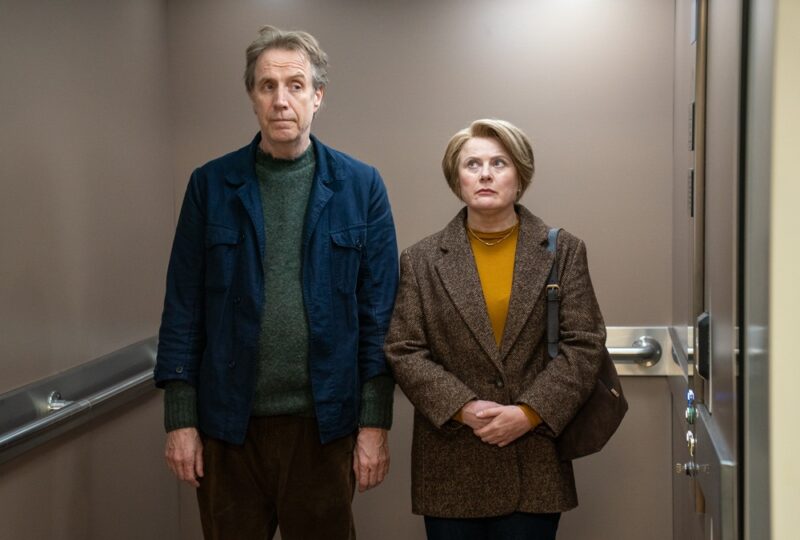
Films centred around degenerative illness are often walking an unenviable tonal tightrope. Push too hard towards inspiration and the characters can become vessels for an uplifting message; lean too heavily into suffering and their lives become defined entirely by their diagnosis. Onwards and Sideways understands that living with Parkinson’s can be frightening, exhausting, frustrating and, sometimes, unexpectedly funny, but it also understands that the people experiencing it remain exactly that: people.
That humanity is perhaps unsurprising given screenwriter Paul Mayhew-Archer has lived with Parkinson’s since 2011. His script has an intimacy that rarely feels as if it’s observing the condition from the outside, instead finding humour and tenderness within the indignities and uncertainties that come with a body increasingly refusing to cooperate. Under John Madden’s restrained direction, the result is an affecting dramatic comedy that knows exactly when to make its audience laugh, and, for the most part, resists instructing them when to cry.
Rhys Ifans plays Tony, a widowed primary school teacher whose diagnosis arrives after he notices something unusual in the movement of his hand. Laura Linney is Emma, an American composer receiving the same news at the same clinic on the same day. Their circumstances immediately connect them, but their responses couldn’t be more different. Tony retreats into himself, withholding the diagnosis from his workplace and attempting to preserve the life he knows, whilst Emma initially charges towards her new reality with considerably more openness.
Their paths continue crossing over the following years, and Onwards and Sideways gradually reveals itself as less a film about two people dying than two people figuring out how they want to keep living. There’s something quietly beautiful in the way their relationship evolves. They don’t need to explain every tremor, every moment of exhaustion or every fear about what their bodies might do next. Family members can offer love and support, but Tony and Emma share an understanding that exists without explanation.
Ifans is particularly moving in how little he initially gives away. Tony’s grief over his late wife has calcified into a loneliness he doesn’t quite recognise, and his diagnosis only deepens that isolation. Ifans lets the character’s fear gradually surface, making the moments where Tony finally allows himself to admit that he’s scared all the more affecting. There’s a gentleness to the performance that beautifully complements his more recognisably eccentric qualities.
Linney has the ostensibly brighter role, but Emma’s optimism increasingly reveals itself as something more complicated. Her determination to remain herself is tested as Parkinson’s progresses, and Linney is extraordinary at communicating the emotional exhaustion underneath that resilience. Both actors are remarkable physically, but crucially their performances never feel constructed around an assortment of symptoms. The tremors, stiffness and changes in movement are part of these people rather than the performances themselves.
It’s also why their eventual intimacy works. Madden doesn’t treat their connection as some grand romantic salvation from illness. Instead, they give each other permission to be frightened, angry, ridiculous and vulnerable. Their diagnosis may have brought them together, but it isn’t ultimately what defines their relationship.
The film occasionally pushes harder than necessary. Thomas Newman’s score is beautiful in isolation, but Madden sometimes deploys it over scenes where Linney and Ifans are already doing more than enough to generate an emotional response. There are also moments where the film’s trajectory becomes easy to anticipate, particularly as Tony’s career and both characters’ physical independence begin to diminish. A little more trust in the audience would have made several of its emotional beats even stronger.
But sentimentality never overwhelms the honesty at the film’s centre. Mayhew-Archer’s humour proves particularly valuable in this respect, allowing Parkinson’s to exist alongside laughter without either trivialising the disease or treating those living with it as too fragile to be funny. Monica Dolan is also excellent as Tony’s fiercely protective sister Liz, embodying the particular helplessness of loving somebody whose condition you cannot fix.
Perhaps the most affecting idea in Onwards and Sideways is that a diagnosis capable of changing almost everything about your life doesn’t necessarily have to change who you fundamentally are. Tony and Emma’s bodies betray them in increasingly devastating ways, but the experience also forces them to interrogate what remains when so much they took for granted begins slipping away.
Warm, funny and deeply compassionate, Onwards and Sideways may follow a familiar road, but Madden, Mayhew-Archer, Linney and Ifans navigate it with enough honesty to make the journey feel distinctly their own. It understands that accepting the uncertainty of what comes next doesn’t mean surrendering to it. Sometimes moving onwards means accepting that life will inevitably take you sideways along the way.


THREE AND A HALF STARS (OUT OF FIVE)
Onwards and Sideways is screening as part of this year’s Toronto International Film Festival, running between September 10th and 20th, 2026. For more information, head to the official site here.
