

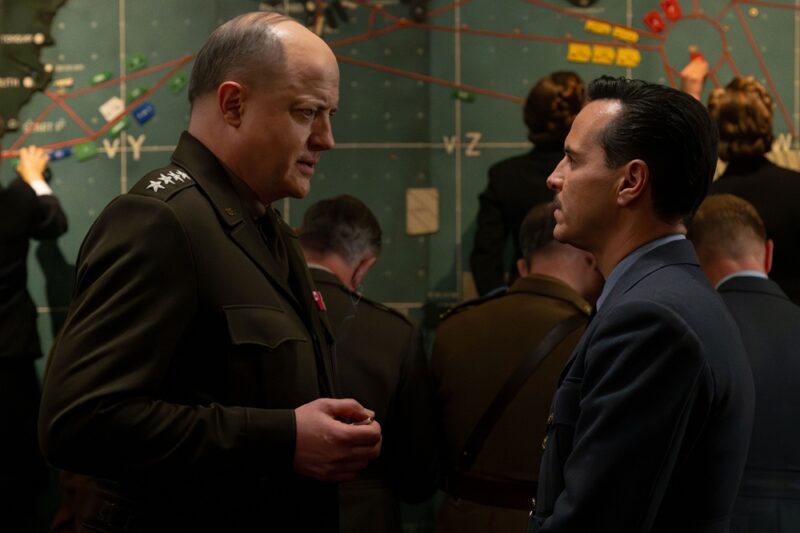
History may remember D-Day as one of the defining victories of the Second World War, but for the men tasked with deciding when it should take place, victory was anything but certain. Before Allied soldiers stormed the beaches of Normandy, before the sacrifices and triumphs that would become etched into collective memory, there were weather charts, conflicting forecasts, increasingly frayed nerves and an almost unimaginable decision resting on the shoulders of a handful of individuals. It’s an extraordinary reminder that some of history’s most consequential moments aren’t necessarily shaped on the battlefield, but in rooms where people must make impossible choices without ever knowing whether they’re right. In Pressure, Australian filmmaker Anthony Maras finds a fascinating new perspective on a familiar chapter of history, transforming the seemingly uncinematic business of meteorological predictions into an unexpectedly gripping examination of courage, responsibility and the terrifying uncertainty of war.
Set across the tense 72 hours preceding the Normandy landings in June 1944, Pressure follows Scottish meteorologist Group Captain James Stagg (Andrew Scott), whose responsibility for forecasting the weather surrounding Operation Overlord places him at the centre of an extraordinary moral and strategic dilemma. With the Allied forces preparing to undertake the largest seaborne invasion in history, Supreme Commander General Dwight D. Eisenhower (Brendan Fraser) must determine whether conditions will permit the operation to proceed or whether postponement could jeopardise months of preparation and potentially alter the course of the war. The stakes are almost impossible to comprehend. Thousands of lives hang in the balance, and the difference between success and catastrophe may ultimately rest on the interpretation of something as unpredictable as the weather.
It’s a premise that might initially sound more suited to a history lecture than a gripping theatrical experience, but Maras understands that suspense doesn’t necessarily require bullets flying or explosions erupting. Sometimes, the most frightening possibility is simply not knowing what comes next.
Working from a screenplay co-written with David Haig, adapted from Haig’s stage play, Maras crafts an intensely contained drama that finds its momentum in the increasingly desperate pursuit of certainty. Maps are studied, forecasts challenged, information reconsidered and opinions defended with growing ferocity. Every new development seems to complicate rather than clarify the situation, and the closer the invasion draws, the more unbearable the pressure becomes. It’s a testament to the strength of the writing and Maras’ disciplined direction that conversations about wind speeds, atmospheric conditions and tidal patterns can feel every bit as consequential as the military action unfolding beyond the walls of Allied headquarters.
At the centre of these competing interpretations is the increasingly contentious relationship between Stagg and American meteorologist Colonel Irving Krick (Chris Messina). Where Stagg advocates for an approach grounded in evolving atmospheric observations and scientific analysis, Krick places greater confidence in historical weather patterns and established precedent. Their disagreements extend beyond professional rivalry, becoming a fascinating examination of how evidence can be interpreted differently by people equally convinced of their own conclusions. Neither man has the luxury of absolute certainty, yet both understand that the consequences of being wrong could be catastrophic.
Scott is exceptional as Stagg, delivering a performance of extraordinary intelligence, restraint and emotional complexity. His meteorologist is not an immediately endearing figure. Abrasive, stubborn and frequently impatient with those who question his expertise, he possesses little interest in making himself agreeable to the military establishment. But beneath that difficult exterior lies a man whose commitment to scientific integrity is inseparable from his sense of moral responsibility. Scott allows that humanity to emerge gradually, revealing the exhaustion, fear and personal sacrifice beneath Stagg’s unwavering professional resolve.
It’s a performance that resists the temptation to make its protagonist conventionally heroic. Stagg’s courage isn’t expressed through grand physical gestures or inspirational speeches, but through his willingness to stand before some of the world’s most powerful military figures and deliver an assessment they desperately don’t want to hear. Scott makes every hesitation, every measured response and every moment of barely contained frustration feel significant. His is a portrait of quiet conviction, made all the more affecting because the character understands that being right about the evidence offers no guarantee of a favourable outcome.
That internal conflict becomes particularly poignant through Stagg’s personal circumstances. With his pregnant wife Liz (Tamsin Topolski) away from him and her safety thrown into question following a bombing, the meteorologist finds himself confronting an almost unbearable collision between public duty and private anguish. His responsibility to the Allied operation prevents him from seeking the reassurance he so desperately needs, reinforcing the film’s central preoccupation with the emotional consequences of uncertainty. Scott navigates these competing pressures beautifully, ensuring that Stagg never becomes merely a mouthpiece for scientific principle.
Equally compelling, though in an altogether different register, is Fraser’s portrayal of Eisenhower. Rather than attempting an exacting impersonation of the historical figure, Fraser draws upon his natural warmth and accessibility to reveal the vulnerability beneath the commander’s imposing responsibilities. His Eisenhower is a man expected to project absolute confidence while privately wrestling with the knowledge that every available decision carries potentially devastating consequences.
Haunted by the disastrous losses suffered during Exercise Tiger, the rehearsal operation that preceded D-Day, Eisenhower understands the human cost of failure with painful clarity. Fraser conveys that burden through a performance that alternates between explosive frustration, weary contemplation and moments of almost paralysing doubt. There is something particularly affecting about watching a man entrusted with the fate of thousands struggle against the limitations of his own knowledge. His authority may be unquestionable, but his certainty is anything but.
The contrasting approaches of Scott and Fraser provide Pressure with its emotional foundation. One portrays a man whose responsibility is to interpret the evidence; the other, a man who must act upon it. Their relationship becomes a compelling meditation on leadership, particularly the courage required to acknowledge that making an informed decision is not the same as guaranteeing its success.
The supporting ensemble is similarly impressive. Messina brings a persuasive combination of arrogance, intelligence and combative energy to Krick, making his clashes with Scott among the film’s most entertaining exchanges. Their verbal confrontations provide occasional flashes of dry humour without diminishing the seriousness of the situation. Kerry Condon, meanwhile, is quietly indispensable as Kay Summersby, Eisenhower’s driver and personal secretary, whose emotional intelligence and intuitive understanding of the commander make her a stabilising presence amid the escalating tension. Condon brings a welcome sensitivity to the role, suggesting an individual who recognises the humanity beneath the military hierarchy. Damian Lewis, as Field Marshal Bernard Montgomery, contributes further volatility to an already combustible collection of personalities, while Con O’Neill lends authority to the surrounding military discussions.
Having previously demonstrated an ability to create sustained, almost suffocating tension with Hotel Mumbai, Maras applies that same instinct for immediacy to considerably different material. Here, the threat is neither a visible attacker nor an approaching army, but an immense and largely uncontrollable natural force. The director finds inventive ways to communicate the danger without allowing the film to become overwhelmed by exposition, maintaining a strong sense of urgency even as much of the action unfolds within a relatively confined setting.
The film’s theatrical origins remain apparent, but rather than working against it, that intimacy becomes one of its greatest strengths. The increasingly claustrophobic interiors, the restless movement of military personnel and the relentless accumulation of information create the sensation of a command centre operating on the edge of collective exhaustion. The measured editing ensures that the narrative rarely loses momentum, while Volker Bertelmann‘s evocative score amplifies the mounting anxiety without overwhelming the performances. Brief glimpses of the broader conflict serve as reminders of the human reality beyond the strategy rooms, but Maras wisely keeps the emphasis on the decisions that precede the violence rather than the spectacle of war itself.
Perhaps the film’s greatest achievement, however, is its ability to make a familiar historical outcome feel genuinely uncertain. Audiences know that the Normandy invasion ultimately proceeded, yet Pressure never allows that knowledge to diminish the suspense. By approaching these historical figures as individuals living through events rather than monuments being remembered for them, Maras restores the terrifying unpredictability of the moment. These men had no understanding of how history would eventually judge them. They were simply attempting to make the best possible decisions with incomplete information, limited time and consequences too enormous to fully contemplate.
It’s this perspective that gives Pressure an unexpectedly contemporary resonance. Although its events took place more than eight decades ago, its exploration of conflicting expertise, political necessity and the temptation to favour reassuring certainty over uncomfortable evidence feels particularly relevant. The film raises compelling questions about the responsibilities of leadership and the difficulty of trusting specialised knowledge when that knowledge cannot promise the answers we want. In doing so, it becomes something considerably more thoughtful than a conventional historical reconstruction.
There are occasional moments when the dialogue’s explanatory demands become apparent, and some of the supporting military personnel remain more functional than fully realised. Yet these are relatively minor shortcomings in a film whose central performances and thematic conviction are so consistently strong. Maras understands exactly where the emotional weight of the story lies, and his confidence in the material allows the film’s quieter exchanges to carry enormous dramatic significance.
What ultimately lingers is not simply the remarkable historical significance of Stagg’s forecast, but the unsettling recognition that history is often shaped by decisions made without the comfort of knowing whether they are correct. Pressure is a film about the courage to challenge authority, the responsibility of listening to expertise and the extraordinary burden of choosing a course of action when every possibility carries the potential for disaster.
A gripping, intelligent and emotionally resonant drama, Pressure is elevated by magnificent performances, razor-sharp writing and Maras’ assured direction. A masterclass in sustained tension, it’s one of the year’s most compelling cinematic surprises.


FOUR STARS (OUT OF FIVE)
Pressure is screening in Australian theatres from October 29th, 2026.
