
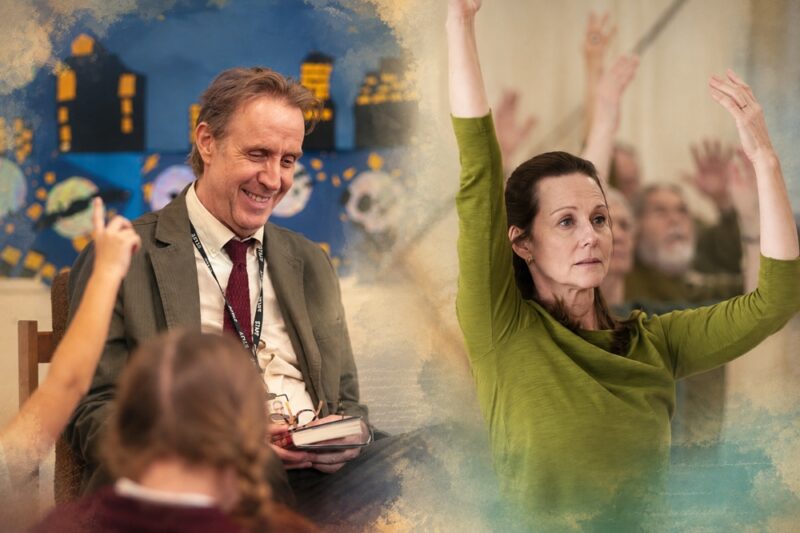
You both begin with essentially the same piece of devastating information on the same morning, but the film then spends its time showing us that the same diagnosis doesn’t create the same person. When you’re building these characters, how important was it to protect who Tony and Emma already were from allowing Parkinson’s to become the thing that suddenly explains everything about them?
Rhys Ifans: Yeah, we spoke a lot about that. I think anyone in the Parkinson’s community will know that one of the challenges with any diagnosis is not letting it define you. The beautiful irony is that, because of that pitfall, you almost become more yourself. You dig into the things that make you who you are in order not to be defined by the thing that’s happened to you. That was very interesting to us.
The other pleasing poetry in the architecture of the story, certainly from my perspective with Tony, is that he’s someone who is alone in the world with his grief. He hasn’t entirely processed it. Grief has become his partner, in a sense. Parkinson’s and Emma allow him to stop grieving and give him the opportunity to step through that, to let go of something and embrace something new, different and devastating.
You can apply the word “beautiful” to anything, even the greatest tragedy. I think they both discover a strange beauty in the world and in each other.
Laura Linney: I thought a lot about the power of the unexpected, whatever form that takes for anybody. Something happens to someone, and how does that change or challenge them? I think there’s also the power of an unexpected connection. A connection to someone can change everything.
Then, on top of that, there’s the unexpected change in your body, which affects your emotions, affects your mind, affects your worldview and affects your family. Everything is moving, shifting and changing, and you’re trying to figure out, “What’s going to become of me?”
I think there’s a sense of the unknown that doesn’t come naturally to human beings. We’re not particularly good with discomfort, so the question becomes: how do you deal with that?
Laura, there’s a moment where Emma simply says, “I don’t want to lose,” and your delivery absolutely devastated me. What struck me is that she doesn’t say, “I don’t want to die” or even “I don’t want to be ill.” It’s specifically about losing. When you played that moment, what did you understand her to be most afraid of losing?
Laura Linney: I think her ability to function at that point is so diminished because she’s incredibly tired. She’s emotionally tired, and I think the physicality of having Parkinson’s makes you very, very tired. Your body is doing so much all day long, and emotionally she’s also being whipped through it. It’s a real tornado of an experience.
I think there’s a realisation that she is not who she was and never will be again. She is now forever changed, and she’s coming to grips with, “What does that mean? What does that actually mean?”
I’m not sure when you both signed onto the film, but John was saying earlier drafts of the script seemed to focus more solely on Tony. Emma was more a character who was weaving in and out of the story. When you received this script, how much of it resembled the story we see now?
Laura Linney: Rhys has been attached to this for over 10 years.
Rhys Ifans: It’s a difficult film to pitch. I always wanted it to have that shape and structure, because a movie has to have a beating heart for us to receive it. I think what changed in the film is that they receive the diagnosis at the same time. That’s when it becomes part of the architecture of the story. That’s when it takes on the shape of a fairytale and becomes almost mythological, where it feels as though the universe has decided to bring these two people together. I think, as a species, we respond well to that shape of things.
There’s a particular intimacy between Tony and Emma because each can understand something about the other that even the people who have loved them for years can’t completely access. Do you think they fall towards each other because they’re understood, or because, perhaps for the first time since their diagnoses, they don’t have to explain themselves?
Rhys Ifans: He hasn’t been intimate with another adult. Although he has this wonderful relationship with his pupils, this is probably the first time in a decade that he’s been able to say “I’m scared. What am I going to do? Can you help me?”
The film is genuinely very funny, and a lot of that humour comes from Tony and Emma being able to say things about Parkinson’s to each other that might sound cruel coming from somebody outside that experience. Did you think about humour almost becoming its own private language between them – a way of reclaiming some power over the thing that’s trying to dictate their lives?
Rhys Ifans: I’m so glad you said that! We’ve only watched it once, before it was finished. And, let me tell you this, it wasn’t funny (laughs). To hear that is great.
Laura Linney: They’re just living in this surreal experience. And when you’re out of control, humour is a lifejacket.
Rhys Ifans: Our loss of control makes us laugh. There’s an inescapable slapstick component to this condition. You fall over. You’re incontinent. Of course there’s a funniness. It’s almost like the pre-diagnosed you is able to laugh at the diagnosed you. I can’t speak to it as an experience, but Paul speaks about it on his podcast. He can go from talking about the devastation of living with it, to laughing about putting his trousers on back-to-front that morning in the space of a sentence. I don’t know…humans are great! (Laughs).
Laura Linney: And this movie was made by people who are uniquely good. Every day on this set, it was just a very unique experience.
Onwards and Sideways is screening as part of this year’s Toronto International Film Festival, running between September 10th and 20th, 2026. For more information, head to the official site here.
