


Stephen King’s Carrie has been revisited on screen numerous times, but Mike Flanagan’s eight-episode television adaptation has something those earlier incarnations never truly had: time. Time to understand Carrie White before the blood falls. Time to explore Margaret White beyond the religious fanaticism that has traditionally defined her. And time to consider the small acts of kindness and cruelty that gradually shape a tragedy audiences have spent decades believing they already know.
A bold and timely reinvention of King’s coming-of-age story, Carrie expands the author’s cultural landmark into something more intimate and psychologically detailed. At its centre remains the profoundly complicated relationship between Carrie (Summer H. Howell) and her mother Margaret (Samantha Sloyan), two people who unquestionably love each other but seem incapable of giving the other the kind of love they actually need.
For Sloyan, however, viewing either woman simply as a victim of the other risks flattening the relationship. The conflict, she explains, stems largely from Margaret’s refusal to participate in the outside world, contrasted against Carrie’s increasingly desperate desire to experience it.
“In the ownership that Margaret feels over Carrie, and that part of her – she’s never left the house, so in a way, she’s still a baby to Margaret,”
Sloyan says.
There is heartbreak in watching Carrie grow beyond the boundaries Margaret has established for her. Sloyan likens it to the experience of a parent realizing that the person they have devoted themselves to is inevitably going to build a life beyond them. Margaret’s fear is further complicated by what she believes awaits her daughter outside their home.
“She loves you, but she’s going to move on,” Sloyan says of that parental experience. “Margaret’s worked her whole life, and plus, her concerns over how the world is going to accept Carrie and what she sees the world do to different people.”
Howell similarly resisted thinking of Carrie as a victim. Instead, she saw a teenager confronting the confusing realization that the world views both her and her mother very differently than she has been raised to believe.
“I don’t think she ever really feels like a victim,” Howell explains. “I think it’s just the confusion of learning how the outside world sees her and her mom, and how radically different they are, and learning how to cope with that.”
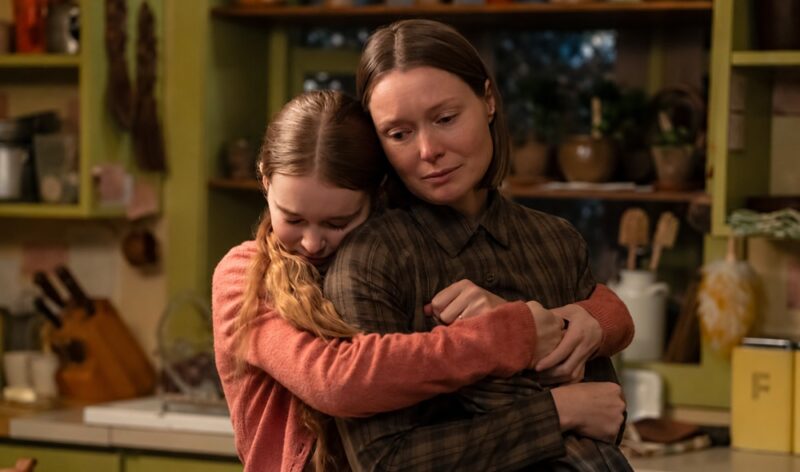
Of course, Carrie has a particularly unusual outlet for the emotions accompanying that discovery. Where another teenager might slam a bedroom door during an argument with their mother, Carrie can use telekinesis to send Margaret flying into a closet.
“Normal teenagers can’t do that,” Howell jokes. “We go and we close the door and we have our space, which Carrie does, but she does it with more flair and powers (laughs).”
That balance between the familiar and supernatural appears crucial to Flanagan’s approach. Rather than fundamentally disconnecting these characters from King’s original creations, Sloyan felt the showrunner was interested in finding different avenues into the same people.
Piper Laurie’s Oscar-nominated performance in Brian De Palma’s 1976 film remains particularly difficult to escape when discussing Margaret White. Sloyan recalls someone describing Laurie as “looming” over the house, while King’s novel presents Margaret with an almost animalistic intensity. What surprised Sloyan about Flanagan’s writing was discovering that Margaret could maintain that terrifying presence without simply reproducing what had already been done.
“We could accomplish that same presence, but without that kind of fervor so much,” she says. “She’s just as menacing, but in a more intimate way.”
That distinction became essential to Sloyan’s interpretation. This is still recognizably Margaret White, but her weapons have changed.
“We still have a terrifying Margaret. It’s just not the same. She’s not using the same tools.”
For Howell, the greatest surprise was discovering just how intelligent and adaptable Carrie could be.
“I think what surprised me a little bit reading it, and what excited me about Carrie, was how smart she is,” Howell says.
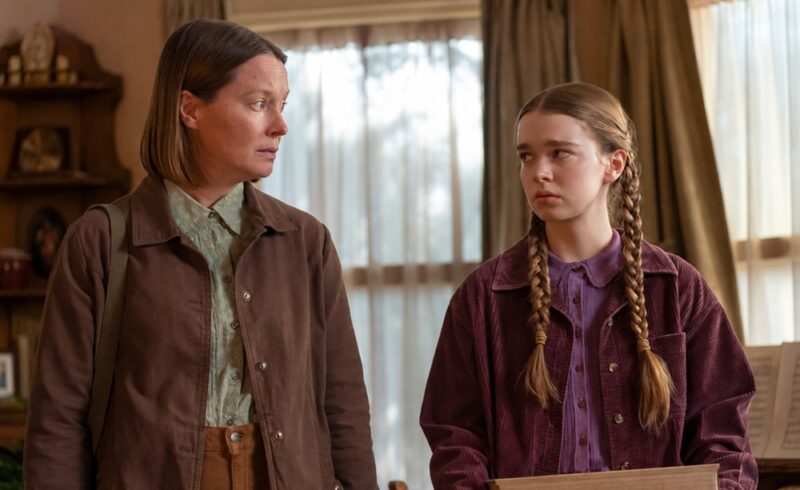
Rather than portraying Carrie as hopelessly naive when confronted with the language, fashion and social rituals of other teenagers, this version allows her to learn. She might initially stumble over slang or misunderstand something her classmates take for granted, but she absorbs those lessons quickly.
“She learns quickly, though, and she takes it forward with her and adapts really quickly,” Howell explains. “She’s not just freaking out about everything being new. She’s like, ‘Okay, this is how I start to dress now. This is what I take away from that.’ She’s very optimistic. She’s a quick learner.”
That intelligence also makes Carrie’s emotional journey more complicated. Her telekinesis has always functioned as an extraordinary physical manifestation of feelings she has never been given the tools to properly express, and for Howell, one emotion proves particularly difficult for Carrie to accept: anger.
“Probably validating her anger,” she says, “not understanding that it comes from a place of grief and sadness.”
Howell points to a scene between Carrie and her guidance counsellor as particularly meaningful in exploring that emotional repression. Carrie is entering a new world and attempting to reinvent herself within it, but she remains reluctant to expose the vulnerability underneath.
“She doesn’t want to show her tears. She doesn’t want to cry in front of her new world,” Howell says.
It is within that tension that Flanagan’s Carrie seems most interested in finding something new. Carrie White has always been headed towards a night audiences know will end in horror, but eight episodes allow the series to examine every seemingly insignificant decision that pushes her closer to it. Margaret’s suffocating love, Carrie’s hunger for independence, the cruelty of her classmates and the emotions she cannot yet articulate all become pieces of something larger.
The question, then, is no longer simply how Carrie White becomes the girl covered in blood at the prom. It’s whether, given enough time to truly know her, audiences will still see a monster when she gets there.
All 8 episodes of Carrie will be available to stream on Prime Video from October 7th, 2026.
