

For more than 50 years, we’ve known how the story of Carrie White ends.
Stephen King’s 1974 debut novel has become so embedded in popular culture – helped immeasurably by Brian De Palma’s seminal 1976 adaptation – that even those who have never read the book or watched one of its screen incarnations likely know the image: a teenage girl, a prom queen’s crown and a bucket of blood.
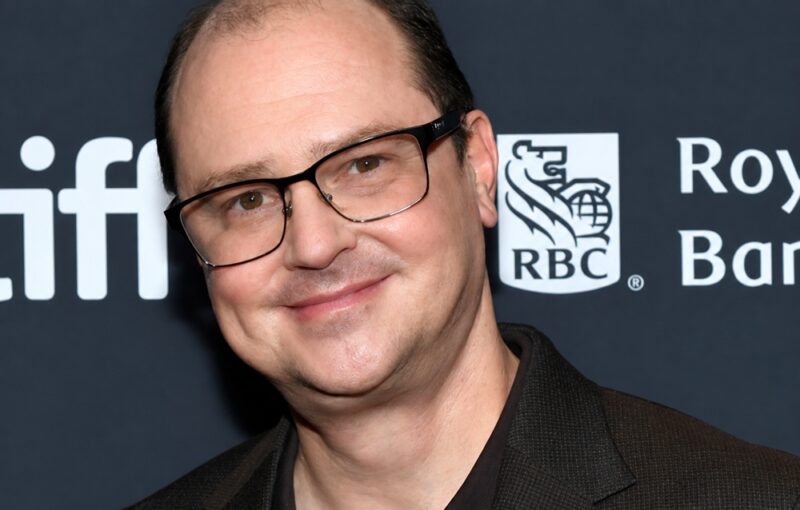
That familiarity presents an unusual challenge for Mike Flanagan’s Carrie. How do you create suspense around a tragedy whose destination audiences already know?
For Flanagan, the answer appears to lie not in making the catastrophe feel inevitable, but in showing us all the moments when it wasn’t.
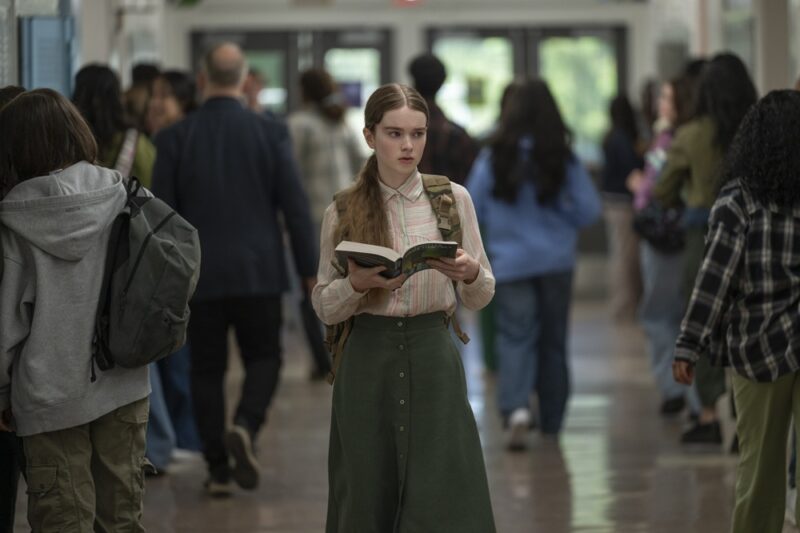
Amazon MGM Studios’ new eight-episode adaptation stars Summer H. Howell as Carrie White, here reimagined as an open, curious and earnest teenager who has spent much of her life isolated at home by her fiercely protective mother, Margaret (Samantha Sloyan). Following the sudden death of her father, Carrie is thrust into public high school and a world of viral humiliation, social-media cruelty and adolescent pressures at the same time that mysterious telekinetic abilities begin to emerge.
During an initial press conference attended by our Peter Gray, he asked Flanagan whether expanding King’s story across eight episodes had allowed him to identify a point where Carrie’s tragedy genuinely could have been prevented – perhaps through something as seemingly insignificant as an act of kindness – and whether recognising those opportunities changed who he believed was ultimately responsible for creating the Carrie we know.
“That’s a great question, Peter,” Flanagan responded. “And the answer is absolutely.”
“The off-ramps on the way to this tragedy were something that were very interesting to us in the writers’ room. And there are a number of them through the series, not just for Carrie, but for a number of other characters as well.”
It is an idea that fundamentally changes the dramatic machinery of Carrie. Rather than spending eight episodes simply counting down towards an ending we expect, Flanagan is interested in the roads that might have led somewhere else.
Central to that approach is his belief that Carrie has always been mischaracterised, at least to some extent, by its reputation as a horror story.
“One of the things that was important to me about this approach to the story was that it was a tragedy,” he explained. “I view Carrie very much as a story of tragedy more than a story of horror. It becomes horrific at a certain point and the behaviours in it can be horrific, but it is a tragedy first and foremost.”
Television also gives Flanagan something previous adaptations have not had: time.
Across eight episodes, he can move beyond Carrie herself and investigate the people surrounding her, including characters traditionally positioned as straightforward antagonists. Flanagan specifically pointed to Chris Hargensen, Carrie’s mother Margaret White and Billy Nolan as figures whose decisions become more complicated when audiences are allowed to understand how they reached them.
“I was not only interested in those moments where Carrie’s path could have been altered, but also with Chris Hargensen and with Margaret White and with Billy Nolan even,” he said, describing them as characters who have historically been presented as “simply monstrous.”
Instead, Flanagan wanted “to really humanise them and look at those moments where they come to those forks in the road and those choices.”
That distinction is crucial. Humanising the people who hurt Carrie doesn’t necessarily absolve them. If anything, giving them opportunities to choose differently potentially makes the consequences of their eventual decisions even more devastating.
“Because I think this is a story about the choices people make and how that leads to a tragic outcome, not about just the inevitable monstrous qualities of them,” Flanagan continued.
“There’s nothing about the story that’s inevitable. And that’s part of the fun we had with it, was to really look at the choices.”
When Peter subsequently spoke with Flanagan again, that conversation provided an opportunity to dig deeper into one of the most intriguing consequences of his approach: a Margaret White who is considerably more complicated than the terrifying religious zealot audiences may expect.
King was a young man when he imagined the interior life of Carrie White more than half a century ago. Flanagan is approaching the material from a very different stage of life – not only as a filmmaker who has lived with King’s work for decades, but as a father himself.
Asked whether there was anything about Carrie or Margaret he found himself understanding differently now, Flanagan admitted his response to Margaret surprised even him.
“Oh, sure,” he said. “It was important to me, because I think this has been adapted so many times so beautifully by De Palma and others, that we were always trying to do kind of a different version of Carrie and Margaret.”
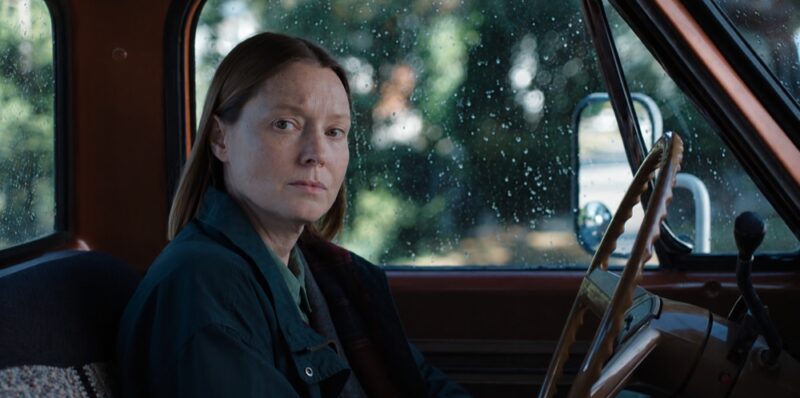
“And what shocked me was just how many times I agreed with Margaret White’s perspective along the way, which is something I never thought I would say, having been familiar with this story and that character for so long.”
It’s a striking admission given Margaret’s place in the Carrie mythology. But Flanagan’s empathy for her does not come from endorsing the extremes of her behaviour. Rather, he found an emotional point of entry through something much more ordinary: parental fear.
“Approaching Margaret from the perspective of a parent who loves her daughter fiercely and wants her daughter to be safe and has no idea how to make that happen, I related to that,” he explained.
The timing proved particularly personal. Flanagan’s eldest son was beginning high school just as the filmmaker was deciding whether another adaptation of Carrie was something he wanted to pursue.
“I was so worried. I still am so anxious about that, and so worried for him and for my other – I have two other kids behind him that I’m worried for them,” he said.
“Not knowing the best way to love our kids and keeping them safe, I found so relatable. And kind of a Margaret who starts at that place is a very different experience.”
It is perhaps one of the most significant departures in Flanagan’s interpretation. Margaret can still hurt Carrie. She can still make terrible decisions. Love does not automatically make those decisions less damaging. But if they originate, at least initially, from a recognisable desire to protect her child, the relationship becomes more tragic precisely because the love between them is genuine.
Sloyan and Howell’s performances lean heavily into that tension. There is affection between this mother and daughter, something that makes the deterioration of their relationship feel less like the inevitable collision between victim and monster and more like the destruction of something that, under different circumstances, might have survived.
And that returns us to those “off-ramps” Flanagan spoke about.
If Margaret is capable of love, Chris is capable of humanity and Carrie herself is capable of hope, then nobody begins the story already destined to become their worst self.
They get there through choices.
That idea also complicates another description frequently attached to Carrie: revenge.
The iconography lends itself easily to that interpretation. A bullied teenage girl is publicly humiliated, her extraordinary powers are unleashed and the people responsible suffer horrifying consequences. On the surface, Carrie can look like one of popular culture’s definitive revenge fantasies.
But revenge requires something important: intention.
When we put that distinction to Flanagan – whether what happens should genuinely be understood as Carrie taking revenge or whether audiences have imposed that idea upon what is actually a much sadder loss of control – he agreed that his version operates differently.
“I can understand the gravity toward that word,” he said. “I always looked at this story, the way we were telling it at least, as a tragedy.”
“You’re right. Revenge implies agency and intent, and I think Carrie’s reacting in real time to something.”
That difference fundamentally changes how we are asked to view Carrie when the story reaches its darkest moments. If this isn’t a calculated act of vengeance, the horror does not come from watching an abused girl finally decide to punish everyone who has wronged her. It comes from watching someone overwhelmed by humiliation, trauma and extraordinary power respond in the moment – and then confront what that response has caused.
Flanagan pointed to a moment late in the series that was particularly important to his understanding of Carrie.
“There’s a moment toward the end of the series where Carrie reacts to something she’s just done with such horror, and I was more interested in that,” he explained.
Once again, Flanagan returned to the cumulative nature of the tragedy.
“This story was the tragic collision of a lot of little moments and a lot of little choices that a lot of different people had to make between kindness and cruelty,” he said. “And that trajectory from all these different people under all these different circumstances led to a tragic outcome, and how we reconcile that – that’s kind of the big question of the show.”
It is difficult to imagine a clearer distillation of what separates this Carrie from simply being another retelling.
Flanagan is less interested in asking what Carrie does than in examining everything that has to happen before she does it.
Fifty years later, the choices remain
That philosophy speaks directly to Flanagan’s reasoning for revisiting a story that has already received multiple high-profile adaptations.
In a statement accompanying the series, the filmmaker admitted his own first reaction when a new adaptation was proposed was simply: “Why?”
His answer eventually came from looking at how disturbingly relevant King’s themes remain. Bullying, empathy, cruelty and school violence have hardly disappeared in the five decades since Carrie was published. They have instead evolved, with social media creating new arenas in which humiliation can spread instantaneously and cruelty can become communal entertainment.
Flanagan consequently approached the series not as an exercise in preservation, but reinvention. Rather than recreating Sissy Spacek’s frightened and withdrawn Carrie, he imagined a girl eager to experience a world from which she had been sheltered. And rather than treating Margaret, Chris and the other people who fail Carrie as inherently monstrous figures, he became interested in what might happen if their worst behaviour emerged from recognisably human places.
That philosophy is particularly intriguing when applied to a story whose ending is practically part of our collective cultural memory.
We know what Carrie White can become. Flanagan wants us to consider all the people, decisions and failures that help make her that way.
And perhaps that is where an eight-hour Carrie can distinguish itself most dramatically from the versions that came before. The horror isn’t merely that something terrible happens to Carrie and something terrible happens because of her. It’s that, along the way, there were opportunities for people to choose empathy over cruelty, restraint over anger and kindness over humiliation.
They simply didn’t take them.
And, crucially, Carrie herself does not necessarily emerge from that process as an avenging figure finally exercising her power. She remains a teenage girl reacting to an unbearable situation in real time, capable of being horrified by her own actions even when it is too late to undo them.
Perhaps that is also why Flanagan, now a father watching his own children move closer to the age Carrie is in King’s story, can find himself understanding a woman like Margaret White in ways he never expected. The series is not asking us to excuse the damage people cause because they are afraid, because they believe they are protecting someone or because they themselves have been hurt.
It is asking us to understand where those choices come from.
Because if Carrie is fundamentally a tragedy rather than a revenge story, inevitability would almost let everyone off the hook. Tragedy hurts precisely because another outcome was possible.
In Flanagan’s telling, then, the question may no longer be whether Carrie White’s catastrophe can be stopped. We already know where this story is going.
The more uncomfortable question is how many chances everyone had to stop it – and why, when kindness might have changed everything, they didn’t.
All 8 episodes of Carrie will be available to stream on Prime Video from October 7th, 2026.
