

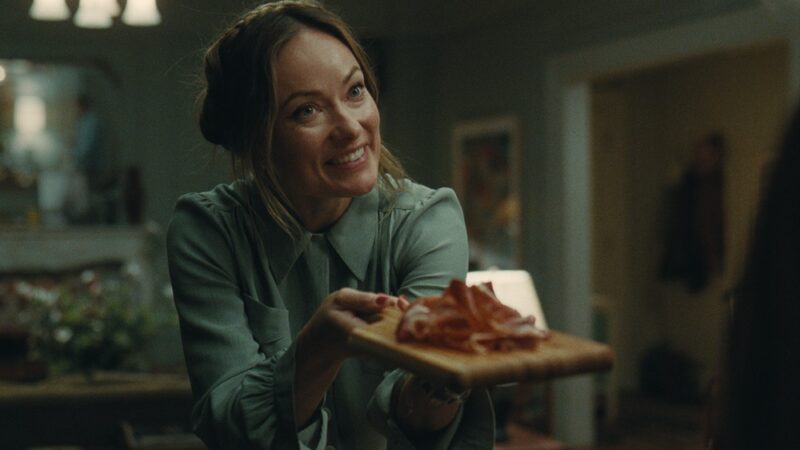
Across Booksmart, Don’t Worry Darling and now The Invite, Olivia Wilde has shown an unmistakable fascination with characters reaching a point of rupture. Her films may differ wildly in tone and genre, but they all orbit a similar question: what happens when people begin to challenge the life they have accepted as normal?
With The Invite, Wilde brings that question into its most intimate space yet. Adapted from Cesc Gay’s Spanish film The People Upstairs – itself based on his stage play – the film unfolds over one evening, inside one apartment, as married couple Angela (Wilde) and Joe (Seth Rogen) invite their upstairs neighbours, Pína (Penélope Cruz) and Hawk (Edward Norton), over for dinner. What begins as an awkward attempt to confront them about their noisy sex life gradually becomes a sharp, funny and emotionally exposed examination of marriage, desire, resentment and reinvention.
For Wilde, the universality of the premise was immediately clear.
“The first thing I did was watch the original film before I read the script,” she explained during a press conference for the film. “I wanted to understand the source of this adaptation.”
Wilde said she was intrigued by the fact that Gay’s story had already been adapted across several cultures and languages, prompting her to wonder what kind of emotional truth could make the material so transferable.
“There must be a very authentic core to it,” she said. “I was rolling around laughing, thinking, this is such a simple premise that is just so fertile for adaptation.”
That simplicity also allowed Wilde to pursue a production process she had long wanted to explore. Inspired by filmmakers such as Sidney Lumet and Mike Nichols, she wanted to rehearse extensively, shoot in order, work on film, and allow the material to evolve through performance.
“It finally offered something simple enough to create the framework for the kind of production process I had dreamed of,” she said. “Can we rehearse, workshop, shoot this in order, on film, and make it a living, breathing piece of material that changes as we perform?”
According to Wilde, Rashida Jones and Will McCormack’s English-language script changed considerably throughout that process, shaped by rehearsal, improvisation and the specificity brought by its four actors: Wilde, Rogen, Cruz and Norton.
That sense of discovery became central to the film’s energy. Wilde described The Invite as the first project she had worked on that truly felt like “a living, breathing piece of material” she had to respond to in real time.
“By shooting in order, we could really feel on a visceral level when something was working or when we needed to adjust momentum,” she said. “In a way, it’s almost like editing the film while you’re directing it.”
But that looseness was only possible because of rigorous preparation. Wilde worked closely with cinematographer Adam Newport-Berra and production designer Jade Healy to establish a firm visual framework before allowing the actors freedom within it.
“It was the first time I really understood that combination: preparation meets complete liberation,” she said.
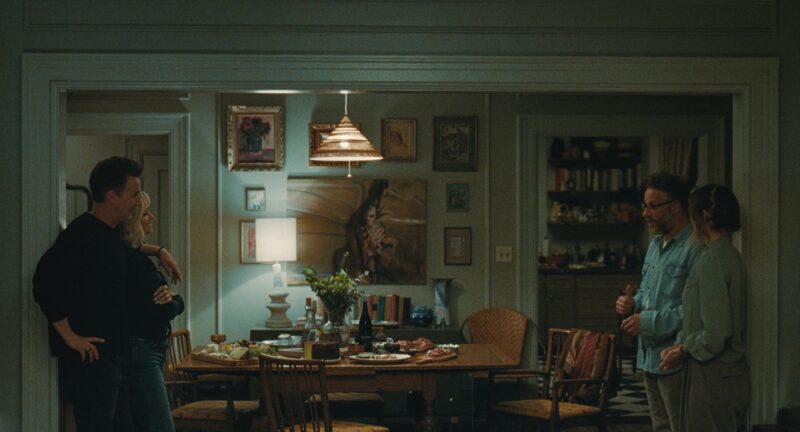
The apartment itself became one of the film’s most important collaborators. Originally written as a more open-plan space, Wilde felt the story needed rooms, corridors and corners where characters could separate, hide and become different versions of themselves away from their partners.
“We needed spaces to hide, spaces with a little privacy,” she said. “We loved the idea of each couple becoming a different version of themselves apart from the other.”
Those “house tour” scenes, in which the couples split into different rooms, were largely developed through improvisation. Wilde said the team used “every square inch” of the set, embracing mirrors, glass and frames within frames to suggest emotional barriers.
“The space is a character,” she said. “I’m deeply proud of that part of it.”
The film’s theatrical origins also presented a challenge: how to make a single-location, dialogue-driven story feel truly cinematic. For Wilde, the answer lay in using the camera to give audiences an emotional proximity that theatre cannot.
“You have to ask yourself why it should be adapted into a film at all,” she said. “The best reason to turn something into a movie is the visceral, emotional connection to the characters that only the camera – along with music and everything else – can provide.”
She cited Who’s Afraid of Virginia Woolf? as a major influence, particularly in the way the camera becomes more emotionally unstable as the characters do. She also looked to Robert Altman for naturalistic overlapping dialogue, wanting the cast to feel like “a harmonizing jazz quartet” without the film becoming shapeless.
That balance of discipline and spontaneity extended to Wilde’s insistence on shooting on 35mm.
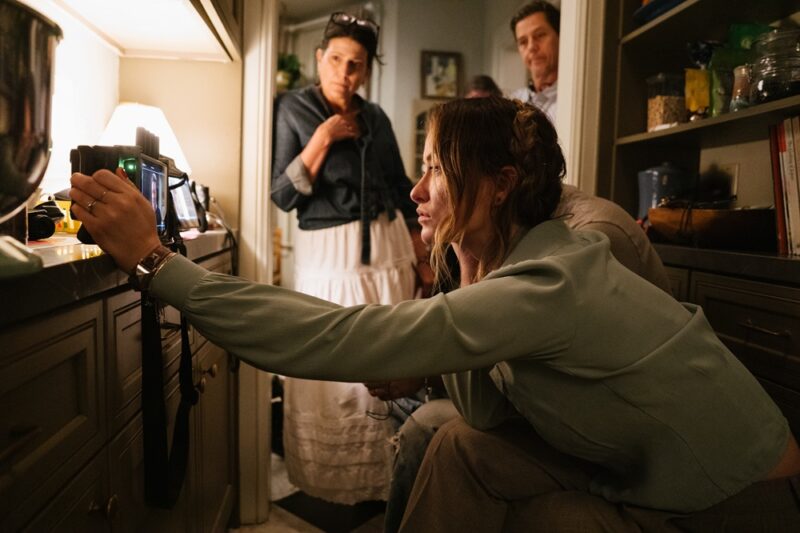
“I’m a big proponent of shooting on film,” she said, noting that she paid for the film stock herself because she was so determined to make The Invite that way. “There’s this idea now that comedies don’t need film, which isn’t true.”
For Wilde, film changed the energy of the set. It raised the stakes, sharpened everyone’s focus, and created what she described as an almost magical atmosphere when the camera started rolling.
“There’s something about the sound of film going through the camera that almost puts a spell on the set,” she said.
That spell appears to have extended to the performances. Wilde described Rogen as essential to her understanding of Joe, saying she realised he had to play the role while directing an episode of The Studio.
“The character of Joe needed the wide range of complexity that Seth has as an actor,” she said. “You needed to love him while recognizing his frailty, empathize with him while also feeling frustrated by him.”
She called this period of Rogen’s career his “Albert Brooks era,” adding that she believes The Invite contains his best work.
Cruz, meanwhile, brought much of Pína’s texture and unpredictability to the role. Wilde said many actors might have treated the character as a flawless, seductive figure, but Cruz was more interested in her awkwardness, anger, silliness and contradictions.
“She kept layering in different elements of Pína – like a lasagna,” Wilde said.
Cruz also pushed for the character’s platinum blonde wig, which Wilde initially thought was unnecessary.
“She said, I need it, because I need to depart from myself physically in order to transform personality-wise,” Wilde recalled. “The second she put that wig on, it was a full transformation.”
The film’s emotional foundation was further shaped by relationship therapist Esther Perel, whose ideas around reinvention deeply influenced Wilde’s view of love and marriage. The film opens with Oscar Wilde’s line, “One should always be in love. That is the reason one should never marry,” but Wilde hopes audiences interpret that quote differently by the end.
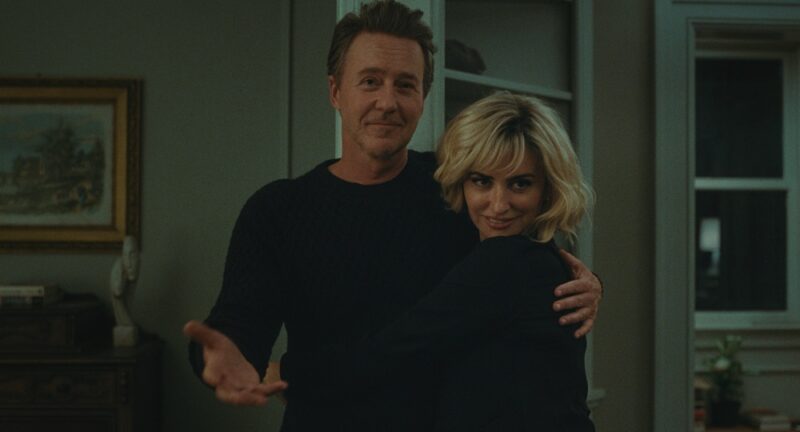
She said making the film made her “far less cynical” about long-term relationships.
“I love the concept of the freedom to reinvent and evolve, both individually and as a couple,” she said. “Maybe if you can continue this engagement in the process of loving, which means reinvention, then marriage itself becomes something less unromantic.”
That idea of reinvention also speaks to Wilde’s own developing identity as a filmmaker.
When asked by our Peter Gray about the connection between Booksmart, Don’t Worry Darling and The Invite – all films about characters questioning the lives they have accepted as normal – Wilde said it was a pattern she only recognised once she was already making The Invite.
“The focus on relationships as the core of each film is purposeful, because I know that’s what I’m most interested in,” Wilde said.
She pointed again to Mike Nichols as a guiding influence, particularly his ability to investigate “how human beings relate to each other, and the texture of relationships of all kinds.”
For Wilde, her years as an actor appear to have shaped that instinct. Acting requires constant attention to how a character relates to others, and directing has allowed her to build films around those shifting dynamics.
“I wanted to create films that let actors really lean into relationships and all their specific complexities,” she said. “Letting the actors themselves show you the definitions and idiosyncrasies of a relationship.”
She also referenced Wong Kar-wai’s reflections on In the Mood for Love, specifically the idea that a filmmaker may not fully understand their movie until the actors reveal it through performance.
“They’re the ones peeling their hearts off into the characters,” Wilde said. “Only then can you understand the relationship you’re trying to portray.”
Looking ahead, Wilde can see that throughline continuing.
“It’s funny to realize, in thinking about what comes next, that it’s also about people reaching a moment of wondering whether the life they’re living is the one they want to continue,” she said. “So maybe that’ll end up being my specialty.”
If The Invite is any indication, it is a specialty worth embracing. Wilde has crafted a film about marriage, performance, desire and disappointment, but also one about the terror and possibility of change. In her hands, a dinner party becomes a reckoning, an apartment becomes a maze, and four people asking the wrong questions finally stumble toward the right ones.
The Invite is now screening in Australian theatres.
