

For more than 50 years, we’ve known how the story of Carrie White ends.
Stephen King’s 1974 debut novel has become so embedded in popular culture – helped immeasurably by Brian De Palma’s seminal 1976 adaptation – that even those who have never read the book or watched one of its screen incarnations likely know the image: a teenage girl, a prom queen’s crown and a bucket of blood.
That familiarity presents an unusual challenge for Mike Flanagan’s Carrie. How do you create suspense around a tragedy whose destination audiences already know?
The answer, as it turns out, is to make us desperately wish Carrie could somehow avoid it.
Expanding King’s novel across eight episodes, Flanagan isn’t particularly interested in obscuring the landmarks of the story. The cruelty, religious fanaticism, burgeoning telekinetic abilities and looming spectre of prom are all here. Instead, his Carrie finds its purpose in the spaces between those familiar beats, examining the seemingly insignificant acts of kindness and cruelty that accumulate until something – or someone – finally breaks.
It makes for an emotionally bruising adaptation that feels both reverential to King and distinctly Flanagan, even when some of its larger swings don’t land with quite the same force.
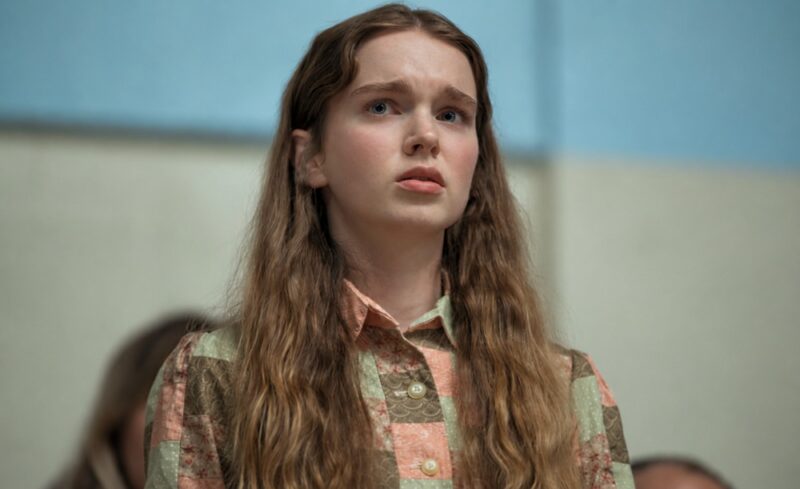
This time, Carrie White (Summer H. Howell) has spent virtually her entire life removed from society, raised at home by her deeply religious parents and largely ignorant of the world beyond their walls. When the death of her father forces Carrie and her mother, Margaret (Samantha Sloyan), into public life, Carrie is enrolled at Ewen High School, where everything from smartphones to the casual social politics of the hallway feels foreign.
What could have reduced Carrie to an eccentric outsider instead makes her enormously endearing. She isn’t unintelligent or incapable of understanding the world; she simply hasn’t been given the opportunity to experience it. There’s an eagerness to her initial steps towards independence that makes what follows all the more painful.
Howell is extraordinary in the role.
Rather than attempting to echo Sissy Spacek’s iconic performance, she creates a Carrie who feels entirely her own. There’s an openness to Howell’s work that proves crucial. This Carrie is curious, funny, intelligent and almost painfully sincere. She wants friends. She wants experiences. She wants to understand the strange new world she’s suddenly been dropped into.
Most importantly, she wants to believe people are good.
That’s where Flanagan finds the tragedy.
For all its supernatural elements, the most frightening thing about Carrie remains how easily kindness can be weaponised against someone who doesn’t yet understand cruelty. Howell beautifully charts that erosion without allowing Carrie’s innocence to become stupidity. Even as she begins recognising what she’s capable of, there remains something heartbreakingly hopeful about her desire to belong.
Flanagan’s decision to move the story firmly into the social-media age could have easily felt like the most obvious possible update, but it’s also one of the series’ most effective. King wrote Carrie around public humiliation long before humiliation could be recorded, reposted, memed and preserved indefinitely.
Here, embarrassment doesn’t disappear when the school bell rings.
Phones are everywhere. Rumours mutate into content. Cruelty can find an audience within seconds. An anonymous social-media account becomes its own destabilising force within the school, turning private mistakes into public entertainment and giving teenage viciousness a reach previous versions of Carrie couldn’t have imagined.
It’s a smart evolution of King’s central idea because the technology isn’t itself positioned as the villain. The people using it are. Flanagan understands that the horror isn’t simply that teenagers now carry cameras in their pockets; it’s that humiliation no longer necessarily has an ending.
The series is particularly effective when exploring how differently its young characters respond to that environment. Chris Hargensen (Alison Thornton), Sue Snell (Siena Agudong) and the other students surrounding Carrie aren’t afforded equal depth, but the expanded runtime means they rarely feel like bodies waiting to be positioned around a predetermined climax.
Thornton, especially, finds something interesting in Chris without softening her ugliness. Understanding why somebody lashes out isn’t the same thing as excusing what they do, and Carrie is generally smart enough to recognise the distinction. Agudong, meanwhile, gives Sue a compelling moral uncertainty, capturing the uncomfortable distance between knowing something is wrong and having the courage to actually stand against it.
Amber Midthunder brings a welcome warmth to Rita Desjardin, while Matthew Lillard makes Principal Grayle considerably more textured than the archetypal ineffectual school administrator. Across the board, Flanagan uses the additional breathing room of television to remind us that the adults surrounding Carrie have lives, failings and compromises of their own.
But it’s Sloyan who nearly walks away with the series.
Margaret White is one of King’s most recognisable monsters, yet Sloyan and Flanagan resist reducing her to religious mania. Their Margaret remains frightening, controlling and capable of tremendous damage, but she’s also recognisably human.
And, in her own distorted way, she loves her daughter. That distinction matters.
Sloyan plays Margaret as a woman whose fear of the world has hardened into ideology. Her faith, paranoia and need for control become inseparable from her conviction that everything she does is protecting Carrie. The tragedy is that Margaret’s warnings about the outside world aren’t entirely unfounded; Carrie does encounter cruelty almost immediately. Margaret simply interprets that cruelty as proof that isolation was the answer.
The resulting push and pull between mother and daughter gives the series its strongest material. Carrie is discovering that the world is simultaneously more wonderful and more terrible than she was told, while Margaret watches her daughter’s curiosity as evidence that she’s losing her. Their relationship becomes less a simple battle between victim and oppressor than a warped expression of love in which protection has become possession.
Sloyan is phenomenal at navigating that contradiction. She never asks us to forgive Margaret, but she does force us to understand her.
It’s indicative of what the eight-episode format affords Flanagan. Carrie has never been an especially complicated narrative, but television allows him to widen its emotional perimeter. Teachers, parents and students who might previously have existed primarily in relation to Carrie are given room to become people themselves. King’s original novel was already interested in reconstructing catastrophe through different perspectives and documentary fragments, and the series similarly treats the tragedy as something larger than a single girl’s story. Pasted text
Not every expansion proves equally necessary.
Flanagan introduces a broader mythology around Carrie’s abilities and the history of women like her, and while the idea is thematically understandable – particularly in connecting Carrie’s persecution to something much larger than herself – it can occasionally feel as though the series is straining to expand a beautifully contained tragedy into a mythology.
There are moments, too, where Flanagan’s fondness for articulating his themes threatens to overwhelm their impact. Carrie is often most powerful when nobody explains what it means; when Howell’s face, Sloyan’s silence or the casual indifference of another student tells us everything.
Thankfully, those indulgences rarely derail what is otherwise an impressively confident expansion.
And although Carrie is unquestionably horror, those expecting eight episodes of traditional scares may be surprised by how little Flanagan relies on them. The supernatural is important, but the series’ most upsetting sequences are often painfully ordinary; A classroom. A locker room. A phone held in the wrong direction. A joke that everybody except its target thinks is funny. A parent convinced they’re protecting their child.
Flanagan understands that the telekinesis was never the truly frightening part of Carrie. The frightening part was always watching a vulnerable person be pushed, again and again, while everyone around her convinces themselves that their individual contribution couldn’t possibly be the one that matters.
That makes this adaptation feel unexpectedly relevant without reducing it to “Carrie, but with smartphones.” More than half a century later, King’s story remains a warning about what happens when cruelty becomes communal entertainment, when adults fail young people, and when the desire to belong collides with a world determined to remind someone they don’t.
The fact that we already know where Carrie’s story is heading only makes Howell’s performance more devastating.
Every smile becomes something to protect. Every tentative friendship feels precious. Every small victory carries an uncomfortable shadow.
And therein lies Flanagan’s greatest achievement. He doesn’t ask us to fear Carrie White.
He makes us love her.
So when the world inevitably starts teaching this gentle, curious girl how cruel it can be, the horror isn’t wondering what Carrie might eventually do to everyone else.
It’s watching what everyone else does to Carrie.


FOUR STARS (OUT OF FIVE)
All 8 episodes of Carrie will be available to stream on Prime Video from October 7th, 2026.
