
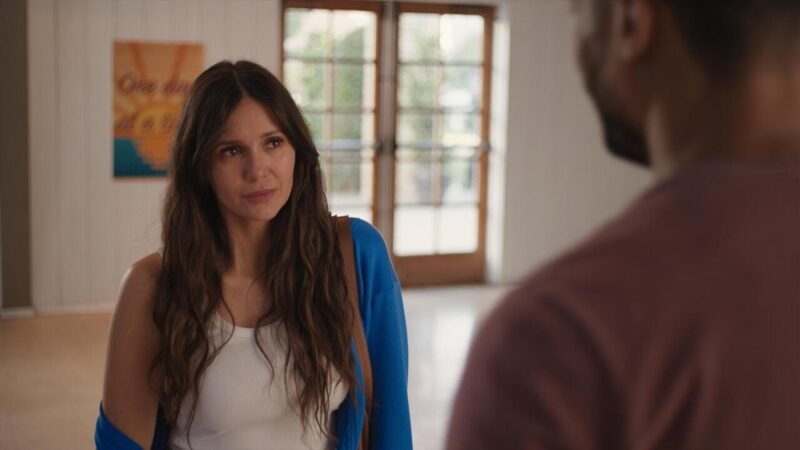
Heartbreak is universal. So too is the tendency to tell ourselves we’re ready to move on when we’re anything but. In General Admission, writer Sarah Adina channels one of the most vulnerable chapters of her own life into a sharply observed comedy about a woman who attends a support group hoping to heal, only to reveal far more about herself than she ever intended. What unfolds is equal parts hilarious, awkward and painfully relatable.
Premiering at the 2026 Tribeca Festival, the short (read our full review here) is elevated by a fearless lead performance from Nina Dobrev and assured direction from Kaily Morgan Smith, who together navigate the delicate balance between comedy and emotional honesty. Ahead of the film’s premiere, our Peter Gray spoke with Adina, Dobrev and Smith about transforming personal trauma into comedy, capturing the messy reality of self-improvement, and why the path to change is rarely as straightforward as the movies would have us believe.
Comedy has a way of disarming audiences before delivering something very emotionally honest. What conversations did you all have early on about balancing the laughs with the deeper themes that were underneath them?
Sarah Adina: This really happened to me. I actually did this. I’ve always believed the best comedy comes from traumatic experiences, so the goal was to take one of those rock-bottom moments and turn it into something funny. But like any good comedy, it also needed those emotional waves. I was so lucky to have Kaylee directing and Nina starring because they’re both brilliant at balancing comedy and drama. I got to put my authentic truth on the page, and they helped shape it into what it became.
Kaily Morgan Smith: What was so beautiful about Sarah’s script was how perfectly it captured those raw emotional beats, and Nina brought them to life so beautifully. Not only is Nina a comedic genius, she has this natural cadence and instinct for knowing exactly how to land a moment. We also surrounded her with incredible comedic actors like Adam Shapiro and Cedric Yarbrough, and being able to cut to their reactions was such a gift. Honestly, one of the hardest parts of the edit was deciding which reactions to use because every choice changed the scene.
Even the music could shift a moment, making it feel either more comedic or more emotional. It really was like walking a tightrope the entire time. But that’s the best kind of challenge to have, because it meant we had so much great material to work with. I think my editor was eventually ready to kick me out of the room. He kept saying, “You’ve got to make a decision and move on.”
Sarah, as the writer, because Nina’s character spends much of the film trying to control how she’s perceived by the room, what fascinated you about the gap between the story she wants to tell herself and the story she’s actually revealing?
Sarah Adina: Oh, wow. When I walked into that room, and even when I was writing this, I was genuinely looking for connection. I thought I was going to meet people who understood codependency and the struggle of trying to find yourself when you’ve become so attached to another person.
I really believed I was going to find my people there. Eventually I did, but it took some time. While I was writing, I kept coming back to the idea that I wanted to be as authentic and honest as possible, because that’s how you truly connect with people. The more specific and truthful you can be about your own experience, the more likely it is that someone else will see themselves in it.
And Nina, I will reiterate and say how incredible your performance is. Your character Kelly talks a lot throughout the film, but there are these moments where we can see her trying to recover from what she’s just said. How much of that internal panic was something that you developed during the performance?
Nina Dobrev: If you saw the script, it was almost nine pages long, and I was talking for most of it. As an actor, that was both exciting and incredibly challenging. Not only did I have to memorise all of those words, but I had to bring them to life in a way that felt authentic and truthful to Sarah’s experience. Sarah is my best friend, so it was such a joy to get to embody her and tell her story. No one knows me better than she does, and I don’t know anyone better than her. We’re all best friends, and that level of trust made the whole experience really special.
Sarah Adina: It really was a labour of love. The truth is that Nina knows my voice, I know Nina’s voice, and Kaily knows both of us. We all know each other so well that when we came together, everything felt incredibly seamless. There was a real sense of trust from the start. We didn’t have to spend a lot of time explaining ourselves because we already understood where everyone was coming from. It made the whole process feel easy in the best possible way. We were genuinely working as a team, and everything flowed naturally because of that shared history and friendship.
Nina Dobrev: It was really challenging because the takes were so long. Every time we rolled, it was about ten minutes, and we had to do that across wide shots, close-ups, my coverage, other people’s coverage – every possible angle. By the end of the day, it was a lot to sustain emotionally. I had to cry, stay vulnerable, and keep finding those emotional beats take after take. The biggest challenge was walking that fine line between drama and comedy. Ultimately, I just played it as straight as I could because the story was real and honest. I never approached it as a comedy. The situation itself was so painfully relatable and inherently awkward that it became funny on its own. That’s where the humour comes from – the fact that it’s completely sincere.
Kaily, I wanted to ask you about how quickly the room itself becomes a character. We’re constantly reading reactions and trying to interpret what everyone else is thinking. How did you approach directing a story where so much of the story lives in observation rather than dialogue?
Kaily Morgan Smith: From the beginning, I knew this had to be a two-day shoot. People kept telling me we could do it in one day, but I was adamant. I wanted to give Nina the space to do what I knew she was capable of, and I didn’t want her performance to feel rushed.
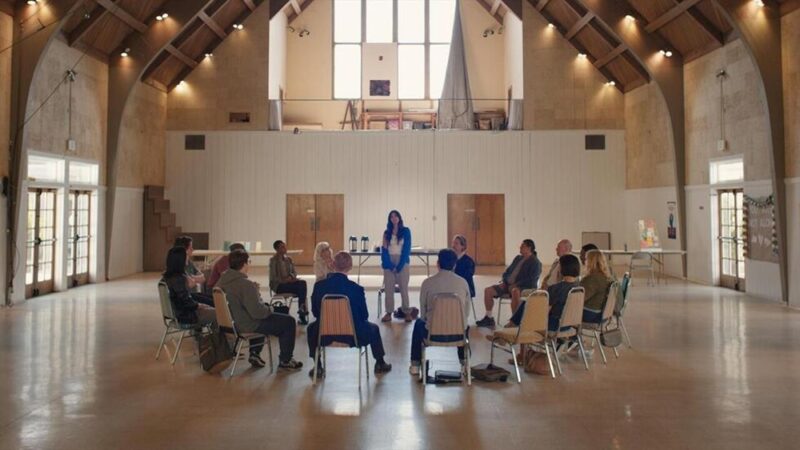
I also knew how much coverage we were going to need. Even though the script was only seven pages, we approached it almost like a play. It naturally broke into two acts, so we’d run the first half, pause, reset, and then run the second half. We repeated that process over and over throughout the shoot.
There was a huge amount of planning involved, especially with the shot listing. On paper, a short film that takes place entirely in one room sounds easy, but it ended up being far more challenging than I expected. Sustaining the energy, finding visual variety, and capturing all the different emotional shifts within that single space required a lot more work than people might imagine.
And for all three of you, the film obviously begins with Kelly wanting to becomes a different person, but by the end it feels more interested in self-acceptance rather than self-reinvention. Was that always the central idea for you? Or did that theme reveal itself as the project evolved?
Nina Dobrev: I think we’ve all been in a situation…we’ve been around each other long enough, and been through a lot of different relationships. Love and heartbreak is so universal. I do think it was important for the character to ultimately accept herself.
Sarah Adina: Part of it is recognising that people often repeat the same cycles over and over until they truly make the choice to change. The journey from self-awareness to actual change is usually much longer than we like to admit. That’s why I always joke that if we ever continued this story, it wouldn’t be a feature – it would be a series. Nobody changes in 90 minutes. You need three seasons to get to real growth.
For me personally, when I was trying to leave a toxic relationship, I kept finding myself back in the same place after swearing I’d never go back. The truth was, I just wasn’t ready yet. I hadn’t fully committed to making a change. That’s the journey the three of us have always talked about wanting to capture. So often stories present transformation as a single breakthrough moment, but in reality it’s messy, repetitive, and full of setbacks. We hadn’t really seen that portrayed in a way that felt honest, and that was something we were interested in exploring.
Kaily, a lot of short films build towards a twist, but General Admission feels more interested in emotional revelation. Was it important that audiences leave thinking about themselves rather than being surprised?
Kaily Morgan Smith: Absolutely. I’d love for people to walk away from this thinking about themselves. For me, this story is really about a woman reclaiming herself, and that’s what I know a larger version of this story would ultimately be about. Her showing up to that meeting is just the first step in that journey.
If someone watching has experienced a similar heartbreak or recognises some of the same patterns that Kelly falls into, I hope they can take something from it and think, “Okay, maybe I don’t have to go to a CoDA meeting, but I can start somewhere.” Maybe that’s therapy. Maybe it’s having an honest conversation with a friend. Maybe it’s simply acknowledging something they’ve been avoiding. The goal isn’t to tell people exactly what to do. It’s to remind them that change starts with showing up and taking that first step.
As you said, Nina, there’s so much coverage. I imagine you’re repeating the performance over and over. This is something that requires you to be funny and vulnerable and self-aware, but then also completely lack self-awareness at the same time. How did you find the balance between these very contradictory qualities?
Nina Dobrev: It was definitely a tightrope. Normally, I like to go second when we’re shooting coverage because it gives me a chance to warm up and settle into the scene first. In this case, though, because the material was so vulnerable and emotional, I actually asked to go first. I wanted to experience it, discover it, and get it all out while those feelings were still fresh.
Honestly, I was worried that if I kept repeating it over and over, I wouldn’t have enough left by the time we got to my coverage. I wanted the emotion to feel real and immediate, not something I was trying to recreate after multiple takes. For me, it was important that we captured that honesty as early as possible rather than trying to manufacture it later. Fortunately, we were able to get there right away, and that gave me confidence that we had what we needed.
I just want to give all three of you your flowers, because what struck me most was how raw and authentic it felt. At times it almost plays like a documentary. The awkwardness, the vulnerability, the repetition of unhealthy patterns – it all feels painfully recognisable, regardless of someone’s specific circumstances. And what I loved about Kelly is that she’s never trying to deceive anyone. She’s flawed, but her mistakes come from a very human place. Do you think the most compelling characters are often the ones whose flaws stem from good intentions rather than malice?
Sarah Adina: We were actually talking about this exact thing. So often, people have good intentions, but they can’t seem to get out of their own way. They find themselves stuck in situations they know aren’t healthy, and yet they keep returning to them. For Kelly, she genuinely goes to the group wanting to be vulnerable, to connect, and to find people who understand what she’s going through. But one of the things I took away from my own experience was how easy it is to learn the wrong lesson. I remember leaving and thinking, “Maybe I’m not supposed to get better. Maybe I’m supposed to change so that this relationship works. Maybe if I just try harder, he’ll finally become the person I need him to be.”
I think a lot of us do that. We pursue things that ultimately aren’t good for us because we’re convinced the answer is just one more effort away. We tell ourselves that if we work harder, love harder, or sacrifice more, we’ll finally get the outcome we’re chasing. Eventually, though, something clicks. You realise you’re not actually happy, and that what you’re pursuing isn’t giving you what you need. That’s when you finally walk away. But getting to that point is often a lot messier and takes a lot longer than we’d like to admit.
The film has this discomfort, but it’s so funny at the same time. Kaily, how do you know when has become awkward in the right way verus awkward in a way that risks pushing the audience away?
Kaily Morgan Smith: I rely heavily on intuition throughout the process. When I’m in the editing bay, I can usually feel when something isn’t working. There’s a rhythm to it, and if a scene isn’t clicking, I can sense it instinctively. The first thing I ask myself is, “How am I feeling while I’m watching this? If a moment is meant to feel awkward, am I actually feeling that awkwardness? If it’s meant to be emotional, is it landing emotionally?”
After that, I think it’s really important to show it to someone who has no connection to the project. Someone who hasn’t read the script, wasn’t on set, and doesn’t know what it’s supposed to be. I’ll just say, “Can you watch this and tell me what you think?” Those people are your most honest audience because they’re experiencing it the way a viewer will. They don’t know what was cut, what was difficult to shoot, or what your intentions were. They can only respond to what’s actually on the screen, and that’s incredibly valuable.
General Admission is screening as part of this year’s Tribeca Film Festival, running between June 3rd and 14th, 2026. For more information on the festival, head to the official site here.
