
Grief, closure, and control collide in Holo, a quietly unsettling sci-fi short from Alexander DeSouza that feels unnervingly close to our present reality. Built around a deceptively simple concept – a company offering artificial encounters with the dead through performance and facial technology – the film quickly reveals itself to be something far more intimate, and far more dangerous.
At its core, Holo is less about the technology and more about what people are willing to do with it. Claire, played with a quiet, raw vulnerability by Morgan Kohan, seeks closure after the death of her abusive partner, Jared. What she gets instead is something far more complicated: the chance to confront him again, to reclaim power – or perhaps to rewrite something that can never truly be undone. In a world increasingly shaped by AI and digital resurrection, the premise doesn’t feel like science fiction so much as an inevitability, which makes Claire’s intentions all the more chilling.
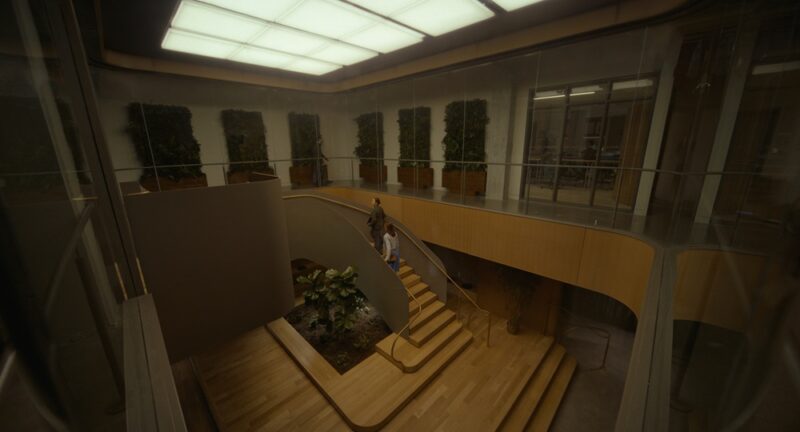
DeSouza directs with admirable restraint, resisting the urge to lean into spectacle. The film’s worldbuilding is subtle, its design clean and elegant, allowing the emotional tension to take centre stage. It’s in that stillness – in the pauses, the glances, the unspoken – that Holo finds its strength. Time stretches in the lead-up to the central confrontation, each moment carrying a quiet dread that lingers beneath the surface.
The performances elevate the material even further. Shane West walks a delicate line as Jared, shifting between charm and menace with unsettling ease. Zelda Williams brings a magnetic ambiguity to Grey, the intermediary figure who exists somewhere between technician and emotional conduit. But it’s Kohan who anchors the film, capturing Claire’s fractured state with a performance that feels both fragile and volatile – a woman teetering between healing and something far more destructive.
What makes Holo particularly compelling is its sense of absence. The film plays into ambiguity, blurring emotional and physical boundaries in a way that feels both haunting and strangely romantic. That tension – between love and violence, memory and manipulation – gives the story a layered complexity that lingers well beyond its runtime.
The final moments deliver a pair of twists that land with precision. One feels almost inevitable; the other cuts deeper, leaving behind something harder to define – not just shock, but a lingering emotional unease that reframes everything that came before.
As a proof of concept, Holo is immensely promising. The idea feels rich enough to sustain a feature-length exploration, particularly in how it interrogates power, consent, and the ethics of resurrecting the past. But even in its current form, it’s a striking piece of work – elegant, unsettling, and quietly devastating.
Terrifying and romantic in equal measure, Holo understands that the most dangerous technology isn’t what it can do – it’s what we want it to do.


THREE AND A HALF STARS (OUT OF FIVE)
Holo is screening as part of this year’s Tribeca Film Festival, running between June 3rd and 14th, 2026. For more information on the festival, head to the official site here.
