
Jane Schoenbrun has always understood that the things we watch can become part of us.
In We’re All Going to the World’s Fair, the internet offered both escape and danger. In I Saw the TV Glow, television became a portal into a life its characters could barely admit they wanted. Their latest film, Teenage Sex and Death at Camp Miasma, continues that fascination with the strange power of media, but it approaches the subject with a far lighter touch.
This is still recognisably a Schoenbrun film, full of characters whose inner lives have been shaped by images, fandom and fantasy. The difference is that this time the melancholy is mixed with gleeful violence, awkward flirtation and some of the funniest conversations about junk food ever committed to film.
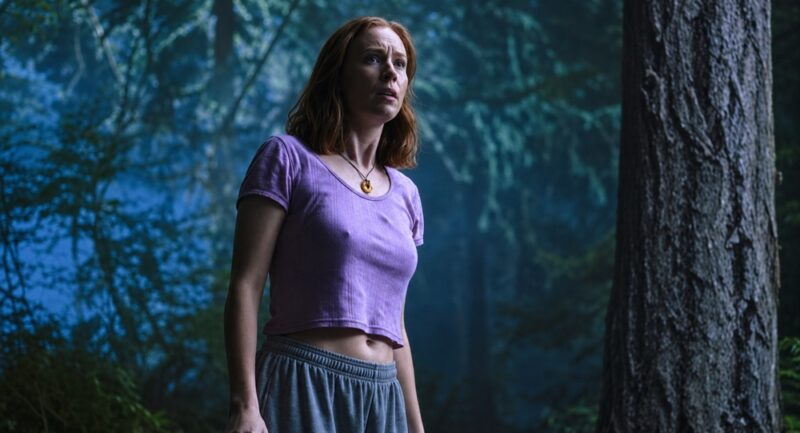
Hannah Einbinder plays Kris, a young queer filmmaker who has recently broken through at Sundance (she apparently made a film that played like a reimagining of Hitchcock’s Psycho, but from the perspective of the shower curtain) and now finds herself attached to a reboot of the fictional Camp Miasma series. The original films were exactly the kind of grubby, sensationalist slashers that flourished in the 1980s: sexually charged, politically dubious and increasingly absurd as the sequels piled up; it’s all very Friday the 13th coded.
At the centre of the franchise is Little Death, a masked killer with a complicated gender history and an instantly ridiculous silhouette. Their costume resembles a discarded piece of industrial machinery assembled into something vaguely human, which makes them look both threatening and strangely pathetic. It is the kind of design that feels destined to become a cult favourite.
Kris has not been hired simply because she is talented. She is also the kind of filmmaker a studio can point toward as proof that an old property has been responsibly modernised. She recognises the calculation behind the offer, but that does not diminish her genuine attachment to the material. For her, Camp Miasma is not merely trash to be rehabilitated. It is formative.
Kris first encountered the film at a moment when she was beginning to understand her own sexuality. What stayed with her was not one of the murders, but the expression on the face of Billy Presley, the original film’s surviving heroine, during an aggressively exploitative sex scene. Where others might see empty performance or cheap titillation, Kris sees something private and profound.
That idea sits at the heart of the film: art does not always mean what its makers intended it to mean.
A scene created to excite one audience can help another person recognise themselves. An image rooted in discomfort or exploitation can still become a source of clarity. Schoenbrun is less interested in solving that contradiction than in sitting with it. Kris travels to the abandoned camp where the original film was shot in an attempt to persuade Billy to return for the reboot. Billy, played by Gillian Anderson, has spent years away from the public eye and now lives in relative isolation among the remains of her former fame.
Anderson makes her instantly compelling. Billy is theatrical without ever feeling false, affectionate without ever becoming entirely trustworthy. She has the confidence of someone who knows the effect she has on people, but there is also weariness beneath the performance. She is part faded celebrity, part recluse and part fantasy figure. Kris cannot decide whether she wants Billy’s approval, her friendship, her body or some impossible combination of all three.
That uncertainty gives the film much of its charge.
Einbinder is excellent at capturing Kris’s nervous intelligence. She plays her as someone who can discuss cinema with absolute authority but struggles to speak with the same confidence about herself. Kris is articulate when analysing images, themes and representation. The moment conversation turns toward intimacy, she seems to lose access to the language she relies on. Her physical awkwardness is often funny, but it is never treated cruelly. Einbinder makes Kris’s discomfort feel specific and lived-in, especially when the film begins examining her complicated relationship with sex.
Although Kris describes herself as sexually experienced and emotionally modern, there is a clear separation between what she understands intellectually and what she allows herself to feel. She has learned how to describe desire without necessarily surrendering to it.
Billy immediately senses this.
Their scenes together are built around tiny tests of control. A glance lingers too long. A casual question becomes unexpectedly intimate. A meal turns into a form of seduction. Schoenbrun allows erotic tension to emerge from gestures that would seem ridiculous in any other context, including an extended exchange involving fast food and dipping sauces; it is a testament to Anderson’s performance that she can make a conversation about condiments feel both absurd and charged.
The humour throughout the film works in a similarly specific register. Schoenbrun understands how obsessive movie lovers speak, especially those who have built parts of their identities around unpopular sequels, forgotten performers and tiny details no reasonable person should remember.
Kris’s fixation on particular snacks and brands becomes a running joke, but it also reveals how she creates comfort through familiar objects. She is not simply a film obsessive. She is someone who organises the world through references, tastes and rituals. That quality makes Teenage Sex and Death at Camp Miasma feel unusually intimate despite its deliberately artificial surface.
The film opens by constructing an entire history for the fictional franchise. We see its early success, gradual decline and repeated attempts at reinvention through archival-style footage, merchandise and cultural commentary. Schoenbrun captures how horror properties are endlessly repackaged until the original appeal is barely visible beneath corporate strategy.
The reboot is therefore both the film’s premise and one of its central jokes.
Kris believes she can make something meaningful from this disreputable material. The studio believes her identity can make the franchise marketable again. Billy has her own relationship with the original film, one shaped by memory, exploitation and survival. No one is approaching Camp Miasma for the same reason.
This allows Schoenbrun to explore the current appetite for reviving damaged or embarrassing properties under the language of progress. The film is sceptical of the idea that changing the identity of the person behind the camera automatically absolves the material of its history.
At the same time, it refuses to mock Kris for loving something flawed.
That tension gives the film more depth than a straightforward satire of reboots or “elevated” horror. Schoenbrun knows that people often form their most meaningful attachments to works that are messy, embarrassing or morally compromised. Loving a piece of art does not mean defending every part of it. The film’s relationship with slasher cinema operates in the same way. It laughs at the genre’s predictability while clearly enjoying it. The murders are extravagantly bloody, the old footage is loaded with tacky dialogue, and Little Death’s mythology is treated with both seriousness and ridicule.
Schoenbrun never gives the impression that they are standing above the genre. The affection is too obvious.
The reconstructed footage from the original Camp Miasma is especially convincing. It has the rough texture and heightened performances of a genuine low-budget horror film, but it never slips into lazy parody. The humour comes from precision rather than exaggeration.
Visually, the present-day story has a more dreamlike quality. The deserted camp feels simultaneously cosy and unsettling, as though Kris has stepped inside an old memory that does not belong to her. The longer she stays, the harder it becomes to separate the mythology of the films from the physical environment around her.
The movie gradually shifts away from realism without announcing exactly when that change occurs. Images bleed into each other. Time becomes less stable. Little Death begins to feel less like a character from an old franchise and more like an expression of everything Kris is unable to confront directly.
That looseness may frustrate viewers looking for a conventional horror narrative, particularly because the film is rarely frightening in the expected sense. Schoenbrun is not especially interested in building toward a series of suspense sequences or shocking revelations. The horror here is more internal. It lies in the possibility that Kris has spent so long interpreting other people’s images that she no longer knows how to experience her own life without turning it into cinema.
This is also where the film differs most meaningfully from Schoenbrun’s earlier work.
We’re All Going to the World’s Fair and I Saw the TV Glow were steeped in loneliness, repression and the terror of recognising a self that feels impossible to become. Teenage Sex and Death at Camp Miasma is more concerned with what happens after recognition.
Knowing who you are does not automatically teach you how to inhabit your body. It does not erase fear, sexual insecurity or the instinct to retreat from pleasure. Transformation can solve one kind of discomfort while revealing another. Kris’s journey is therefore not about identifying herself, but about allowing herself to be present.
The film treats that process with tenderness. Its sexuality is frank, but not simplistic. Desire is shown as thrilling, embarrassing, frightening and sometimes deeply inconvenient. Kris wants intimacy while constantly finding ways to avoid it. Billy becomes both the object of that desire and the person who forces her to examine it.
The relationship between them is too strange and unstable to fit neatly into romance, mentorship or manipulation. That ambiguity is one of the film’s strengths. Schoenbrun allows the dynamic to remain unresolved enough that every affectionate gesture carries the possibility of danger. Anderson and Einbinder make that uncertainty incredibly watchable.
Einbinder gives the film its emotional vulnerability, while Anderson supplies its mystery and sensuality. Together, they create something that feels playful on the surface and quietly painful underneath.
There are moments when the film’s ideas are more compelling than its dramatic momentum. Its deliberately wandering rhythms and surreal digressions occasionally make it feel less focused than Schoenbrun’s previous work. Some viewers may also find the final movement too elusive after such a strong and accessible opening. But even when it threatens to drift, the film remains alive with personality.
It is rare to see a contemporary horror film this willing to be silly without becoming empty, or intellectually ambitious without becoming humourless. Schoenbrun manages to make something that is at once a critique of franchise filmmaking, a celebration of slasher excess and a deeply personal story about learning to experience desire without immediately analysing it.
Teenage Sex and Death at Camp Miasma may be their most approachable film, but it is not a retreat from the ideas that have defined their work.
It still asks what happens when the media that helps us understand ourselves becomes inseparable from the self we are trying to understand. It still explores the distance between identity and embodiment. It still recognises that nostalgia can be both a refuge and a trap. The difference is that this time Schoenbrun allows those ideas to arrive through laughter, flirtation and fountains of fake blood.
The result is a strange, funny and emotionally perceptive slasher romance that loves the genre enough to recognise both its damage and its possibilities. It may be less haunting than I Saw the TV Glow, but it is also looser, warmer and more openly pleasurable. And in a cinematic landscape crowded with lifeless attempts to revive familiar properties, it is refreshing to see a filmmaker use the language of the reboot to create something this personal, unruly and unmistakably their own.


THREE AND A HALF STARS (OUT OF FIVE)
Teenage Sex and Death at Camp Miasma is now screening as part of this year’s New Farm Queer Film Festival, running between July 30th and August 8th, 2026. For more information head to the official site here.
Teenage Sex and Death at Camp Miasma is scheduled for release in Australian theatres on August 6th, 2026, before opening in the United States on August 7th.
