

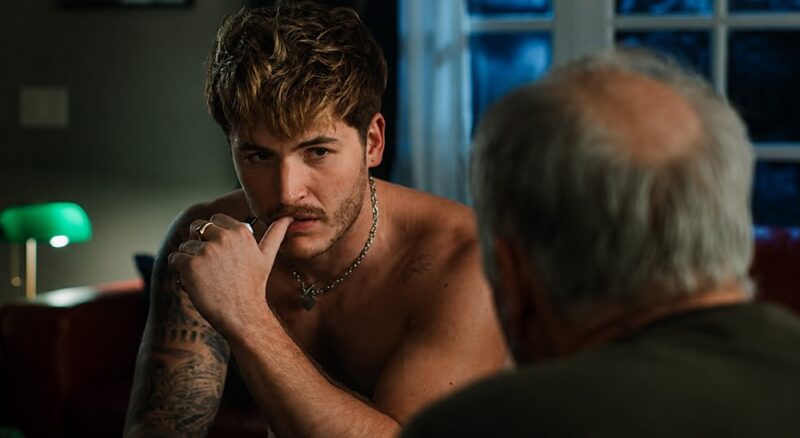
Some films confront difficult subject matter. Blue Film traps you in a room with it and refuses to let you look away.
Writer-director Elliot Tuttle‘s feature debut begins with deliberate provocation. Aaron Eagle (Kieron Moore), a successful Los Angeles camboy, performs dominance for an online audience, weaponising confidence, humiliation and carefully cultivated bravado as part of his lucrative persona; it should be noted that there’s an immediate use of a certain slur that indicates the film’s frankness. When a mysterious client offers him an astonishing sum for an overnight encounter, it initially appears to be another transaction in a profession built on performance. It quickly becomes something far more unsettling.
Waiting behind a ski mask is Hank Grant (Reed Birney), Aaron’s former middle-school English teacher, recently released from prison after serving time for attempting to abuse another child. What follows isn’t a thriller in the conventional sense, nor is it a chamber drama interested in easy revelations. Instead, Tuttle orchestrates a long, emotionally exhausting conversation between two men connected by a past that neither fully understands until the night forces them to confront it.
The film’s greatest strength is its refusal to offer emotional shortcuts. Hank is never presented as someone deserving sympathy, yet he isn’t reduced to a one-dimensional monster either. Birney plays him with unnerving sincerity, portraying a man who has spent years constructing philosophical and religious justifications for impulses he refuses to fully condemn. Every attempt at self-awareness is undercut by another act of manipulation, another contradiction, another reminder that he’s still centering his own desires above the damage he’s caused.
Moore delivers the film’s most devastating work. Aaron initially appears almost invincible, hiding behind the swagger of a man who has transformed vulnerability into commerce. His confidence feels rehearsed because, in many ways, it is. As the evening progresses and Hank systematically dismantles the walls Aaron has built around himself, Moore allows those layers to peel away with heartbreaking subtlety. The performance never feels like a dramatic transformation so much as a painful excavation, revealing a frightened young man buried beneath years of carefully maintained performance.
Tuttle is clearly fascinated by performance itself. Aaron performs masculinity. Hank performs remorse. Both men lie, not simply to each other but to themselves, constructing identities that allow them to survive realities neither wants to acknowledge. Their conversations circle ideas of power, shame, religion, sexuality and control, not searching for definitive answers but exposing the fragile stories people tell themselves in order to live with unbearable truths.
The film is at its most effective when it embraces silence as much as dialogue. Despite being largely confined to a single location, Ryan Jackson-Healy‘s cinematography keeps the room visually alive, subtly shifting the balance of power through framing and distance. The home-video fragments scattered throughout the film initially feel abstract, almost intrusive, but gradually reveal themselves as reminders of innocence forever interrupted. Their cumulative effect becomes quietly devastating.
There are moments when Tuttle’s screenplay reaches a little too eagerly for literary profundity. Some conversations feel more like philosophical essays than spontaneous exchanges between two damaged people, occasionally pulling the audience out of the emotional reality the performances work so hard to establish. Yet those moments are ultimately outweighed by the extraordinary commitment of its cast.
Perhaps Blue Film‘s most impressive achievement is that it never mistakes provocation for profundity. The explicit material isn’t there to shock for its own sake, nor is it interested in exploiting trauma. Every deeply uncomfortable scene serves a larger emotional purpose, illustrating how abuse echoes across decades and how predators often disguise manipulation as compassion, honesty or even love.
This is not an enjoyable film, nor does it aspire to be. It’s emotionally draining, frequently distressing and almost relentlessly uncomfortable. But discomfort is the point. Tuttle asks his audience to sit with conversations most films would avoid entirely, trusting that mature viewers can wrestle with morally impossible territory without demanding easy catharsis.
Whether Blue Film resonates will largely depend on an individual viewer’s tolerance for confronting deeply unsettling subject matter. What cannot be denied is the fearlessness of its performances or the confidence of Tuttle’s filmmaking. It’s a difficult, haunting work that lingers long after the credits roll – not because of what it shows, but because of the uncomfortable questions it refuses to answer.


THREE AND A HALF STARS (OUT OF FIVE)
Blue Film is screening as part of this year’s New Farm Queer Film Festival, running between July 30th and August 8th, 2026. For more information head to the official site here.
