

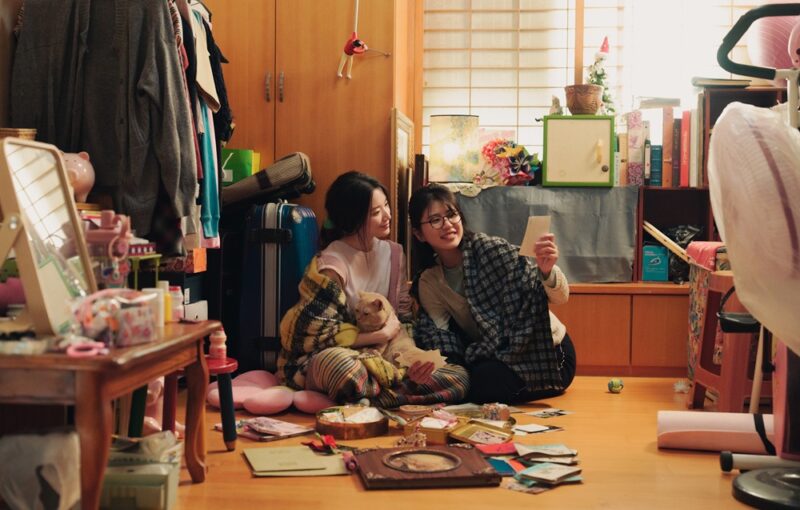
Happiness is an easy concept to romanticise. We spend so much of our lives imagining the job, relationship or milestone that will finally make everything fall into place, only to discover that fulfilment rarely arrives as neatly as expected. That uncomfortable distance between the life we picture and the one we actually inhabit sits at the heart of Feng-I Fiona Roan’s Happily Ever After, a warm, perceptive drama about two sisters discovering that adulthood offers considerably fewer certainties than they were promised.
Twenty-nine-year-old Kitty Lin (Shuhua Yeh) would appear to be doing everything right. Pretty, polite and clearly the favoured daughter of her traditional mother (Kuei-Mei Yang), she has a promising career and a devoted boyfriend, Ledo (Kent Tsai), whose proposal seemingly puts her another step closer to the conventional happy ending she has always imagined. Her older sister Claire (Xuan Chen), meanwhile, has taken a less traditional route. A successful writer, she has rejected many of the expectations placed upon her, though she still lives at home and has yet to tell her conservative mother about her longtime girlfriend, Shannie (Hung Pei-Yu).
Neither woman is quite as secure in her choices as she would like the other to believe.
Following her acclaimed debut American Girl, Roan again demonstrates an instinct for finding drama in the ordinary tensions of family life. Happily Ever After isn’t interested in deciding which sister has chosen the “right” path. Instead, it gradually dismantles the identities they’ve constructed for themselves. Kitty may be the dutiful princess preparing to marry into money, and Claire the fiercely independent rebel, but those labels become increasingly restrictive as the sisters realise how often they’ve mistaken performing an identity for actually knowing themselves.
Kitty’s engagement proves the catalyst. What begins as an exciting declaration of love slowly becomes crowded by other people’s expectations. Marriage isn’t merely about Kitty and Ledo anymore; it comes with families, money, tradition, children and assumptions about what kind of wife Kitty should become. Ledo is hardly presented as a villain – indeed, one of Roan’s strengths is her resistance to such easy characterisations – but his tendency to dismiss uncomfortable behaviour as tradition forces Kitty to question how much compromise is reasonable before she starts disappearing inside somebody else’s idea of happiness.
Claire sees those compromises immediately, though her concern can easily curdle into judgement. She has built an identity around rejecting convention, yet she too remains trapped by it. For all her insistence that Kitty should stand up for herself, Claire cannot bring herself to tell their mother about Shannie. Knowing intellectually that you shouldn’t require somebody else’s approval doesn’t magically remove the desire to receive it, particularly when that person is family.
It’s within these contradictions that Roan’s screenplay finds its emotional intelligence. You can believe in independence and still crave security. You can love someone and question whether marrying them is right. You can reject traditional expectations while still mourning the approval you might lose by doing so. Happily Ever After allows those opposing truths to exist without rushing to resolve them.
Yeh, making her acting debut away from her work with K-pop group i-dle, proves a natural fit for Kitty. Her initial brightness makes the character’s gradual unease all the more effective, as smiles become strained and the certainty surrounding her future begins to fracture. Importantly, Kitty’s femininity and romanticism are never treated as naïveté. She isn’t foolish for wanting marriage; she simply has to determine whether she wants the marriage being offered to her.
Chen has the potentially thornier role as Claire, whose righteousness could easily make her abrasive, but she finds the vulnerability underneath it. Claire’s frustration with Kitty is inseparable from her frustration with herself, and their arguments sting precisely because each knows where the other’s insecurities live. Their relationship gives the film its strongest emotional foundation, moving convincingly between affection, resentment, protectiveness and the particular cruelty siblings can deploy when they know each other too well.
Jack Kao is equally lovely as their father, a quietly observant presence who often seems to understand considerably more than he says. He accepts Claire’s relationship without demanding she justify herself and encourages Kitty to maintain financial independence rather than relying on a wealthy husband. It’s refreshing to see a father whose concern for his daughters manifests not through control, but through encouraging their agency.
Roan handles the escalating family tensions with restraint, allowing the humour and warmth of the film’s opening passages to gradually give way to something more bruised without losing sight of the affection holding these people together. Everyone loves each other; they’re simply not particularly good at saying what they need from one another.
Perhaps most refreshingly, Happily Ever After doesn’t argue that happiness lies in rejecting convention any more than it suggests embracing convention guarantees it. Claire’s independence hasn’t liberated her from fear, just as Kitty’s engagement hasn’t delivered the certainty she expected. Their parallel journeys instead become about recognising the difference between choosing something because you genuinely want it and choosing it because you’ve been taught that wanting it will make you happy.
Roan has crafted a tender, thoughtful character study that understands growing up isn’t necessarily about finally knowing what you want. Sometimes it’s accepting that contradictory desires can coexist, that supposedly correct choices can still frighten us, and that happiness isn’t a destination waiting at the end of the right set of decisions. For Kitty and Claire, adulthood means finding the courage to admit they’re still figuring out what their own happily ever after might look like.


THREE AND A HALF STARS (OUT OF FIVE)
Happily Ever After screened as part of this year’s Toronto International Film Festival, which ran between September 10th and 20th, 2026. For more information, head to the official site here.
