
Martin McDonagh has long been fascinated by men who would sooner insult, maim or murder one another than admit they actually care. Friendship in his films is rarely expressed through anything resembling conventional affection; it arrives through arguments, threats, profanities and, occasionally, the reluctant acknowledgement that losing someone might hurt considerably more than expected.
It makes Wild Horse Nine immediately recognisable as a McDonagh film, particularly in the shadow of In Bruges. Once again, two men with considerable blood on their hands find themselves displaced somewhere extraordinarily beautiful, bickering their way through an increasingly existential situation as the possibility of death hangs over them. But where In Bruges found an almost fairytale absurdity in its purgatorial setting, Wild Horse Nine feels older. Wearier. Perhaps even sadder.
It’s also frequently hilarious.
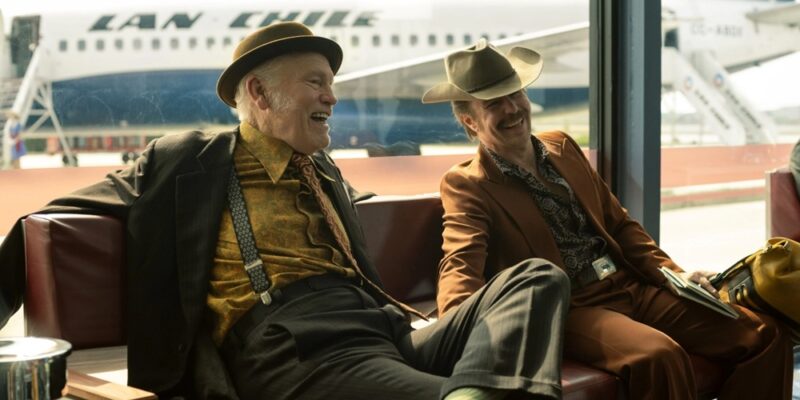
Set in 1973, shortly before the military coup that would overthrow Chilean president Salvador Allende, the film introduces CIA operatives Chris Carlisle (John Malkovich) and Lee Chesterfield (Sam Rockwell), two men whose professional histories have placed them around some of America’s most infamous covert interventions. Their latest destination is Rapa Nui, or Easter Island, ostensibly fulfilling Chris’s desire to finally see the moai statues he’s long been fascinated by.
But neither man is being entirely truthful about why they’re there.
Chris is dying from cancer and experiencing increasingly debilitating dementia. He’s also writing his memoirs, an endeavour that understandably terrifies his superiors given the classified skeletons rattling around inside his deteriorating mind. Their boss, MJ (Steve Buscemi), has therefore tasked Lee with discovering exactly what Chris intends to reveal, particularly regarding one lingering question surrounding the assassination of John F. Kennedy.
The joke, initially, is that Chris doesn’t appear particularly interested in keeping anything secret.
Malkovich is gifted some magnificent dialogue as Chris casually discusses CIA interference, assassinations and destabilisation efforts with people who absolutely shouldn’t be hearing any of it. When he and Lee encounter Chilean students Monica (Mariana di Girolamo) and Alicia (Ailín Salas), his inability – or perhaps unwillingness – to maintain the pretence of being anything other than an American intelligence operative repeatedly leaves Lee scrambling behind him.
McDonagh mines tremendous comedy from this dynamic, but there’s something quietly devastating beneath it. Chris isn’t simply becoming careless. He’s losing control of the mind that has defined him.
He leaves himself notes to negotiate the gaps. Some remind him that he’s dying. Others warn him not to trust Lee. What initially registers as another wonderfully bleak McDonagh gag gradually assumes a much sadder meaning as it becomes apparent that Chris can’t always remember which version of his friend he’s supposed to believe.
Malkovich is exceptional.
McDonagh initially weaponises everything audiences associate with the actor: the strange cadence, unpredictable energy, capacity to make an innocuous sentence sound vaguely threatening. Chris can be monstrous, hilarious, ridiculous and unexpectedly gentle, sometimes within the same conversation. Yet the performance becomes increasingly vulnerable as the bravado begins to fracture.
There’s an anger to Chris’s deterioration that Malkovich never sentimentalises. This is a man who has spent decades operating with absolute certainty, whether or not such confidence was morally deserved. Now his body is failing, his memory is betraying him and the secrets that once made him powerful threaten to disappear alongside him.
He’s also responsible for horrific things.
Wild Horse Nine never requires us to forget that. Chris can reminisce about coups and killings with an almost horrifying casualness, and McDonagh resists transforming approaching death into automatic absolution. Instead, mortality seems to force Chris into the uncomfortable position of finally examining a life spent justifying violence as necessity.
Malkovich plays those contradictions beautifully, delivering one of his richest performances in years.
Rockwell has the less immediately showy role, but he’s arguably just as important to why the film works. Having previously navigated McDonagh’s linguistic minefields in Seven Psychopaths and Three Billboards Outside Ebbing, Missouri, he understands exactly how to play the spaces between the writer’s punchlines.
Lee spends much of Wild Horse Nine reacting to Chris, and Rockwell is such an expressive performer that a stare, grimace or moment of exhausted disbelief can land as effectively as McDonagh’s most carefully constructed insult. But those reactions gradually change. Irritation gives way to concern, and concern to something neither man seems particularly equipped to articulate.
Their relationship could be read as colleagues, brothers, or even father and son, but McDonagh wisely avoids defining it too neatly. These are two men bonded through years of violence, secrets and shared moral compromise. They know terrible things about one another. They may even be capable of doing terrible things to one another.
And they love each other.
That simple emotional truth gives Wild Horse Nine its considerable heart.
McDonagh’s screenplay doesn’t suddenly soften because of it either. Chris and Lee continue verbally assaulting each other with tremendous enthusiasm, and the film contains enough gloriously profane exchanges to satisfy anyone hoping the filmmaker hasn’t discovered restraint. If anything, the humour makes their affection more persuasive. These men communicate through hostility because sincerity would require a vulnerability neither has spent much time practising.
The supporting cast understand the assignment beautifully. Buscemi is wonderfully dry as MJ, whose exasperation at his increasingly uncontrollable operatives comes with its own underlying menace, whilst Parker Posey practically steals the film during her limited appearance as Lee’s spectacularly unfaithful wife. A phone conversation between the two becomes a masterclass in McDonagh’s ability to make emotional catastrophe increasingly funny through sheer escalation.
Tom Waits, meanwhile, appears briefly as Chris’s estranged brother in a sequence whose impact far outweighs its screen time, whilst di Girolamo brings a welcome humanity to Monica, whose encounters with Chris allow another version of the man to emerge.
Yet perhaps McDonagh’s most inspired piece of casting is Rapa Nui itself.
Working with cinematographer Ben Davis, he places these small, morally compromised men against landscapes of staggering permanence. The moai have survived centuries. Chris can barely trust himself to remember yesterday. Against those enormous stone faces, the CIA’s manoeuvring and masculine posturing suddenly seem both terrifyingly consequential and cosmically insignificant.
There’s something almost Western-like about the imagery too. Chris and Lee resemble aging gunslingers approaching the end of an era, wandering through an unfamiliar landscape while slowly realising that whatever mythology they once constructed around themselves isn’t going to survive forever.
That gives the film a contemplative quality that separates it from some of McDonagh’s earlier work.
Yes, the fingerprints are familiar. In Bruges remains the most obvious relative, and there are moments when Wild Horse Nine threatens to echo McDonagh’s previous explorations of violent men, impossible assignments and fractured friendships a little too closely. It doesn’t represent a reinvention of his cinematic language.
What it does suggest, however, is an evolution in temperament.
The cruelty is still there. So is the profanity, absurdity and sudden violence. But Wild Horse Nine seems less interested in watching its characters destroy themselves than asking what remains when men who’ve spent their lives destroying things finally have to confront their own impermanence.
The political backdrop adds another uncomfortable dimension. With Chile heading towards catastrophe, Chris and Lee aren’t innocent observers passing through history; they’re representatives of an organisation entangled in it. McDonagh doesn’t transform the film into a historical lecture, instead allowing that knowledge to hang over the characters and complicate whatever sympathy we develop for them.
Chris’s approaching death can’t undo what he’s participated in. Lee’s affection for him can’t either.
But affection exists nonetheless.
That’s the contradiction McDonagh understands so well, and Wild Horse Nine is at its strongest when it refuses to resolve it. A person can be capable of monstrous actions and still inspire genuine love. Friendship doesn’t necessarily absolve anyone. Sometimes it merely makes the inevitable goodbye considerably harder.
For all its political intrigue, CIA secrets and dark suggestions surrounding American history, Wild Horse Nine ultimately becomes something surprisingly intimate: two men standing near the end of a road neither particularly wants to acknowledge they’ve reached.
Malkovich and Rockwell are sublime together, alternately vicious and tender without allowing either register to overwhelm the other. And when McDonagh finally brings the laughter and melancholy together, the result lands with an emotional force that sneaks up on you.
Wild Horse Nine may travel familiar McDonagh territory, but there’s a different man surveying the landscape this time. Older, more reflective and seemingly increasingly interested in what happens after all the insults have been exhausted, he has crafted another wickedly funny study of male friendship – one that understands sometimes the people we’d have the hardest time saying “I love you” to are the ones whose absence will hurt the most.

FIVE STARS (OUT OF FIVE)
Wild Horse Nine is screening as part of this year’s Toronto International Film Festival, running between September 10th and 20th, 2026. For more information, head to the official site here.
Wild Horse Nine is scheduled for release in Australian theatres on November 5th, 2026.
