

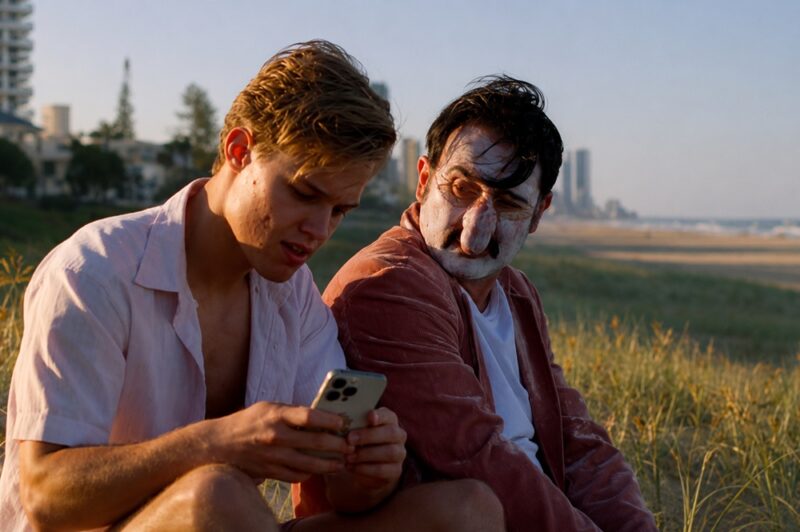
There’s something gloriously difficult to pin down about Phillip Philadelphia. At once a queer melodrama, an absurdist comedy, a portrait of creative decay and a love letter to the strange beauty lurking beneath the Gold Coast’s sun-soaked façade, Adam C. Briggs‘ latest feature refuses to settle into any one identity. Shot on luminous 16mm, it follows the washed-up, possibly delusional screenwriter Phillip (Geoffrey Vagg) as he drifts between motel rooms, fleeting romances and elaborate fantasies, blurring the line between performance and reality in a world that’s equal parts hilarious, unsettling and unexpectedly poignant.
Following the SXSW Sydney-winning A Grand Mockery, Briggs once again explores the uncomfortable spaces between truth and fiction, creating characters who are impossible to fully embrace or reject. Phillip himself is charming and repellent in equal measure: a man clinging to the mythology of an artistic past that may never have existed, while continuing to direct the only stories he has left – those inside his own head.
Ahead of the film’s release, Peter Gray spoke with writer-director Briggs and star Vagg about finding beauty within the Gold Coast’s contradictions, crafting a protagonist audiences can both love and loathe, using discomfort in the pursuit of emotional honesty, and why Phillip Philadelphia may ultimately be less about a failed filmmaker than the quiet tragedy of loving an industry that no longer loves you back.
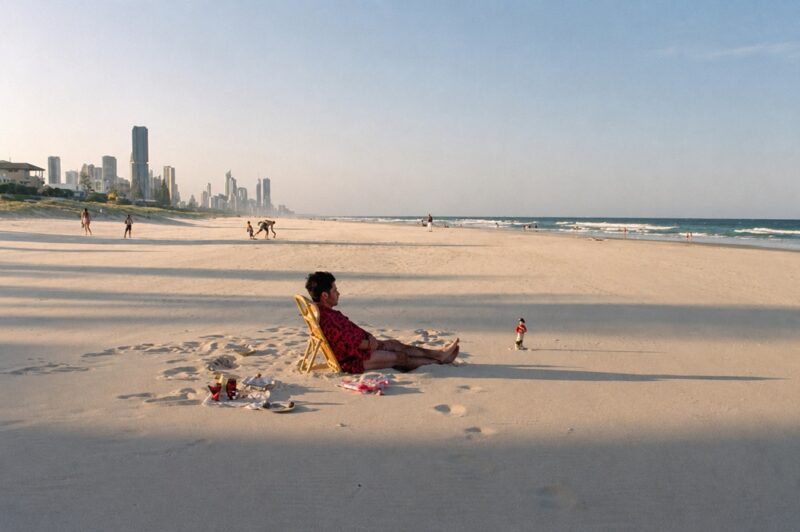
I wanted to ask you first, Adam, because I feel there’s this sort of ugliness utilised as beauty here. The Gold Coast can often be photographed as paradise, but we know that’s not always the case. Was the goal to expose the ugliness beneath the postcard? Or were you actually trying to find beauty inside that ugliness?
Adam C. Briggs: I hope the film isn’t read as some kind of indictment of the Gold Coast, because that certainly wasn’t our intention. I’m from Brisbane, and I spent a lot of time on the Gold Coast between 2021 and 2023. Despite the reputation it sometimes has nationally, I actually think it’s a really lovely place and I enjoyed my time there.
At the same time, I was interested in observing some of its more conservative aspects. There are these slightly garish, imperialist echoes that fascinated me. I remember sitting in a café that looked like any ordinary Australian café, but the menu had things like a ‘Navajo Breakfast’. There were all these strange appropriations and references that made me think about the history and identity of the place.
The Gold Coast is this booming luxury city, and that’s something I feel both drawn to and repelled by. I find it fascinating, but I’m also critical of certain aspects of it. That tension is what interested me creatively. Ultimately, though, I hope people from the Gold Coast see the film as a representation of a place rather than a condemnation of it. We certainly weren’t trying to judge or condemn the people who live there.
In the film there’s a lot of jokes that almost make you ask, “Can we make that joke?” There’s one involving sexual assault, and it wasn’t so much unsettling because of the joke itself, it was about recognising that’s how people make comments. People make jokes about what they’ve been through. For both of you, were you interested in reproducing the ugliness of real conversations rather than provoking audiences for the sake of it?
Adam C. Briggs: I think some of my work, and especially A Grand Mockery, my previous film, could probably be read that way. But we’re certainly not setting out to be provocateurs. That kind of art or cinema doesn’t particularly interest me. What we’re trying to do, even if the performances aren’t always strictly naturalistic, is capture something emotionally truthful. I hope what comes across feels real in the way people actually speak, and in the way they often process or even disguise traumatic experiences through humour or everyday conversation.
The section you’re referring to is actually something that evolved through collaboration. A lot of the cast contributed ideas alongside me, so it’s a very open creative environment where we’re all working together to build a shared meaning. I’m aware there are moments in the film that could upset people, and I’m sure they will for some viewers. I certainly don’t want anyone to have a genuinely negative experience watching it, but I hope that, even when it’s uncomfortable, what they’re seeing feels honest rather than provocative for its own sake.
Geoffrey Vagg: It’s all very playful. It’s not meant to be derogatory or anything. It’s playfully offensive.
Adam C. Briggs: I don’t think it’s super offensive, but I’m always interested, as an audience member, in being made to feel uncomfortable from time to time and then examining why I’m reacting that way. I think there are so many different experiences you can have with a film, and I really appreciate movies that strike a balance between more accessible, digestible material and moments that are a little spikier, because that’s how life works too. Those moments can sneak up on you when you least expect them. I suppose that’s some of the subconscious reasoning behind it. But we were certainly never setting out to shock people or deliberately trigger anyone.
Geoffrey Vagg: All of Philip’s dialogue was fantastic. It had a really poetic quality to it. So if anything he says doesn’t come across as offensive, it’s because there’s something lyrical and considered about the way it’s written. His dialogue always felt incredibly deliberate. That’s how I read it – it all came from his screenplay, and there was a poetic rhythm and intention behind every line.
Because Phillips spends a lot of the film talking about creativity rather than actually creating, did you see him as someone who has been defeated by the industry? Or someone who’s become addicted to the mythology of being an artist?
Geoffrey Vagg: I saw him as someone who was a bit dishevelled and a bit broken by life. That’s how I interpreted the character from the script. My sense was that he’d once been a great writer, but he’d become consumed by the dreams and fantasies of what he could have been. Maybe, in his own version of events, he was once nominated for a Golden Globe before it all fell apart. But I think a lot of the grand claims he makes are probably bullshit. That’s part of who he is – he’s built this mythology around himself, and you’re never quite sure how much of it is true.
Adam C. Briggs: Or maybe not – I don’t know. Maybe he really was a great filmmaker. That’s part of the fun of the character. I think everyone involved with the film had a lot of affection for Phillip, but also a certain amount of disdain for him. Throughout filming, our feelings towards him were constantly shifting. I remember crew members coming up to me after certain scenes and saying, ‘I really don’t like Philip today, Adam.’
He provoked a very visceral reaction in all of us. We almost came to think of him as an entity that existed alongside us rather than just a character in the film. Everyone had a relationship with him, and that relationship was always changing.
Geoffrey Vagg: Yes, because there was a real nastiness to him – a sinister side. I kept thinking about those old British aristocrats. They could be incredibly cutting, and that’s where I found the accent and the voice. I also watched Ken Russell’s The Devils, and a lot of Phillip came from that film. Not so much Oliver Reed’s character, but the lords, the king, and the priests. They all had this incredible grandeur, but they were also very precise and very nasty. That combination really fascinated me.
So I channelled those characters when I was creating Phillip. The inspiration came much more from their precision and their quiet menace than from Oliver Reed himself – although perhaps some of Philip’s look came from him.
As you mentioned that mythology around Phillip and if he had the kind of career he said he did, we get the mention that he wrote The Prince of Tides. He mentions Nick Nolte’s appearance, and Oliver Cameron’s character says that he’s never heard of him. It made me think how there’s this whole generation of people who don’t know these amazing actors or films. Has there ever been an actor or a film that you’ve spoken about with someone and they’ve had no idea on what or who you were talking about?
Geoffrey Vagg: Oh, yes, many times. Even recently, actually. There was a really famous film someone was surprised I hadn’t seen. I’m trying to remember what it was… but I’ve completely forgotten now.
Adam C. Briggs: It was almost a good anecdote (laughs). I never shame anyone for not having seen a particular film. I still have plenty of blind spots myself. There are so many fucking movies out there, and everyone comes to cinema differently. We both grew up watching a lot of films, but some people don’t discover that passion until much later in life. So it’s no surprise they haven’t encountered certain classics.
And there’s this idea in the film that it almost feels like it’s mourning the idea of cinema, whilst it surrounds itself with people desperate to be a part of it. Do you see this film as about people who have fallen in love with an industry that doesn’t love them back?
Adam C. Briggs: Yeah, that’s a really nice reading, Peter. The film is certainly trying to evoke a sense of decay in a number of ways, and I think that interpretation absolutely fits. As a result, Philip retreats into these escapist little worlds that he creates for himself. They’re framed as romantic or sexual pursuits, but he’s clearly not actually making films anymore. Instead, he’s still orchestrating environments and scenarios, almost directing them and acting them out himself.
I hadn’t really thought about it in those exact terms before, but I suppose that’s one of the few things he’s still authoring in the film. They’re an extension of his fantasies and reveries. Before we made the film, I took Jeff to see Pink Narcissus, which was a huge source of inspiration. The story behind that film, and James Bidgood creating these extraordinary worlds inside his New York apartment, really resonated with me. It’s all about constructing these rich inner worlds.
So, yes, I think that’s a really apt way of looking at it. It could absolutely be read as Philip’s response to the film industry – this rather pitiful attempt to keep creating, even if it’s no longer through cinema itself.
Phillip Philadelphia is screening as part of this year’s Melbourne International Film Festival, running between August 6th and 23rd, 2026. For more information on the festival, including session times and tickets, head to the official site here.
