

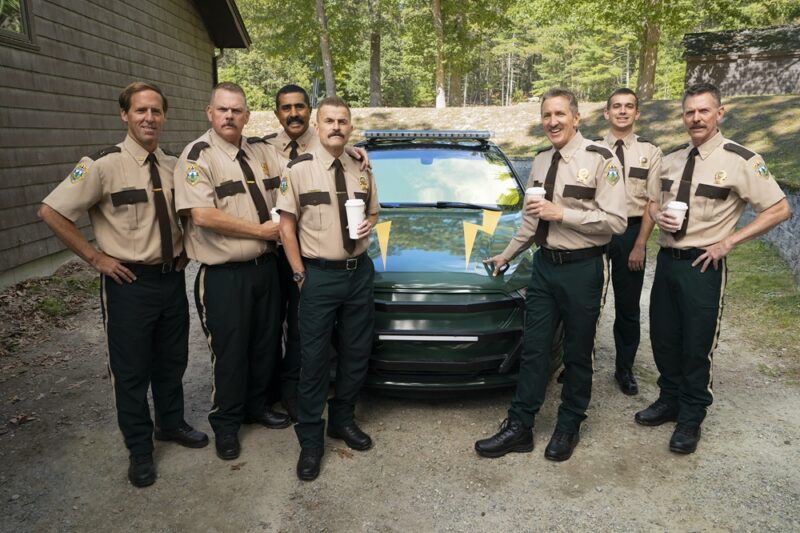
Twenty-five years after Super Troopers transformed a group of sketch comedians into unlikely cult icons, Broken Lizard still hasn’t grown up. Thankfully.
If anything, Super Troopers 3 proves they’ve become even more comfortable embracing the wonderfully bizarre universe they’ve built. What began as a relatively grounded story about Vermont state troopers amusing themselves on lonely highways has gradually evolved into a world where every throwaway line hints at another completely unhinged adventure that audiences never get to see. There are references to stripper escape rooms and stripper crab boils, Farva casually reveals life-changing secrets about himself, and somehow every revelation only makes these characters feel stranger, funnier and more lived in.
Ahead of the release of Super Troopers 3, Peter Gray spoke with Broken Lizard members Jay Chandrasekhar, Kevin Heffernan, Steve Lemme, Paul Soter and Erik Stolhanske about expanding the franchise’s increasingly absurd mythology, the unique relationship they’ve built with fans since the record-breaking crowdfunding campaign behind Super Troopers 2, finding the precise rhythm that makes their comedy work, and why, after all these years, there’s still one piece of Troopers lore they’re desperate to bring to the screen.
One of the things that I loved about Super Troopers 3 is how casually insane the off-screen lore has become. There’s stripper escape rooms and stripper crab boils, and Farva revealing all of these hidden layers about himself. At this point do you all intentionally treat the world like an iceberg, where we only see 10% of the madness that you’ve created for all of these characters?
Paul Soter: I remember in the first one it was very important, especially to Jay, that everything feel like planet Earth. It does seem like we’ve gone away with each movie into absurdity.
Kevin Heffernan: That’s the fun thing, right? People knowing the characters, because now you get to expand their knowledge. You can put things like that (Farva) grew up in the Boston area, and I have an accent, or whatever it is. We can throw those things out there – and people can accept it.
Jay Chandrasekhar: It all still feels possible.
For Kevin, especially, Farva revealing that accent and the weird hidden truths, it feels hilarious because it suggests that you all might not even know who Farva is. Has he become the character who surprises the writers the most – where every sequel uncovers a deeply unsettling part of his life?
Kevin Heffernan: We’ll pitch an idea about the backstory of one of our characters, and you’re like, “Wait a minute, that guy’s been around for 20 years. I didn’t know that about that guy,” and then all of a sudden it becomes funny to you, because this is something you didn’t expect out of that person.
Jay Chandrasekhar: He’s a quaker and a test tube baby, and then you’re like, “He’s not a test tube baby?”
Paul Soter: It did always feel funny to us that no matter how many years we worked together, nobody would ever have an unnecessary conversation with Farva. You would just get in and get out and make it as minimal as possible. There would be a million things we wouldn’t know about this guy.
Steve Lemme: In Super Troopers 2, we established he was sitting with you (Paul Soter’s character, Foster) alone, he’s like, “I realise we’ve never been alone together. You’re kind of a boring fucking dude.” I imagine that was probably your last one-on-one conversations also.
With Super Troopers 2, it was crowdfunded. I know fans bought producer credits and patrol cars and speaking roles because they wanted this world to continue. Did that experience fundamentally change your relationship with the audience? Did it make the movies feel less like “cult comedies” and more like something people genuinely felt ownership over?
Steve Lemme: There are definitely times when we meet people who are like, “I contributed to your crowdfunding campaign,” and you actually feel a real sense of gratitude, because they are the reason this movie got made.
Kevin Heffernan: It’s very flattering.
Erik Stolhanske: We were shooting, we’d have large groups of people on set that had contributed, and they’d come be part of the movie. You felt like you’re making the movie with them.
Steve Lemme: I had a great experience on the set where I was leading a little group of contributors, and they were all wrapped with what I was saying. I was like, “Thank you, this is how we do things…,” and the campaign manager came out, Rob Lowe’s right over there, and they were like, “See you later.” Left me in the middle of my point. Like, fuck you guys (laughs).
Erik Stolhanske: Can’t compete with that guy.
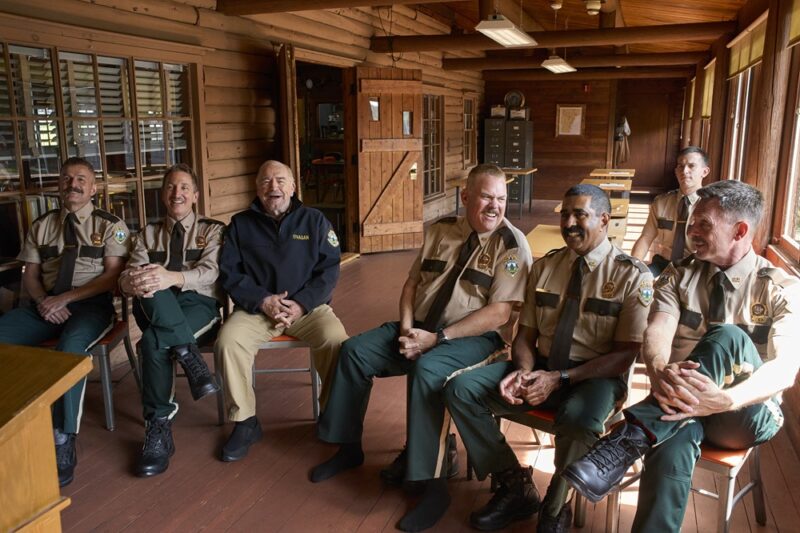
One of the best recurring things in these films is that the Troopers, they’re technically adults with authority, but emotionally they still behave like teenagers trying to amuse each other. Was there ever pressure with these sequels to “mature” the characters, or did you realise that refusal is just the best point?
Paul Soter: I do think there’s a point where we had to acknowledge that we are considerable older than we were in the first movie, but that didn’t mean we had to be more mature though. But we just had to say, yeah, we’re not young guys anymore.
Kevin Heffernan: That’s the case with us anyway. You get older, but you still have the jokes in the way you screw (with) all your friends, or whatever. I think everyone can appreciate that, right?
Jay, as the director, how do you balance chaos with precision now? These movies feel so loose and improvised, but comedy this rhythmic usually requires an almost musical level of timing underneath. How do you balance and project something that feels so loose, but obviously has such a heavy structure to it?
Jay Chandrasekhar: What we’re trying to do, you hit it on the head, which is that we’re trying to capture a rhythm that is going to be funny. Like the lines delivered more slowly is less funny, and a little too fast is not as funny, but there’s a sweet spot of where the song kind of locks in. A lot of what I do is just go a little faster, a little slower, tighten up…try and create two shots where the rhythm is created by the actors. You just try to keep those two shots in the movie as long as possible. But you’re right, that’s what it is – a rhythm game.
Having a comedy like this on the big screen, it makes me very happy, because I feel like the comedy genre is just something we’re not seeing as much in cinemas lately. I’m very appreciative that this is going out there. And you’ve all been working together for so long that I imagine there’s a shorthand language on set. Are there moments where someone can pitch an idea that makes no sense to outsiders, but to the rest of you, you immediately understand the exact comedic rhythm of that?
Paul Soter: Generally speaking, anybody around us doesn’t understand most of what we’re talking about. I feel genuinely bad sometimes, because yes, it’s 30 years worth of inside jokes and shorthand and stupid accents.
Jay Chandrasekhar: Yeah, we would be like, “Remember that guy in Milwaukee two decades ago, the way he kind of limped into that room and started slurring?” That’s what you should be doing. And you’re like, “Oh, I get it.”
And just before letting you all go, is there one piece of unseen Troopers lore that exists in your head, but has never made it on screen?
Steve Lemme: It’s a good question.
Erik Stolhanske: There is one plot line we’ve been trying to get on screen for a long time.
Kevin Heffernan: The Mad Speeder. There was a mad speeder that drives around in Vermont, and it’s a naked woman. If you catch her, she’ll make love to you. We’ve been trying to work that in to every movie, including this one, and we can’t seem to get it in there. Someday, we’re gonna get the lore of the Mad Speeder.
Super Troopers 3 is screening in Australian theatres from August 6th, 2026, before opening in the United States on August 7th.
