
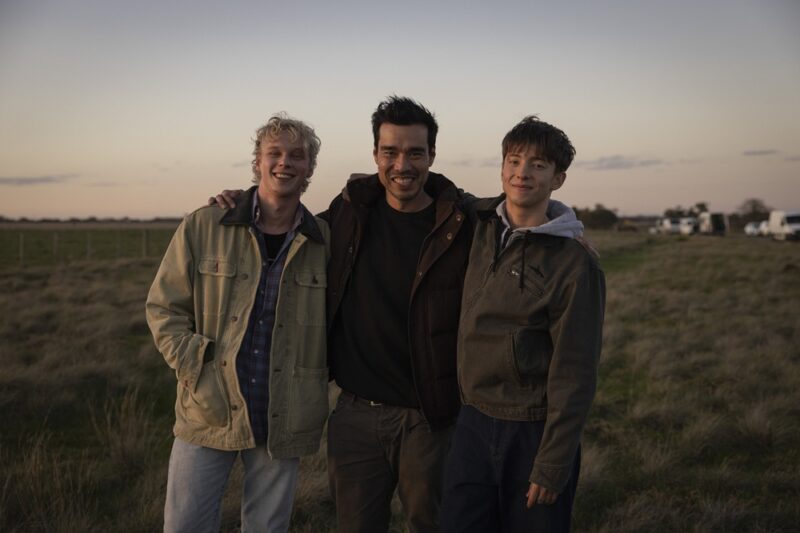
Horror has long been a genre built around fear, but in Adrian Chiarella‘s debut feature Leviticus, terror is rooted in something far more intimate: desire itself.
Fresh from a breakout Sundance premiere that sparked a fierce bidding war before being snapped up by NEON, the latest film from Causeway Films (Talk to Me, Bring Her Back, The Babadook) blends queer coming-of-age drama with supernatural horror to devastating effect. Following teenage boys Naim (Joe Bird) and Ryan (Stacy Clausen) as their burgeoning connection unleashes a violent entity that takes the form of its victim’s deepest desire, Leviticus explores internalised shame, religious trauma, first love, and the frightening power of being seen.
Ahead of the film’s Australian release, Peter Gray spoke with writer-director Chiarella about horror as a universal language, the weaponisation of scripture, Australian horror’s unique visual identity, and why the most terrifying moments in Leviticus have nothing to do with monsters.
As a gay man, these are the kind of stories that hit so much harder. So I want to say congratulations, first. I know that you’ve said that fear travels across culture in a way that humour doesn’t. Given your own multicultural upbringing, was horror the first cinematic language you trusted to be universally understood?
Yeah, absolutely. I remember when I was a kid, if I told a joke to one side of my family – my Chinese side, for example – I might get a laugh there, but other relatives wouldn’t find it funny at all and would just look at me strangely. But a scary story was different. If someone hurt themselves at school, or if I thought somebody had been following me home one day, and I told that story to a relative, it didn’t matter where they were from in the world – I’d always have that listener in the palm of my hand. So I knew from a very young age that there was something incredibly universal about horror and stories that tap into that emotional space.
Going off that, the “monster” in this is obviously the person we’re most attracted to – which is just the most devastating metaphor, especially for any queer person growing up. Was the original here “I might be punished for wanting this,” or something even more internal – “what if wanting this makes me dangerous”?
I think it was both, really. There was the fear that I might get hurt. I always knew the monster had to take the form of what you desire most, because it’s the perfect lure. It draws you in and forces the character to confront that terrifying thought: “Oh my God, my desires are going to hurt me.” But as a filmmaker, it’s always tricky. You have to figure out, okay, that’s a great setup, but where does it go? What happens in the second half? What’s the ending? What’s the story really about?
Without getting too spoilery, I knew I was onto something when I realised that, once we got into the guts of the story, it had to become about the character feeling like he’s hurting the person he cares about as well. That’s where the best horror happens. Once I figured out that rule and the mechanics of the monster, I knew we had not just a film, but an ending too.
The film understands that homophobia is not only an external violence, it can often become this inner voice. This reflex. How hard was it to dramatise internalised shame without making the character of Naim simply a villain?
Yeah, that was really difficult, and it ultimately came down to how we were going to end the film. That ending – that final frame – is something we worked on for a very long time, going all the way back to the first draft. I had so many different versions of how to land the plane, how to take this character through everything he’s experienced and bring him to a place that feels satisfying for the audience.
I knew that ending had to work, but I also knew, very early on, that one of the key ideas in the script was that first-act betrayal. Naim feels betrayed by Ryan, and then tries to hurt him in return. One of the things I love about horror is that there’s almost always some kind of transgression – don’t cross this line, don’t feed this creature after midnight, that sort of thing.
The best horror films, for me, are the ones where you’re never entirely sure who committed the transgression that unleashed the curse. With this story, I loved the idea that it could be any number of things. Was it what the parents did? Was it what Ryan did to Nahum? Was it what Nahum did to Ryan?
I wanted that ambiguity in the first act. And to your point, there’s something about Naim’s internalised homophobia that may have influenced the choices he makes when he goes to the pastor’s house. That idea was always really important to me.
The title arrives carrying centuries of weaponized scripture. Did you choose it because that word already feels like a threat to queer people?
Yeah, I did. I did choose it for that reason. The word itself carries a sense of fear, and that’s exactly what a horror film is trying to evoke. There was actually a scene near the beginning of the film where Ewen Leslie’s character, the pastor, delivers a sermon about that specific verse from Leviticus – the passage many people point to when condemning homosexuality. But when we got into the edit, it just didn’t sit right. It felt like the film was over-explaining itself. So we tried the film without that scene, and everything seemed to work much better.
For a long time, I wondered whether the title might be too obscure without that context. I kept thinking, “Have I made it too difficult for people to connect the dots?“ But since we’ve started screening the film around the world, so many people from the LGBTQIA+ community have come up to me and said, “No, I completely understand why you called the film Leviticus.”
So that was really reassuring. It made me realise that the title still carries the meaning I hoped it would.
The ritual scene is horrifying because it’s so intimate, yet public at the same time and supposedly loving. Were you interested in the idea that some of the worst violence is committed by people who believe they’re saving you? Was that a theme you wanted to explore?
Yeah, I mean, I didn’t have religious parents, but I did go to a religious school. It was an all-boys school, and as a kid I experienced not only homophobia from the students around me, but also from the institution itself. You’d hear things being said by teachers, the chaplain, or other authority figures. Sometimes it was direct, sometimes it was just a throwaway comment or a backhanded remark, often tied to biblical passages. But little by little, it gives you the feeling that the whole world is against you.
So when I was creating the ritual in the film, I wanted it to feel like it came from a place of authority. Even though that authority takes the form of this very ordinary old man who shows up carrying all his belongings in a plastic bag, he’s still someone the parents and the community trust – someone they believe can, quote-unquote, “cure” their children. That idea was really important to me, because those figures often derive their power not from who they are as individuals, but from the authority people choose to give them.
I find that Australian horror often finds the terror in emptiness. We have wide roads and dead towns and industrial spaces. In Leviticus, isolation is lethal. Literally lethal. What did the Australian landscape give you that another country’s horror language couldn’t?
I’ve been obsessed with the visual language of Australian horror for as long as I can remember. I’m not old enough to have been around when films like Wake in Fright first came out, but I was certainly watching them from a young age.
I think there’s something about our landscape that naturally lends itself to stories about being lost in a terrifying world. I definitely wanted to bring that feeling into this film. I didn’t want to shy away from it. I wanted audiences to feel like they were stepping into what has become a very recognisable subgenre of Australian horror.
At the same time, we were telling a queer story – a queer coming-of-age love story – and that was something we really leaned into. The challenge, and the opportunity, was finding a way to bring those two traditions together.
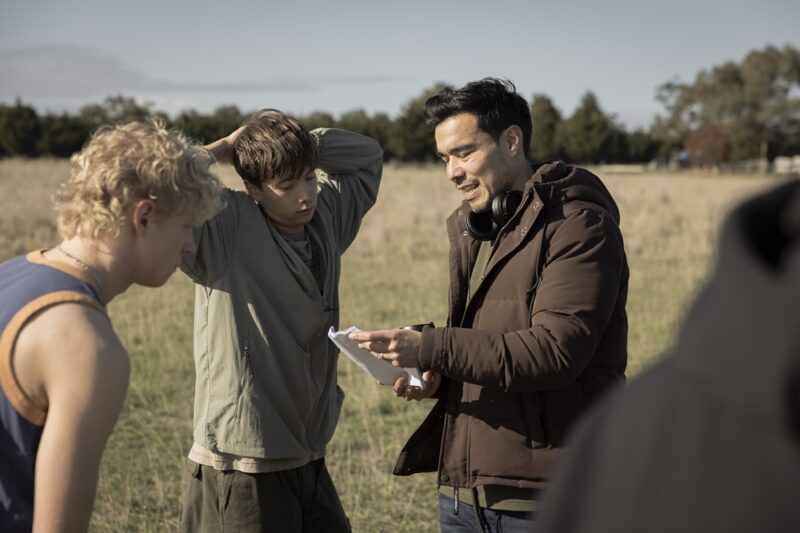
I know you’ve described the town as “trapped in amber.” Was that timelessness about nostalgia or about the way certain prejudice are untouched by time?
It was a little of both. I remember saying to the team that I wanted to create a world where you got the sense that industry had once existed in this town – that it had seen better days. Maybe a lot of the people who worked there had moved away, but the ideas and attitudes they brought with them had stayed behind.
But beyond that, from a cinematic point of view, I wanted to create a world that anyone could feel nostalgic for. I wanted it to feel familiar regardless of when or where you grew up. The goal was to transport audiences back to that particular period in their lives when they were experiencing the same kinds of emotions and discoveries that these two characters are going through. That sense of nostalgia felt just as important to the film as the horror itself.
Looking at the film’s visual language, this entity is only visible to the cursed characters, which makes it like this secret queer code. Was that invisibility important? Because so much queer fear is invisible to everyone else except the person living it…
Yes, exactly. I wanted it to function almost like a code between the queer characters. But the other fear I wanted to explore was the idea that, for many young queer people, one of the hardest and most frightening experiences is having the people around them not believe that what they’re feeling – or even who they are – is real.
We’re seeing more conversations about that now. People are questioning whether it’s appropriate to talk to teenagers about LGBTQIA+ issues at all. Should young people be exposed to those conversations, or should they be shielded from them entirely and encouraged to ignore those feelings?
That was something I wanted to allude to in the film. The idea that these characters are experiencing something very real, very frightening, and yet the people around them either can’t see it or refuse to acknowledge it. The fact that the entity is only visible to the queer characters who have gone through the ritual was a really important part of that concept for me.
Obviously it’s a horror film, but there is still a beautiful love story here between Ryan and Naim. How did you find protecting that tenderness? Even though there’s this horror around them, you need to make this a genuine story that we care about. How was that balance for you?
I did, right until the very end. Throughout the edit, we were constantly adjusting the balance – adding more horror, then pulling it back; leaning further into the love story, then pulling that back too. We’d ask ourselves questions like: Do we need another scene of tension between the two lead characters in the first act? Are we waiting too long to introduce the love story? Are audiences going to get impatient for the horror to begin?
All of that was part of the alchemy of making the film. It was something I was working through from the script stage right up until the final sound mix, which is really the last thing you do on a film like this. It was a constant consideration.
But I knew it would be worth it. I knew the love story wasn’t just important to me personally – it was also one of the things that made the film distinctive. There have been some incredible horror films released in recent years, but I knew that what we were doing was also telling a love story and a coming-of-age story. That was always at the heart of the film, and I never wanted to lose sight of that.
The abandoned mill holds this very pure sense of spirituality. And then you have the church feeling like this rigid, man-made structure. There’s this dichotomy to that. Did you want their first love to feel closer to grace than the original spaces that are judging them?
Yes, absolutely. That’s something cinematographer Tyson Perkins and I talked about a lot. We spent a great deal of time thinking about how light would move through that abandoned mill space. Finding the right location was a huge part of that, and Tyson put a lot of work into lighting it in a way that created the feeling we were after.
By contrast, the church is this grey cinderblock structure – a real church in Melbourne’s southern suburbs – with a red brick cross built into the wall. We kept the curtains drawn for most of the scenes. We used to joke that they were this sort of sad pink colour. Some light filtered through, but it remained a very dark space.
I remember taking some of the cast to a modern Pentecostal church service as part of our research and rehearsal process. One thing that’s interesting about those churches is that they’re often held in all sorts of different venues nowadays. The service we attended was actually in a cinema they had rented on a Sunday morning.
I remember sitting there and thinking how strange it felt. There was no natural light at all, because that’s how cinemas are designed. I’d always imagined churches as places of spirituality where you feel connected to the outside world – where natural light plays an important role in the experience. That definitely informed our approach. We didn’t completely block out natural light in the church scenes, but we were very deliberate about limiting it. We wanted the space to feel enclosed and disconnected in a way that contrasted with the openness and grace of the mill.
I just thought, “Oh man, church would have been so great in a cinema.” But then if you’re not watching a movie, it’s just this terrifying dark space! And just before I let go, after making Leviticus, do you think the scariest thing in the film is the monster, the doctrine that creates it, or the moment these characters believe that the doctrine is about themselves?
I want to leave that question for the audience to answer, but I can tell you that the hardest scenes for me to shoot were the moments of real-world homophobia. The aggression from some of the younger characters in the second half of the film, the acts of violence, and some of the things the parents do to their children – that was the most difficult material for me to work on.
Those scenes carried a very different weight than the supernatural elements. I genuinely felt a sense of fear going into them, both as a filmmaker and as a person. Working through those moments with the cast and crew was emotionally challenging because they were rooted in something real. As frightening as the monster is, those scenes were the ones that stayed with me the most.
Leviticus is screening in Australian theatres from June 18th, 2026, before opening in the United States on June 19th.
