
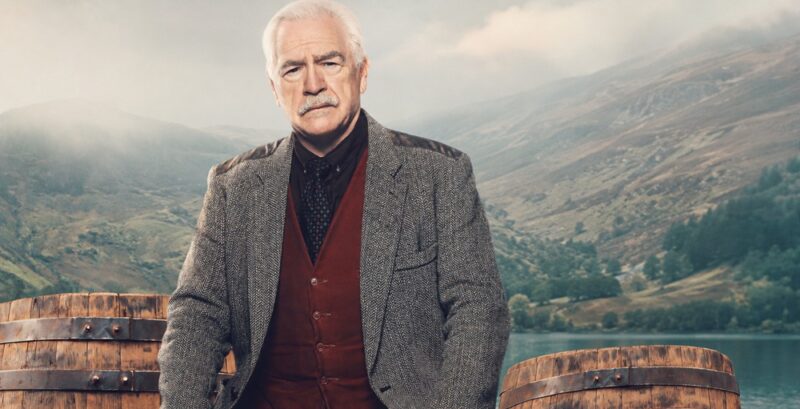
For a film centred on whisky, Glenrothan is ultimately far more interested in what people inherit than what they produce. Set against the striking backdrop of the Scottish Highlands, Brian Cox‘s directorial debut follows two estranged brothers forced to confront decades of resentment, family history and the pull of a homeland neither can truly escape. While the story unfolds around a struggling distillery and the future of a family business, its real concerns are roots, reconciliation and the complicated ways the past continues to shape the present.
Speaking with our Peter Gray, Cox proved every bit as thoughtful and expansive as the themes explored in the film itself. What began as a conversation about returning home quickly evolved into reflections on Scottish identity, family legacy, ageing, migration and the emotional weight of history. Along the way, he spoke warmly of co-star Alan Cumming, the deeply personal significance of his own heritage, and why the need to belong somewhere never really leaves us.
I wanted to ask you first about the notion of returning home. I know that you’ve built the film around the idea that people can spend decades running from a place only really to discover that the place has never really left them. Do you think that’s something unique to Scotland? Or is that simply part of being human?
I think the idea of home is one of the most complicated parts of being human. It’s something Australians understand particularly well because so many people leave home, whether for work or opportunity. I remember when I was a young actor there were people like Bud Tingwell and Vincent Ball who had built successful careers overseas, but there was always this longing to return. Eventually, many of them did.
Home isn’t just where the good memories are. It’s also where the pain is. That’s very clear in this film. For Alan’s character, returning isn’t simply about financial hardship; it’s about confronting a place that has always been difficult for him. His daughter has travelled back to Scotland with her own daughter, but he hasn’t, and there are very specific emotional reasons for that. We see the rejection he experienced and the scars it left behind.
Sandy (Alan Cumming’s character) became (my character) Donal’s protector in many ways, his spokesman when they were younger. I also have to praise the two young actors who play our younger selves. They do a wonderful job. And there’s an added layer for me because my own son, Alan Cox, plays my father. I find that fascinating. He’s very Scottish in many ways, although he was raised in England, and he absolutely loves the role.
Ultimately, it’s all about roots. They never leave you. I love Scotland deeply. As a matter of fact, my wife is hiking there at the moment and has completely fallen in love with the place. She keeps telling me she doesn’t understand why it affects her so strongly, but there’s something overwhelming about the landscape. Even in bad weather there’s a magic to it. The land itself has a presence.
My relationship with Scotland is tied very specifically to my hometown. It was a beautiful place when I was growing up, but there was a lot of social engineering afterwards. In Glasgow, entire communities were uprooted. Neighbours who had lived opposite each other for decades were deliberately moved to different towns. Those connections were broken. I experienced a smaller version of that myself when friends were relocated to housing schemes outside the town. Once people are separated from the heart of a community, something important is lost.
Roots matter. I think that’s almost an animal instinct. We need familiarity. Sometimes we don’t even know what we’re missing, only that there’s a disconnect somewhere inside us.
For me, that also connects to my Scottish and Irish heritage. My family is largely Irish, but we’re essentially the same people, the same Celtic roots. History separated us, and both cultures carry wounds from that. Those histories become part of who we are, whether we realise it or not.
That’s really what this film is about. David Ashton, our writer, is deeply connected to those ideas as well. At its heart, the story is about reconnecting with where you come from and understanding that the need for home never truly disappears.
The relationship between yourself and Alan is so great in this. It made me look at family legacy. The distillery here feels like it’s more than just a business in the film. It feels like a physical manifestation of inheritance…
Absolutely. You’re absolutely on the money. It’s about the inheritance and the worth of it. But it also had to do with the development, because the whiskey was always malt whiskey originally, and then blended whiskey came in, and blended whiskey was anathema to a lot of the old style distillers. Donal is experimenting with (that). He’s experimented with the notion of blended whiskey, and to his father blend is a dirty word. So that is very much into the heart of the people.
Do you think Scotland’s greatest export is whiskey or storytelling? And are the two more closely related than people realise?
(Laughs) Scotland has contributed an extraordinary amount to the world. Anaesthesia, the telephone, television – Scots have been responsible for remarkable innovations. Yet sometimes, particularly in the current climate, there’s a feeling that Scotland is treated as a second-class partner, as though we’re somehow upstarts. Our culture stretches back centuries and remains incredibly strong.
I’ve long supported the idea of an independent Scotland, but over time I’ve come to believe that what Britain ultimately needs is a federal system. The idea came from simply looking at a map. Scotland, England, Wales and Ireland are interconnected whether we like it or not. Even if you’re arguing for independence, you still have to acknowledge those realities.
The question becomes: how do we remain ourselves while also being part of something larger? For me, the answer is a federal society, where the nations of these islands share responsibilities while retaining their own identities. We can’t simply cut ourselves off from one another. Geography, history and culture make that impossible.
The Scottish border has shifted countless times throughout history. These islands have always been intertwined. That’s something we carry within us. It’s why Scots often appear fiercely protective of their identity. I dislike the word nationalism – I’ve never been comfortable with it – but I do understand the importance of national identity. They’re not the same thing. Identity is about understanding who you are and where you come from. Nationalism can become something much more rigid and exclusionary.
For Scots, that sense of identity runs very deep, and I think that’s part of what continues to resonate in stories like this one.
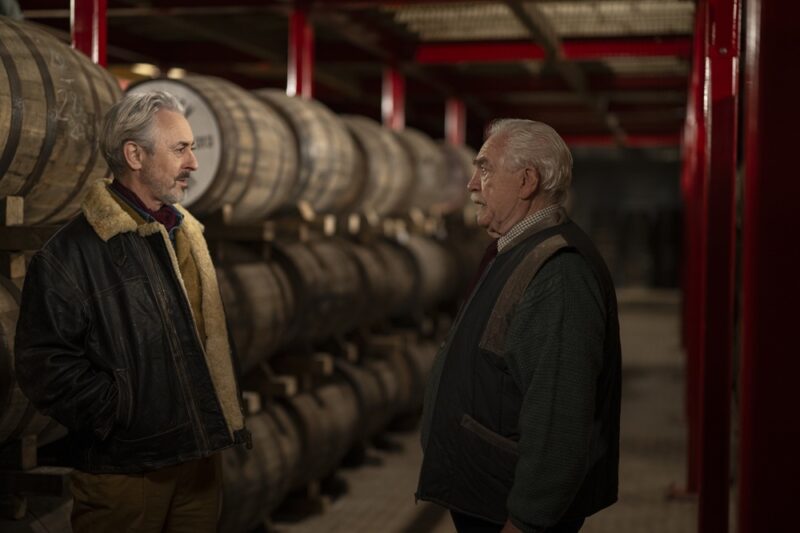
Off the notion of identity, there’s a line in the film, “I’ll live ’til I die,” and it’s almost the film’s thesis in a way. After making this movie, what does that phrase mean to you now?
It means just that, I’ll live until I die.
I recently celebrated my 80th birthday, which was a shock because I’ve always thought of myself as nine years old (laughs). I’ve never really dwelt on my age. I’ve just got on with life. But eventually you realise you’re getting older, whether you like it or not. That’s inevitable.
When that milestone arrived, I found myself reflecting more on where I came from. My hometown is a complicated place. It’s very different from Glasgow or Edinburgh because it was built as a migrant community. The Irish came over to work in the jute mills after losing everything back home. That’s why my family arrived.
In the nineteenth century, the town was known as “She Town” because around 80 percent of the workforce was female. The mills were run largely by women. That’s part of my heritage, and it’s something I’ve always carried with me. It’s a complicated inheritance because I’ve seen both the advantages and the disadvantages that came from it. But those roots shape who you are. As I’ve grown older, I’ve become increasingly aware of how much those histories, those communities and those experiences remain a part of me.
Honestly, Mr. Cox, an absolute honour to chat with you. Congratulations on the film. Making your directorial debut as a nine-year-old…
(Laughs) I’m particularly proud of Alan because he’s a genuinely fine actor. People know him for this wonderful public persona he’s created, and rightly so. He’s become this extraordinary character in the public imagination. Nobody dislikes Alan. But underneath all of that, there’s still a lost boy in him, just as there is in all of us.
If you’ve ever seen Alan’s episode of Who Do You Think You Are?, it’s well worth watching. It’s a fascinating exploration of his family history. He discovers that his grandfather was a deeply troubled and violent man. After the war, he never returned home, ending up in Malaya instead. He lived a reckless life, reportedly playing Russian roulette, and ultimately died as a result of it.
What makes the programme so compelling is seeing Alan confront those truths about his family and where he comes from. That’s why I think he’s so well suited to a story like this. He understands that idea of carrying history with you, whether you want to or not.
I did really love hearing you mention that he could play the role gay if he wanted, and he told you that he was bisexual, so you said, “Play it straight!”
(Laughs) I remember saying to Alan, “If you want to play the character as gay, then we can make that work.” And he said, “No, I’m bisexual.”
I said, “Okay, then you’re playing him straight.” And that’s exactly what he does. Alan is bisexual, and that’s an interesting perspective to bring to a role because it isn’t defined by being aligned exclusively with one sex or the other. It comes from a different place of understanding.
I’m not bisexual myself, but I have enormous empathy for people who are. I’ve always felt it’s important to recognise and respect experiences that may be different from your own.
Glenrothan is now screening in New Zealand theatres, before opening in Australia on June 25th, 2026.
