

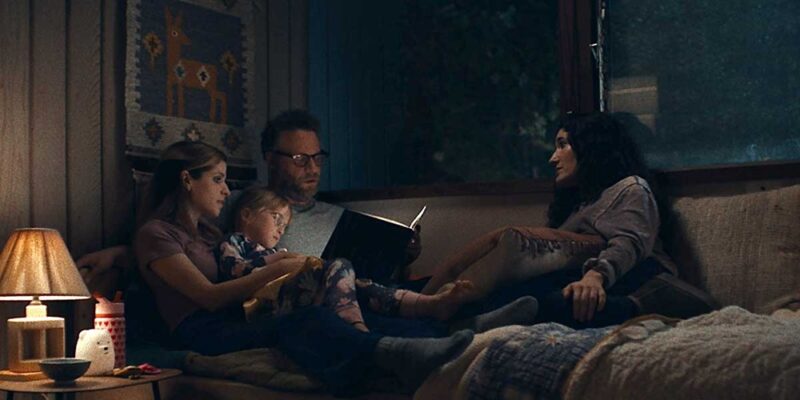
At a certain point in a long-term relationship, “When are you having kids?” seems to stop being considered an intrusive question and instead becomes accepted small talk. Marriage apparently isn’t enough of a milestone. Happiness isn’t enough of an answer. There must be a next step, and for Annie and Aaron, the wonderfully lived-in couple played by Anna Kendrick and Seth Rogen in Babies, everybody seems particularly interested in knowing what theirs will be.
The problem is they don’t know either.
That uncertainty sits at the beautifully complicated heart of writer-director Lauren Miller Rogen’s sophomore feature, a warm, frequently hilarious and surprisingly moving comedy about parenthood that understands choosing not to have children can be just as significant a life decision as choosing to have them. More importantly, Babies doesn’t arrive with its answer already written. It allows Annie and Aaron to wonder, contradict themselves, experience jealousy, relief, fear and curiosity, and occasionally entertain entirely different futures within the same conversation.
They’ve reached that stage where almost everyone around them has crossed into parenthood. Their friends Becky (Issa Rae) and Ethan (Zach Cherry) are expecting their third child, whilst Eliza (Kate Berlant) and Luke (Dan Stevens) already have a young daughter. Annie and Aaron love their friends’ children, but watching everybody else construct their lives around school runs, pregnancies and bedtime routines inevitably raises questions about what they’re potentially missing.
Then again, they can smoke weed in their house. They can have sex in the living room. They can go somewhere without organising childcare. Freedom looks pretty appealing too.
Miller Rogen mines considerable humour from that contradiction without making either lifestyle the punchline. Parents aren’t miserable prisoners secretly jealous of their child-free friends, nor are Annie and Aaron emotionally incomplete adults waiting for a baby to give their existence purpose. Everybody has gained something from the choices they’ve made, and everybody has surrendered something too.
That balance gives Babies an honesty that similar comedies often lack.
The question becomes considerably less theoretical when Eliza announces she is separating from Luke and temporarily moves in with Annie and Aaron, bringing her daughter Eve with her. Suddenly, the couple gets something resembling a trial run at parenthood. They discover the affection, domesticity and unexpected joy of having a child occupying their home, but also the exhaustion and responsibility that accompany it.
And still, no divine revelation arrives.
That may be the film’s most refreshing quality. Annie doesn’t hold a baby and suddenly discover a maternal instinct she never knew existed. Aaron doesn’t spend a day entertaining a child and immediately decide fatherhood is his destiny. They can adore children without necessarily wanting their own, just as moments of imagining themselves as parents don’t automatically invalidate their previous contentment.
Kendrick is particularly well suited to Annie’s constant internal negotiation. Few performers can communicate anxiety and self-consciousness quite so amusingly, and Miller Rogen makes clever use of that quality through Annie’s interior monologues. She can convince everyone around her that she’s perfectly comfortable with her decisions whilst mentally interrogating every possible alternative.
Rogen, meanwhile, gives Aaron an appealing gentleness. His chemistry with Kendrick is crucial because Babies isn’t built around the usual romantic-comedy question of whether these two people should remain together. Their marriage is strong. They like each other. They make each other laugh. The dramatic tension instead comes from two people who love the life they’ve created wondering whether they’re supposed to want another version of it.
That stability is surprisingly radical in itself. Miller Rogen doesn’t manufacture some enormous relationship-destroying argument simply because the screenplay requires a third-act crisis. Annie and Aaron can disagree, become frustrated and question themselves without suddenly behaving as though years of affection have evaporated.
The same generosity extends to the wider friendship group.
Berlant brings her reliably eccentric comic timing to Eliza, but there’s genuine hurt underneath the humour as she navigates the collapse of her marriage. Rae and Cherry similarly add texture to the film’s portrait of adulthood, even if both occasionally feel underserved by a screenplay juggling numerous relationships. Stevens, too, makes an impression despite relatively limited material.
That slightly episodic construction can make Babies feel loose in places. Miller Rogen moves between couples, conversations and domestic crises rather than driving towards some enormous narrative destination, and certain characters disappear just when their stories begin to become particularly interesting.
But that looseness also suits a film about people discovering that adulthood rarely resembles the clean timeline they were promised.
Its most quietly affecting subplot involves Annie’s parents. Her mother is living with Alzheimer’s, whilst her father, played with beautiful restraint by David Strathairn, is simultaneously caring for the woman he loves and confronting what his own life might look like beyond that responsibility. Annie encourages him to continue living, dating and seeking happiness, advice that inevitably reflects back on her own difficulty in granting herself permission to construct a life outside convention.
It also expands the film’s definition of caregiving. Parenthood is only one way to devote yourself to another person. Annie cares for her parents. She supports Eliza. She helps raise Eve during a turbulent period. Friends become part of each other’s families, stepping into roles that aren’t recognised by traditional labels but can prove every bit as essential.
This is where Babies develops into something considerably richer than its title initially suggests.
Miller Rogen isn’t arguing against parenthood. In fact, some of the film’s most affectionate moments involve parents and their children. What she questions is the cultural assumption that marriage and biological parenthood represent the ultimate evolution of adult intimacy, as though every other relationship is somehow waiting in a lower division.
Why can’t friendship be treated with the same reverence? Why can’t a couple decide their family is already complete? Why does being wonderful with children automatically mean someone should produce their own?
Babies asks these questions without turning itself into a manifesto.
That restraint is mostly to its benefit, though occasionally the film brushes against larger ideas about communal parenting and the social structures surrounding families without exploring them as deeply as it might. Certain conflicts are tidily resolved, and its episodic nature means not every member of the excellent ensemble receives equal attention.
But Miller Rogen is far more interested in emotional truth than ideological argument, and the conversations have the appealing quality of subjects that have clearly been debated around actual dinner tables. People change their minds mid-sentence. They envy lives they don’t necessarily want. They can simultaneously love what they have and wonder about what they don’t.
Kendrick and Rogen make those contradictions feel completely natural.
And, crucially, Babies is funny. Its humour comes less from elaborate set-pieces than recognisable behaviour: exhausted parents, awkward conversations, inappropriate observations and the gulf between how adults imagine they’ll handle life’s major decisions and how spectacularly unprepared they remain when those decisions actually arrive.
By its closing moments, the question of whether Annie and Aaron will have children almost feels secondary. Babies has gradually become less concerned with reproduction than with permission – permission to construct adulthood according to your own needs rather than somebody else’s expectations. Some people will have children. Some won’t. Some will desperately want them. Others will remain uncertain for years. None of those paths automatically determines whether a life will be meaningful.
Warm, witty and refreshingly non-judgmental, Babies understands that family isn’t defined exclusively by who we create, but by who we choose to care for and who continues showing up for us.
Perhaps instead of asking people when they’re having kids, we could simply ask whether they’re happy.


FOUR STARS (OUT OF FIVE)
Babies is screening as part of this year’s Toronto International Film Festival, running between September 10th and 20th, 2026. For more information, head to the official site here.
