

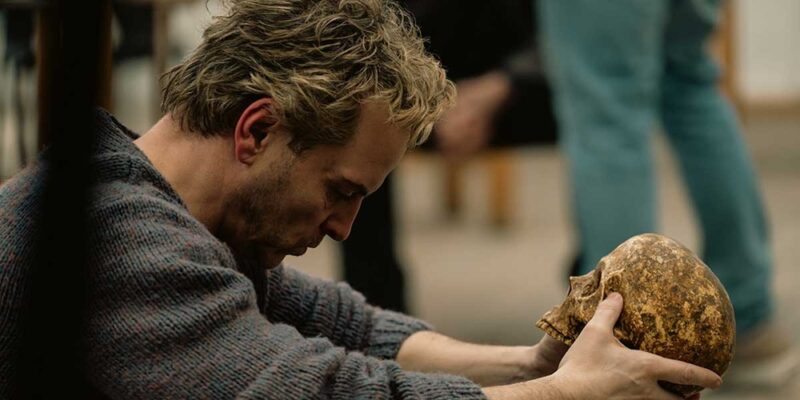
There’s an agonising distinction between wanting to live and wanting to have lived. Elsinore, Simon Stone’s deeply affecting account of the final chapter in Scottish actor Ian Charleson’s life, understands that difference intimately. Faced with a body increasingly betraying him, Charleson isn’t simply fighting for more time. He wants the time he has left to amount to something. And when the role of Hamlet unexpectedly comes his way, he sees an opportunity not to postpone death, but to leave something behind before it arrives.
It’s 1989, and Charleson (Andrew Scott) is still best remembered for Chariots of Fire, the 1981 Oscar-winning drama whose Vangelis theme seems to have enjoyed a more enduring cultural afterlife than the actors running along the beach. His subsequent appearance in Gandhi suggested a career of considerable promise, but almost a decade later Charleson is frustrated by where that promise has led him. He’s working, but not soaring. He’s openly gay among those closest to him, but cautious about what that openness might mean professionally. And, unbeknownst to almost everyone around him, he is living with HIV.
Then Daniel Day-Lewis walks off the National Theatre’s production of Hamlet.
Director Richard Eyre (Johnny Flynn) needs another Prince of Denmark, and Charleson is offered the chance to step into arguably the most coveted role in British theatre. There is just one problem: his HIV has progressed to AIDS. His health is deteriorating, and what begins with symptoms that can still be disguised gradually becomes impossible to ignore.
For Charleson, however, Hamlet is not merely another job. It’s Everest.
That distinction is crucial to Stephen Beresford’s screenplay. Elsinore could easily have framed Charleson’s determination as a straightforward inspirational narrative about a dying man heroically overcoming illness, but the film is more interesting when it allows that determination to become complicated. The people treating him want to preserve his life. The people who love him want more time with him. Charleson wants those things too, naturally, but he also wants to do something extraordinary while he still can. If conserving his remaining strength means spending those extra months doing nothing that makes him feel truly alive, what exactly is being preserved?
Scott understands every contradiction contained within that question. The actor has already demonstrated an almost frightening ability to externalise private grief, particularly in All of Us Strangers, but Charleson requires something different from him. This isn’t a man defined by sadness. He’s funny, vain, flirtatious, stubborn, occasionally infuriating and capable of commanding a room even when his body is beginning to fail him. Scott gives him a social electricity that makes his eventual physical deterioration all the more painful. Before the illness visibly takes hold, we understand why people are drawn to him.
That humour is especially important. Elsinore is dealing with death almost from its opening moments, yet it never allows Charleson or the queer men surrounding him to exist solely as victims awaiting tragedy. They flirt. They bitch. They dance. They make jokes about symptoms that terrify them. There’s an ease in the shorthand between these men that contrasts with the discomfort of the outside world, where even medical professionals can make their fear of AIDS painfully apparent.
Stone also understands the horror of watching your own body for evidence. One of the film’s most quietly devastating recurring ideas is Charleson inspecting himself for signs that the disease is progressing. When a lesion eventually appears on his face, it isn’t merely another symptom. It threatens the carefully maintained boundary between the illness Charleson knows he has and the illness everyone else can now potentially see.
That question of visibility runs throughout Elsinore. Charleson is gay but wary of allowing that identity to define his public persona. His former collaborator Derek Jarman (David Dawson) challenges him over that caution, believing Charleson has a responsibility to be more publicly honest about both his sexuality and, eventually, his diagnosis. The film wisely resists turning their disagreement into a simple question of courage versus cowardice. Jarman understands the political necessity of visibility during a crisis being met with ignorance and institutional indifference; Charleson understands that visibility can demand an intensely personal price.
There’s something particularly cruel about asking a dying person to turn their death into activism.
Charleson ultimately became the first major British celebrity to have his death from AIDS publicly announced, but Elsinore is interested in the human being before the historical significance. It asks what it meant to carry that knowledge while continuing to audition, rehearse, drink, laugh and walk into rooms where almost nobody knew what was happening inside his body.
His relationship with Dr Margaret Johnson (Olivia Colman) gives that conflict its sharpest expression. Colman is characteristically excellent, bringing humour and brusque compassion to a woman whose job is to keep Charleson alive even when her patient seems determined to negotiate for something more specific: just keep me alive long enough to do this. Their scenes become an ongoing argument between quantity and quality, medicine and ambition. Neither position is treated as entirely wrong.
Billie Piper provides another emotional anchor as Patsy Pollock, Charleson’s casting-director friend, while Peter Mullan and Georgia Glen make enormous impressions with relatively limited screen time as his parents. The supporting ensemble is stacked with familiar British talent, but Stone never lets the film become a parade of cameos. Instead, these characters gradually create the sense of a life extending far beyond the man at its centre.
And that becomes particularly important because Elsinore is inevitably telling two stories simultaneously: Charleson’s and that of a generation.
There was a time when AIDS narratives became so closely associated with queer cinema that the genre understandably pushed outward, demanding stories in which LGBTQ+ characters were allowed romance, stupidity, adventure, joy and happy endings. But distance can create its own distortion. The AIDS crisis wasn’t simply a tragic backdrop against which queer stories were once routinely told. It was an annihilation of lives, relationships, communities and creative futures, compounded by prejudice, fear and political neglect.
Elsinore never needs to turn Charleson into a representative for every gay man who died during that period. In fact, its power comes from doing the opposite. It makes him specific. He wants Hamlet. He wants the audience. He wants the applause. He wants Thursday night. He wants another drink, another joke, another rehearsal and another chance to prove that Chariots of Fire wasn’t the defining achievement of his career.
There are moments when Stone and Beresford push those emotions rather forcefully. The score occasionally tells us exactly when our throats should tighten, and certain montages lean into the conventions of the prestige biopic rather than resisting them. Elsinore is not especially interested in withholding sentiment, and viewers allergic to overt emotionality may find some of its choices overly calculated.
But Scott makes calculation almost irrelevant.
His extraordinary achievement is that we stop watching the machinery of an awards-season performance and simply watch a man trying to remain himself while pieces of that self are being taken away. As Charleson grows weaker, Scott doesn’t abandon the charisma established earlier; he lets it flicker. A joke takes more effort. Movement becomes considered. Defiance starts requiring energy that Charleson increasingly cannot afford. The body slows while the appetite for life remains maddeningly intact.
And then there is Hamlet.
The obvious parallel between actor and character could have been unbearable in less assured hands: a dying actor playing Shakespeare’s most famous meditation on mortality while confronting his own approaching death. Yet Scott’s performance within the performance gives Elsinore another dimension. Charleson isn’t simply using Hamlet to express what he feels; the role becomes somewhere he can put everything he cannot otherwise control. Scott has the unenviable task of playing an actor who disappears into another character while we remain acutely aware of the body underneath the costume, and he makes those layers feel seamless.
It also explains why Charleson refuses to let the role go.
The tragedy isn’t simply that he is dying. It’s that, just as death is approaching, he finally gets the opportunity that makes him feel most alive.
Stone never pretends that determination can conquer biology. There is no miracle waiting in the wings, and no inspirational platitude capable of changing what happened to Charleson, who died in January 1990 at just 40 years old. What Elsinore offers instead is remembrance. Not the polished remembrance of an actor frozen permanently in his most famous film, but something messier and more valuable: a portrait of someone funny, difficult, frightened, ambitious and desperately unwilling to let his final chapter be written entirely by his illness.
That is what makes Scott’s performance so wrenching. He doesn’t play Charleson as a man learning how to die. He plays him as someone stubbornly trying to decide how he wants to live. And for a few extraordinary nights on the National Theatre stage, Ian Charleson got to decide for himself.


FOUR STARS (OUT OF FIVE)
Elsinore is screening as part of this year’s Toronto International Film Festival, running between September 10th and 20th, 2026. For more information, head to the official site here.
