

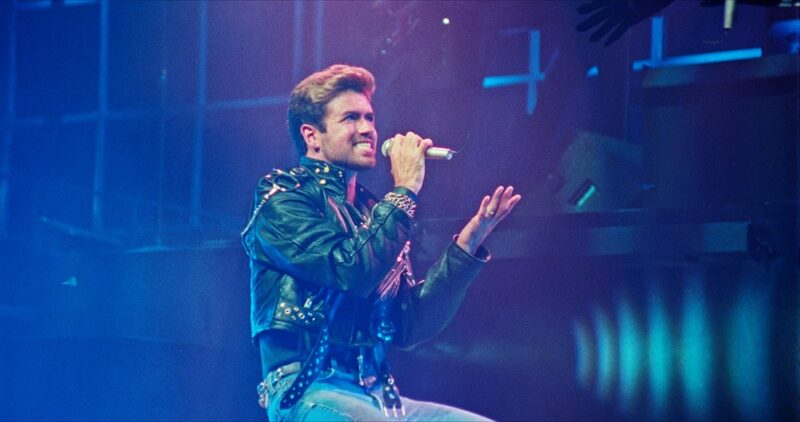
Long before concert films became lavish, meticulously choreographed cinematic spectacles, George Michael needed little more than a microphone, a leather jacket and an audience willing to surrender to his considerable charisma. In George Michael: The Faith Tour, the long-unseen footage of the singer’s electrifying 1988 performances in Paris has been lovingly restored for the big screen, capturing an artist at the extraordinary intersection of commercial superstardom, creative independence and personal discovery. It’s a fascinating time capsule of a performer who seemingly had the world at his feet, even as he was still coming to understand the man beneath the image.
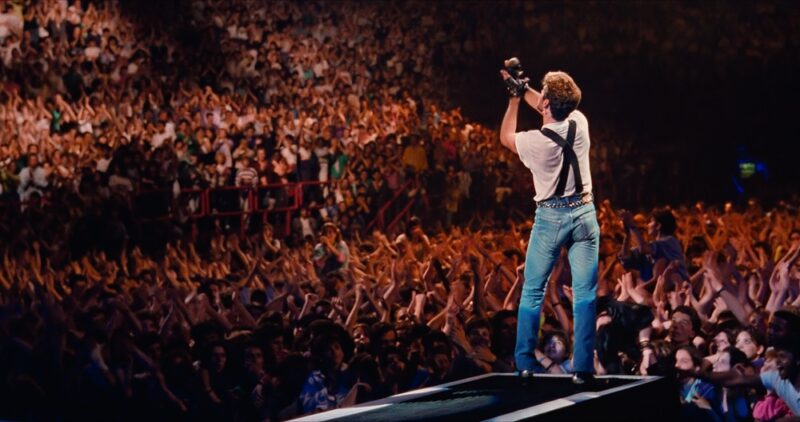
Filmed across two nights at Paris’ Palais Omnisports de Paris-Bercy on May 30 and 31, 1988, the concert captures Michael during his first solo headlining tour, following the phenomenal success of his debut album, Faith. Shot on 35mm film using 14 cameras, the footage has a nostalgic intimacy that feels almost quaint when compared to the elaborate production values of contemporary concert films such as Taylor Swift’s The Eras Tour, for example. The staging is relatively modest, the band largely remains in the background, and the spectacle is driven less by elaborate theatricality than by the sheer magnetism of the man at its centre. But that simplicity proves to be one of the film’s greatest strengths. Michael doesn’t need an army of dancers or an endless parade of costume changes to command attention. He simply needs to sing.
And sing he does. Whether delivering the provocative swagger of “I Want Your Sex”, the infectious energy of “I’m Your Man” or the aching vulnerability of “One More Try”, Michael is a captivating presence, his remarkably assured vocals effortlessly moving between sensuality and emotional exposure. He bounds across the stage, indulges in playful gyrations and commands the audience with the confidence of someone who understands precisely how to hold a crowd in the palm of his hand. He may not have been a dancer in the traditional sense, but his physicality is undeniably part of the performance, every movement reinforcing the carefully cultivated image that helped define an era.
That image, of course, is inseparable from the Faith phenomenon itself. The leather jacket, designer stubble, dark sunglasses, jeans and guitar became an instantly recognisable shorthand for a particular kind of late-1980s masculinity. It was rugged, rebellious and overtly sexual, but watching Michael perform with the benefit of hindsight reveals something considerably more complicated beneath the surface. His confidence is frequently accompanied by tenderness, his swagger by an almost disarming vulnerability. The image may have been meticulously constructed, but the emotions running through the music feel anything but artificial.
It’s this fascinating contradiction that emerged when our Peter Gray spoke with Andy Morahan, who co-directed the concert film alongside Michael’s longtime collaborator David Austin, and Mary McCartney, whose accompanying short film, Finding Faith, offers a more intimate portrait of the singer.
Reflecting on the visual language of masculinity that defined the Faith era, Gray asked Morahan how consciously he and Michael had played with the contrast between the traditionally masculine imagery of leather jackets, stubble and guitars, and the extraordinary sensuality and vulnerability of Michael’s performances.
For Morahan, the transformation was less a sudden reinvention than the culmination of an artistic evolution already underway during Michael’s final years with Wham!
“It wasn’t something that just was a bolt out of the blue,” Morahan explained, pointing to the visual changes evident in songs such as “I’m Your Man” and Michael’s duet with Aretha Franklin. “He’s already kind of changing into the leather jacket, shorter hair, dark hair, the beard, all that kind of stuff. So by the time it got to Faith, the actual video for ‘Faith’, it culminated in that. That was the perfect song for that iconic look.”
What makes those observations particularly compelling is the way Michael’s public image can now be viewed through the lens of his sexuality and the expectations placed upon male pop stars at the time. Although the Faith aesthetic appeared to embrace conventional masculinity, there were subtler flourishes suggesting an artist experimenting with how much of himself he could reveal.
“I don’t think we were particularly aware of it being gender fluid or whatever,” Morahan admitted. “I think George added things that were little hints for him as to where his head and his sexuality were going, the pearls on the jacket and stuff like that. He was quite playful with what he was doing.”
It’s a revealing distinction. Rather than interpreting Michael’s image as an elaborate disguise, Morahan’s recollections suggest something more fluid and instinctive: a young man exploring different expressions of masculinity while simultaneously navigating his own identity. The visual confidence of Faith wasn’t necessarily evidence of someone who had everything figured out, but perhaps someone discovering what felt authentic through the very act of performing.
“Underneath, he was a deep thinker,” Morahan continued, praising McCartney’s contribution to the theatrical presentation. “I think the film that Mary’s done at the beginning shows you what a deep thinker he was. But I think he was just discovering himself.”
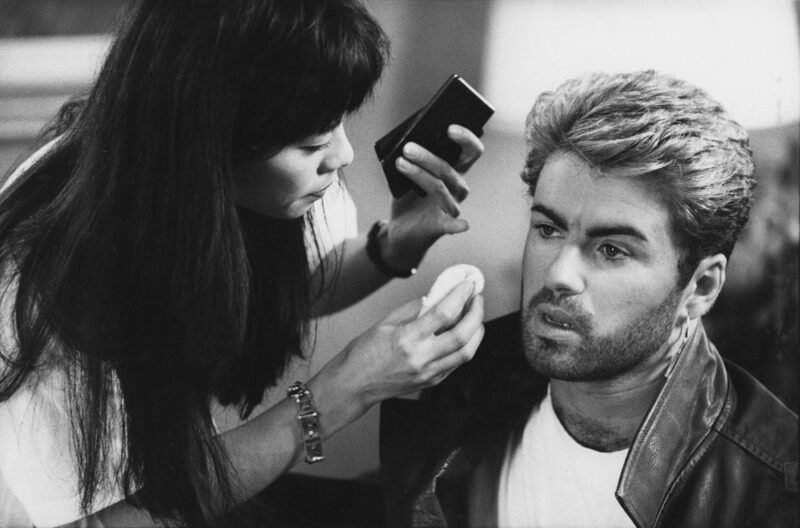
That sense of self-discovery becomes an essential emotional thread connecting the two films. McCartney’s Finding Faith, which precedes the concert footage, incorporates previously unseen photographs by celebrated photographer Herb Ritts, behind-the-scenes material from the “Faith” music video and an unheard interview with Michael recorded around 1989 and 1990. Together, these elements provide a more reflective perspective on the artist audiences are about to witness in full flight, offering a glimpse of the intelligence and introspection behind one of popular music’s most recognisable faces.
For Austin, however, the honesty of Michael’s artistry was never something that needed to be uncovered retrospectively. It had always been present in the music itself.
“George’s material has always been completely honest,” Austin explained. “If you’re looking back now, people say, ‘Oh well, yeah, of course, obviously.’ But he’s always been completely honest with his writing. His writing has been completely honest. It’s about him. It’s about who he was. It’s about his life. Who he’s interacting with. So there’s a real honesty in his material as well.”
It’s an observation that lends additional poignancy to the concert footage. Songs that might once have been consumed primarily as irresistible pop anthems now carry the weight of everything audiences have subsequently come to understand about Michael’s life. The yearning of “Father Figure”, the emotional devastation of “One More Try” and the provocative liberation of “I Want Your Sex” all speak to different aspects of an artist whose music was frequently more revealing than the public perhaps realised.
And yet, for all the temptation to examine the performances through a contemporary lens, George Michael: The Faith Tour is equally effective when simply allowed to exist as a celebration of an extraordinary entertainer at the height of his powers.
The restoration preserves the distinctive texture of its late-1980s origins, with the comparatively restrained staging allowing Michael’s vocals and stage presence to remain the principal attractions. Rather than attempting to modernise the experience, the film embraces the aesthetics of its era, creating an affectionate snapshot of a moment when Michael was transitioning from the youthful exuberance of Wham! into a more sophisticated and self-directed solo artist.
For McCartney, the experience of watching the footage also revealed connections to performers from an earlier generation, particularly in Michael’s physicality and effortless ability to command a stage.
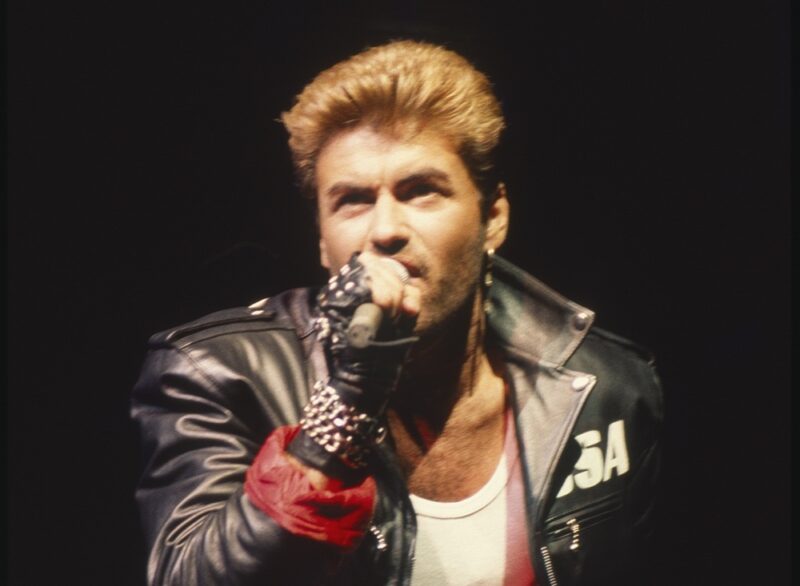
“I felt I saw little hints of Elvis, like the way he was, and some of the moves,” she observed. “So it sort of went almost from the ’50s up until present day. It’s pretty timeless, and it’s pure joy.”
Her comparison is an apt one. Like Elvis Presley before him, Michael understood the power of suggestion, the relationship between music and movement, and the ability to communicate sensuality through the smallest physical gesture. But where Elvis helped establish a particular visual vocabulary for the male pop idol, Michael’s performance feels like an evolution of that tradition, combining the familiar iconography of masculine confidence with a sensitivity that made his artistry distinctly his own.
McCartney also believes that audiences experiencing the concert in cinemas will struggle to remain passive observers.
“I don’t think anyone watching it in the cinemas is going to be staying in their seat very long,” she laughed.
And she’s probably right. With a set list that moves through defining hits including “Everything She Wants”, “Careless Whisper”, “Monkey” and “Faith”, the film is as much an invitation to celebrate Michael’s remarkable musical legacy as it is an opportunity to reconsider the cultural significance of his image.
Perhaps the most affecting quality of George Michael: The Faith Tour, though, is the knowledge that the performer on screen had so much of his personal and artistic journey still ahead of him. Here was a young man who had already achieved extraordinary fame, whose voice could fill an arena and whose image had become a defining symbol of his generation, yet who was still negotiating the complicated relationship between public expectation and private identity.
Watching him now, nearly four decades after those Paris performances, there’s something profoundly moving about seeing an artist who could project such effortless confidence while still discovering himself. The leather jacket, the stubble and the guitar may have helped create the icon, but it was the vulnerability, intelligence and emotional honesty beneath them that made George Michael endure.
And while the scale of concert filmmaking has changed immeasurably since 1988, this beautifully preserved performance offers a welcome reminder that spectacle and intimacy needn’t be mutually exclusive. Sometimes the most extraordinary thing on a stage is simply the person standing upon it.
George Michael: The Faith Tour is screening in Australian theatres from November 12th, 2026.
