

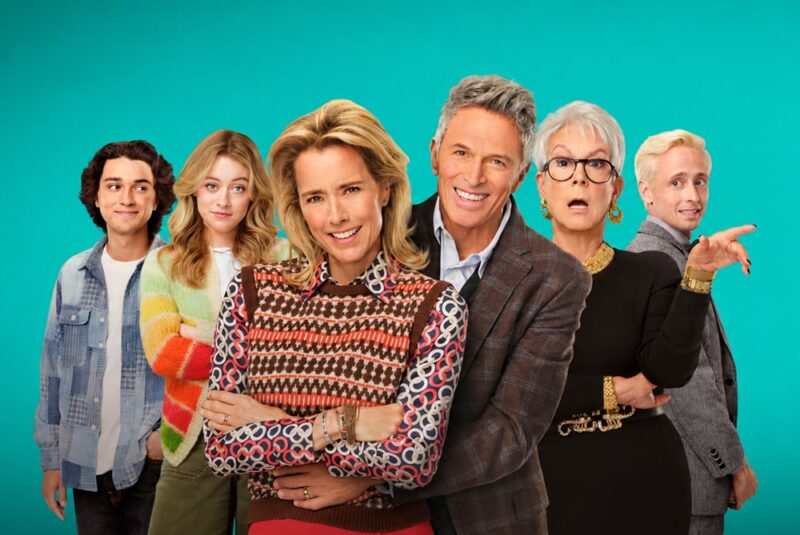
Television has become awfully serious about being taken seriously. Prestige dramas arrive with cinematic ambitions, comedies increasingly disguise themselves as emotionally bruising character studies, and the once-reliable pleasure of spending half an hour with a group of funny people in a familiar setting has become something of an endangered experience. Somewhere along the way, the multi-camera sitcom, with its theatrical rhythms, unapologetic punchlines and the comforting sound of an audience laughing along, fell out of fashion. Not necessarily because audiences stopped wanting to laugh, but because television began treating the very mechanics of making us laugh as something faintly embarrassing. Which is why NBC’s Newlyweds, starring the gloriously underappreciated Téa Leoni, feels like such a welcome proposition. It’s a reminder that comedy doesn’t always need to reinvent itself to justify its existence. Sometimes, the simple pleasure of watching gifted performers bounce off one another is more than enough.
Co-created by Gail Lerner and Jamie Lee Curtis, Newlyweds centres on Jeanie (Leoni), a free-spirited woman who impulsively marries a considerably more buttoned-up professor (real-life husband Tim Daly) following a whirlwind romance. It’s the sort of premise that might once have comfortably anchored a network sitcom for six seasons, its comedic potential resting not on an elaborate concept but on the timeless collision of two fundamentally different personalities attempting to build a life together. And there’s something particularly appealing about a romantic comedy that places people with a little more life behind them at its centre. Television has never been especially generous when it comes to depicting love, desire and romantic reinvention beyond a certain age, particularly for women. The idea that falling foolishly, passionately and perhaps irresponsibly in love isn’t exclusively the domain of twenty-somethings feels refreshing in itself. That Newlyweds chooses to explore this through the familiar language of a traditional sitcom makes the prospect all the more appealing.
Of course, the real attraction is Leoni, whose return to multi-camera comedy feels both overdue and entirely appropriate. Long before she became synonymous with the political gravitas of Madam Secretary, Leoni demonstrated a remarkable aptitude for physical comedy, impeccable timing and the particular kind of controlled chaos that distinguishes a genuinely great sitcom performer. Her three-season run as Nora Wilde in The Naked Truth, which premiered in 1995, remains one of the more underappreciated comedic performances of its era. As a photographer navigating the absurdities of tabloid journalism, Leoni displayed a willingness to look ridiculous, surrender her dignity and commit completely to whatever increasingly preposterous situation the writers placed her in. She could be sophisticated one moment and spectacularly unhinged the next, often without needing to say very much at all. It was the sort of performance that invited comparisons to Lucille Ball, not because Leoni was imitating her, but because she understood something fundamental about comedy: that elegance and embarrassment can be remarkably effective companions.
And perhaps that’s what makes Leoni such an interesting performer. She has always possessed an effortless glamour, the sort of screen presence that might ordinarily encourage an actor to protect their image. Yet her greatest comedic strength has often been her complete lack of vanity. Like Ball before her, Leoni understands that a beautiful woman making an absolute fool of herself can be infinitely more entertaining than one determined to remain composed. Her expressions can turn an otherwise ordinary exchange into a perfectly timed punchline, while her ability to move between deadpan disbelief and full-bodied exasperation gives her comedy a wonderfully unpredictable quality. She doesn’t simply deliver jokes; she reacts to the absurdity around her, often making the moments between the dialogue just as funny as the dialogue itself. It’s a skill that feels especially suited to multi-camera television, where the performer, rather than the editing, is frequently responsible for generating the rhythm of a scene.
That distinction is worth remembering at a time when the traditional sitcom has become something of a television punchline in its own right. Multi-camera comedy is often dismissed as old-fashioned, its brightly lit sets, heightened performances and studio laughter treated as evidence of an art form that hasn’t kept pace with contemporary storytelling. Yet some of television’s most enduring comedies, from I Love Lucy and The Mary Tyler Moore Show to Cheers, Friends, Seinfeld and Will & Grace, thrived precisely because they embraced those conventions. Their brilliance wasn’t dependent on cinematic sophistication, but on character, chemistry and writing that understood the musicality of a perfectly constructed joke. At their best, these shows possessed an energy closer to live theatre than traditional television, with performers responding to one another and allowing an audience’s reaction to become part of the experience. The laughter wasn’t an intrusion. It was a reminder that comedy can be communal.
That’s not to suggest that single-camera comedy hasn’t produced extraordinary work, or that the evolution of television has somehow diminished the medium. Far from it. But the industry’s enthusiasm for more naturalistic, visually ambitious storytelling has occasionally created the impression that comedy needs to be understated, self-conscious or tinged with melancholy to be considered sophisticated. The traditional sitcom, meanwhile, is too often regarded as a relic, something to be tolerated rather than celebrated. Yet making people laugh consistently, in front of an audience, with relatively little opportunity to disguise an unsuccessful joke through clever editing, is an extraordinarily demanding discipline. It requires precision, generosity and a willingness to embrace the artificiality of the form. When it works, there’s an almost effortless pleasure to it that no amount of cinematic polish can replicate.
And the multi-camera sitcom has another quality that feels increasingly valuable: familiarity. The great examples weren’t simply collections of jokes delivered in recognisable rooms. They became places audiences wanted to return to, populated by characters whose flaws, eccentricities and relationships grew more entertaining through repetition. We knew where everyone would sit, who would interrupt whom and which personality clash was likely to derail an otherwise ordinary evening. That predictability wasn’t a creative limitation. It was the foundation upon which the comedy could become more elaborate, more personal and, occasionally, unexpectedly moving. At a time when so much television demands intense concentration, sprawling mythology or an emotional investment bordering on homework, the prospect of a comedy that simply invites us to enjoy ourselves feels almost radical.
Leoni’s return also offers a timely reminder of how readily television can place talented actresses into increasingly narrow categories as their careers progress. Her work on Madam Secretary demonstrated an entirely different side of her abilities, allowing her to anchor a long-running drama with intelligence, authority and emotional credibility. More recently, her appearance in Only Murders in the Building offered another glimpse of her versatility. But those performances never erased the comedic instincts that helped establish her career. If anything, the intervening years have given her an even richer collection of experiences to draw upon. The prospect of watching Leoni apply her particular blend of sophistication, mischief and beautifully calibrated exasperation to a woman navigating the absurdities of later-in-life marriage is an enormously appealing one.
It’s also encouraging to see a series built around the idea that a woman of Jeanie’s age can still be impulsive, romantic, difficult, ridiculous and entirely capable of making questionable decisions. Too often, characters who have reached a certain stage of adulthood are expected to possess the wisdom and emotional stability that younger characters are allowed to spend entire seasons avoiding. But maturity doesn’t necessarily eliminate foolishness, nor should it. If anything, the contrast between accumulated life experience and the reckless optimism of a whirlwind marriage offers fertile ground for comedy. Love doesn’t suddenly become sensible because we’ve grown older, and the possibility of making a spectacular mess of our lives remains one of the more enduringly human experiences.
Naturally, the success of Newlyweds will depend on more than nostalgia for a television format or affection for its leading lady. A strong premise can only carry a comedy so far, and the real test will be whether its writing, supporting ensemble and central relationship can sustain the kind of character-driven humour that makes a sitcom worth revisiting week after week. But the combination of a premise that embraces romantic possibility beyond youth and Leoni returning to a form in which she once excelled is reason enough to be optimistic.
Perhaps the most encouraging thing about Newlyweds is that it doesn’t need to represent some grand reinvention of television comedy. Its very existence is a welcome reminder that the multi-camera sitcom still has something to offer, particularly when entrusted to performers who understand its rhythms and possibilities. And if the series can introduce a new generation to the considerable comedic gifts of Leoni while reminding longtime admirers of just how wonderfully funny she can be, that alone feels worth celebrating.
Because for all the changes television has undergone, one thing remains reassuringly simple: watching someone with impeccable comic timing make a glorious fool of themselves will never go out of style. And if anyone deserves another opportunity to remind us of that, it’s Téa Leoni.
Newlyweds screens weekly on NBC in the United States on Fridays, before streaming on Peacock the next day. It’s available to stream on HBO Max in Australia.
