

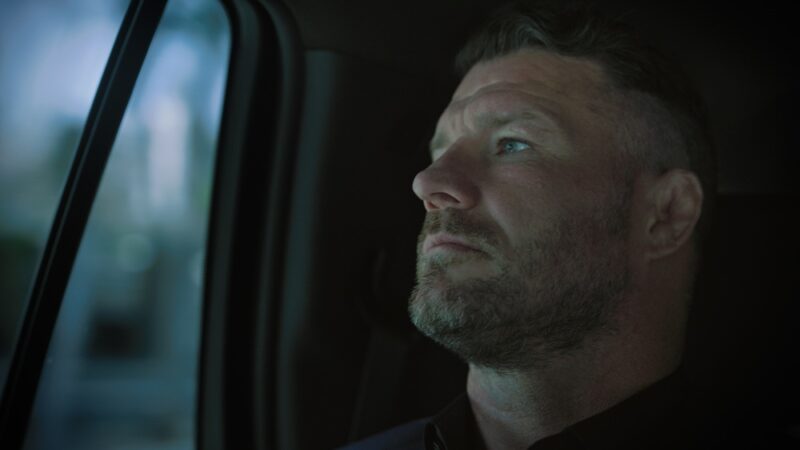
Michael Bisping knows a thing or two about taking a hit. But carrying an action film on his shoulders? That presented the former UFC champion with an entirely different kind of pressure.
In Atlas King, Bisping steps into the title role as a former fighter drawn back into a world he thought he had escaped. Returning home following the death of his mentor, Atlas discovers that ruthless crime boss Clay Emerson (Cuba Gooding Jr.) has tightened his grip on the city’s fight game, whilst those Atlas left behind are in danger of repeating the very mistakes that forced him to flee. What follows blends bruising in-ring action, a high-stakes heist and an old-school crime thriller sensibility, with Bisping particularly determined that its fights retain the grit and authenticity of the real thing.
There are obvious parallels between Bisping and the character he plays, something the actor readily acknowledges, but Atlas King also affords him the opportunity to push beyond the persona audiences may associate with the UFC Hall of Famer. The typically fast-talking, self-deprecating Bisping found himself embracing Atlas’s considerably more stoic nature, whilst the emotional weight of the character even proved difficult to contain during one particularly charged scene opposite Sarah Wayne Callies.
It’s also a project that Bisping almost didn’t get to lead. After outside involvement threatened to reshape the film – including replacing him in the central role – Bisping, writer-director Nika Agiashvili and their collaborators ultimately took matters into their own hands, forming a production company and independently securing the financing needed to make the film on their terms.
Speaking with our Peter Gray, Bisping discussed separating himself from Atlas, bringing genuine MMA brutality to the film’s fight sequences, the unexpected vulnerability he discovered in the character, and why performing opposite an Oscar winner created a pressure unlike anything he experienced inside the Octagon.
On paper, Atlas King sounds deceptively simple: you’ve got a former champion playing a former champion. But acting isn’t impersonating yourself. What did you have to find in Atlas that wasn’t Michael in order for him to become a character rather than an extension of yourself?
Yeah, that’s a great question. The reality is there are a lot of parallels and similarities between us. Atlas King is a former fighter; obviously, I’m a former fighter. He was involved with the mob in LA, gets shot, leaves town to save his life and goes back to England. Sadly, early in my MMA career, I was involved with some unsavoury characters, so I had experience with that.
Atlas goes back to LA to bury his mentor and finds out that his son is involved with the same people Atlas had trouble with. He can’t just go back to England and leave his family to fall into the same traps that he did, so he’s got to stick around and save the day.
But that’s where the parallels end, because what happens in the movie is very different from my life. In terms of the character’s motivation, though, I feel like this script was written for me. I could certainly put myself in his mindset and draw on a lot of those parallels.
Sometimes familiarity can make a role more difficult, though. You know exactly how a fighter walks into a room, carries himself and reacts to danger. Did you ever have to stop yourself from relying on instinct and ask, “What would Atlas do?”
That’s interesting. Anyone who knows me knows I typically speak a million miles an hour. I’m very silly. I’m not very serious most of the time, which is the exact opposite of Atlas King. He’s cool, calm and collected. He speaks slowly and, hopefully, coolly, whereas I talk like a moron most of the time when I’m doing a podcast or chilling with my mates having a beer. So there are definitely a lot of differences in that regard.
And, of course, this is a Hollywood movie and a heist movie as well. That really drew me to the script. It wasn’t just a corny, cheesy MMA movie. It’s a heist movie and a redemption story. I think when people see me involved, they’re probably going to think, “Oh yeah, this is going to be a cheesy MMA film.” But I think they’re going to be quite surprised when they see it.
There’s something fascinating about fighters becoming actors. You’ve spent years learning not to telegraph what you’re going to do, whereas an actor has to let an audience see thought and emotion moving through them. Was there anything you had to unlearn from fighting to become a better actor?
On the physical side, it’s funny because every time I show up on set, the choreographers are always like, “Right, okay, listen, Michael, you do know you’re not trying to hurt them here?” I’m like, “Yes, guys, for crying out loud. I’m well aware I’m not in a fight here.” So there’s always that hurdle to get over with the stunt team initially.
But when it comes to the fight scenes, I wanted them to look real. I wanted them to be gritty. Some of the MMA community will be watching this film, and I want them to know that the fight scenes are realistic.
There aren’t too many fight scenes in the film, but the ones that are there, we wanted them to be gritty, violent and realistic. We’re not flying through the air doing crazy cartwheel kicks and shit like that, because people don’t do that in real life. So I was able to put my own spin on those things and make it gritty.
It’s funny you mention that, because part of me was expecting fight scene after fight scene, and then I realised, “Oh, there’s actually a story here.”
Who would’ve thought it? (laughs)
Atlas has been away from this world, and coming home means confronting a version of himself he thought he’d left behind. When you’re playing someone carrying that much history, how much of the performance is about what you don’t show? Did you think about what Atlas refuses to let the people around him see?
Yeah, because he comes back and sees that he’s left loved ones to basically fall into the same traps that he did, so he feels a lot of guilt.
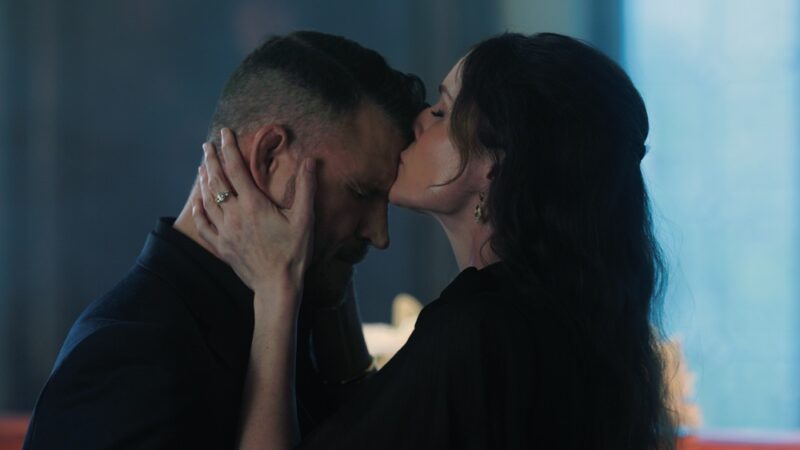
There’s a scene where he’s standing in front of the coffin of his best friend who’s died, and the family is all around him. When I was doing it, I got quite emotional. I cried a little bit, and the director was like, “No, we can’t have that. This is one of the opening scenes. We can’t have the hero a bloody emotional wreck. You’ve got to hold it together a little bit. We want some emotion, but you can’t start blubbering and crying too much.”
I wasn’t bawling my eyes out! But it was like, “You’ve got to be a bit more stoic, Michael. You’ve got to hold it together.”
It’s a heavy situation that he comes back and finds himself in, and that’s a reflection of the whole movie and how much I threw myself into the role. I truly became Atlas King for a couple of months. My wife was very glad when filming was over.
I feel like we’re at the point where we can let our action heroes shed a tear. It’s nice to make them relatable.
Yeah! I’m burying him, for crying out loud! But it was, “Hold it, hold it, hold it there. That’s it. Don’t go too far.” And that was because of Sarah Wayne Callies. She’s such a good actress. The emotion that she evoked from me with her acting was unbelievable. So I’m blaming her for that, because she’s a powerful actress.
You’ve been acting for a while now, but there’s a difference between being brought into a project for your presence and being asked to carry a movie called Atlas King. Did this feel like a moment where you had something to prove to yourself as an actor?
I don’t know about proving something to myself. There’s always doubt. There are always questions. If you’re in this world, you think about having the opportunity to lead a film one day, and obviously there’s a little doubt there: “Can I do this? Can I pull this off?”
But given the script, the character, the assistance and all the research, and sitting down with Nika (Agiashvili, writer/director), the director, and going through it at length, that put me very much at home. I never really had those moments, to be honest. I felt like I was born to play this role.
You mentioned Sarah, and then there’s Cuba Gooding Jr. You’ve said you felt nervous performing scenes with him, which is fascinating given you’ve fought in arenas in front of thousands of people. What was it about sitting opposite another actor with pages of dialogue that created a different kind of pressure?
More importantly, I wanted to deliver. Cuba Gooding Jr., obviously, we know his credentials. It was his first day on set, and we’re doing two or three pages of dialogue. That’s his introduction to the production.
I felt so much pressure to deliver opposite an Oscar winner because if I’m weak, he’s going to think, “Wow, what have I signed on to? This is a load of garbage.” And it wasn’t just about me. It was for the whole production team, for everyone who had given me this opportunity. I felt pressure to represent them and show that this was something worthy, something credible and something that Cuba Gooding Jr. should care about.
If I give a crappy performance and people talk shit about me, whatever. But these guys were putting their heart and soul into this, and I wanted them to be represented. That brought a tremendous amount of pressure.
But as soon as I got there, Cuba was so warm. He had no ego and was so cool to work with. I learned a lot from him because every take he did was completely different. It wouldn’t resemble the one beforehand. I was like, “What’s going on? This is hard to keep up with!” The sentiment of what he was saying was still the same, but the dialogue he used was different every single time. I learned so much from him. It was an amazing experience.
Did that force you to stop thinking about your lines and simply react to whatever he gave you?
Oh yeah, 100%. After a while, we were both just improvising and going for it. Sometimes the insults he had for me as a character were pretty funny – offensive, but funny – and I’m trying to stay in character thinking, “Don’t laugh. Don’t laugh. Don’t ruin this.”
There was a lot of improvisation, and Cuba brought that. We’d been sticking to the script for the most part, and then Cuba shows up and he’s improvising, going off on tangents, saying this and saying that. I’m meeting that energy, and it brought out some of the best scenes in the whole film.
Sometimes you have to keep a bit of the laughter in, because someone says something and you can’t help but think, “Did he actually just say that?”
Exactly! He got very insulting, but that was his job.
You’ve talked about how the movie slowly started becoming something you didn’t want to make, until eventually you decided to make it yourselves. Was there a point where you realised that if you kept agreeing to those changes and compromises, you’d lose the reason you wanted to tell this story in the first place?
Michael Bisping: That would be more for Nika to tell, to be frank, but that’s why we all got together. This company that was going to help with the film replaced me as the lead, and I get it. Listen, I’m not a leading man.
I guess I am now! (laughs)
But, humbly, I’m well aware of where I am in this world. Nika called me one day, after we’d been having conversations for a long time, and said, “Yeah, they really want to replace you.” And I’m like, “Listen, I get it. I wish you nothing but the best of luck with the film. It’s a tremendous script. Truly, no hard feelings. Stay in touch.”
Then I get a phone call about six months later and he’s like, “Yeah, now we want to make it with you.” There were a lot of changes being made. They wanted to change this and change that, so we formed our own production company and struggled to source outside financing, which is really hard in this economy. But we did it.
That’s why this is truly a passion project for all four of us: George (Finn, producer/actor), Johnny (Edward Lee, executive producer/actor), Nika and myself. But that extends to everyone else who came on board. We shot it in downtown LA in the middle of summer. It was absolutely boiling. We’re doing fight scenes in a basement or standing on top of a roof shooting guns, sweating like crazy in 100-degree heat.
We had a good little budget, but it wasn’t a blockbuster budget, far from it. Everyone who worked on it was making sacrifices as well. There was a lot of love, care and attention that went into this, and I think you can see that. I think everyone’s going to be surprised and enjoy the film.
It feels like everything ultimately worked out the way it was supposed to. Making movies is its own kind of magic, and I love seeing action films like this that remind me of the ’80s and ’90s, when things were grittier. They didn’t rely on all the bells and whistles. Sometimes it was just people beating the shit out of each other – and it actually looked like it.
I appreciate you saying that because that’s kind of what we wanted. It’s a throwback to those old-school films. So, yeah, that means a lot that you said that.
Atlas King will be available On Digital and On Demand in the United States from August 21st, 2026.
