

Some stories are difficult to tell because of what they ask us to confront. Others are difficult because of what they ask us to remember. For writer-director Beth de Araújo, Josephine exists somewhere between the two, drawing upon an intensely personal childhood experience to explore the ways violence can fundamentally alter our understanding of safety, trust and the world around us.
But perhaps what’s most extraordinary about the film isn’t simply its willingness to confront such distressing subject matter. It’s the understanding that trauma doesn’t exist in isolation, nor does it necessarily announce itself in ways that others can easily recognise. Sometimes it manifests as anger. Sometimes as an overwhelming need for control. And sometimes it becomes an almost instinctive vigilance, an awareness of danger that remains long after the immediate threat has disappeared.
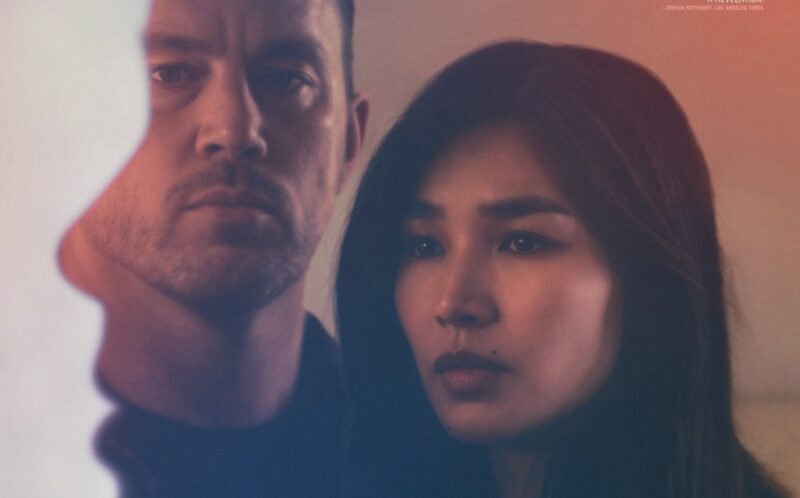
Josephine follows eight-year-old Josephine (Mason Reeves), whose understanding of the world is irrevocably changed after she witnesses a brutal sexual assault in San Francisco’s Golden Gate Park. As she struggles to comprehend an act of violence for which she has no emotional framework, her increasingly unpredictable behaviour leaves her parents, Claire (Gemma Chan) and Damien (Channing Tatum), desperately attempting to protect their daughter from something they cannot explain away or undo.
What follows is an emotionally devastating examination of childhood trauma, but one that refuses to reduce its characters to their suffering. De Araújo isn’t interested in offering easy explanations or reassuring conclusions. Instead, she explores the uncomfortable reality that even the most loving intentions can prove inadequate when confronted with experiences that fundamentally challenge our sense of security.
And while the film originates from de Araújo’s own experience, bringing that intensely private memory to the screen required an entire creative community to find their own emotional connection to the material.
It’s a contradiction our Peter Gray was particularly interested in exploring when speaking with the film’s cast and producers at this year’s Toronto International Film Festival: how do you preserve the intimacy of a story born from one person’s experience while allowing an entire production to take creative ownership of it?
For producer Josh Peters, the answer was rooted in recognising that, while the circumstances of de Araújo’s experience were specific, the emotional uncertainty surrounding childhood was something many people involved could understand.
“Everyone came with their own version of something in their lives that they could not potentially explain at an early age,” he explained.
That shared recognition became particularly important when considering the film’s young lead. Reeves’ performance is astonishing in its emotional complexity, capturing the confusion of a child who knows something terrible has happened without possessing the language to articulate what that experience means.
But creating such a performance required an environment in which the young actor could engage with difficult material without being unnecessarily exposed to its full emotional weight.
“Beth was at the forefront of that, making sure Mason felt safe and comfortable, and she knew enough of what we were talking about, what we were doing, but not too much,” Peters said, emphasising the importance of keeping those conversations age-appropriate.
Having worked with de Araújo across her first two features, Peters was familiar with the filmmaker’s commitment to establishing trust long before cameras began rolling.
“She just creates an environment of trust very early on, and that’s a lot of pre-production, sitting with the actors, sitting with Mason, just kind of getting to know her.”
The intention, he explained, was to establish a familiarity that made the production feel less like an intimidating professional environment and more like being surrounded by people Reeves already knew and trusted.
It’s a philosophy that feels particularly significant given the nature of the film. Where Josephine examines the devastating consequences of a child’s sense of safety being compromised, its production demanded the opposite: a carefully maintained environment in which everyone, particularly its youngest performer, understood that their wellbeing was paramount.
For fellow producer David Kaplan, that responsibility extended well beyond the actors themselves.
The film’s opening assault is deliberately confronting, not simply because of the violence being depicted, but because of the perspective through which audiences experience it. Rather than presenting the event through the familiar cinematic language of adult comprehension, de Araújo places us within Josephine’s bewildered understanding of what she’s witnessing.
It’s a sequence that establishes the film’s emotional foundation, but Kaplan acknowledged that bringing it to life was also the production’s most challenging undertaking.
“The hardest day on set was the work we did in the park,” he recalled.
From the outset, the production recognised the importance of preparing everyone involved, including those who hadn’t been present during rehearsals, for the nature of the material they would be confronting.
It wasn’t simply a matter of ensuring the actors understood their scenes. Kaplan described a broader responsibility to create a working environment where the emotional implications of the subject matter were acknowledged rather than treated as an unavoidable inconvenience of filmmaking.
“I think ultimately, you take the precautions that you can, like having mental health professionals around. You talk to people and you’re communicative about what you’re going to do on the day.”
Intimacy coordinators were also integral to the process, alongside the relationships de Araújo had established with her performers.
But perhaps most importantly, that commitment to care didn’t end when filming wrapped.
“Afterwards, we kept the mental health professionals on standby so that, in the coming weeks after working on this, the particularly hard stuff, we would have people be able to go and talk to somebody or take time.”
Kaplan’s comments highlight something that can be overlooked when discussing difficult filmmaking: the distinction between depicting trauma responsibly and ensuring that the people responsible for depicting it are themselves supported.
For Josephine, the production’s sensitivity wasn’t simply an artistic consideration. It was an ongoing responsibility to the people who had agreed to participate in telling the story.
And, as Kaplan observed, that commitment ultimately originated with de Araújo herself.
“She’s able to keep everybody feeling like there’s a seriousness with which we’re taking this,” he said, describing a production built around an awareness of the film they were making and the emotional demands it could place upon those involved.
That seriousness is particularly evident in the performance of Philip Ettinger, who portrays Greg, the man responsible for the assault Josephine witnesses.
It’s an extraordinarily difficult role, not least because de Araújo refuses to provide the character with the kind of elaborate psychological history that might encourage audiences to rationalise his actions.
In a cinematic landscape where even the most reprehensible characters are frequently afforded complicated backstories intended to explain their behaviour, Josephine makes a striking decision not to centre its perpetrator’s motivations.
Instead, the film is concerned with the consequences of his actions, particularly the way his presence becomes embedded in Josephine’s increasingly fractured perception of the world.
When I asked Ettinger how that absence of an explanatory backstory informed his approach, he spoke about the uncomfortable complexity of recognising someone’s humanity without diminishing the harm they’ve caused.
“I think the nuanced conversation is we were all babies at one point, and to be aware of that is very scary in this world,” he reflected.
For Ettinger, the screenplay’s willingness to acknowledge that complexity without excusing the character’s behaviour was unlike anything he had previously encountered.
“To really take the brave stance of trying to represent this person for the terrible person he is, and also maybe see that he was once a child, or how a child would even understand him… I had never read anything like that in a script.”
It’s a distinction that speaks to the film’s refusal to simplify its subject matter. Recognising that a person responsible for terrible violence once possessed their own childhood innocence doesn’t absolve them of responsibility. Instead, it introduces an unsettling contradiction into Josephine’s attempts to understand a world in which the distinction between safety and danger has become profoundly unstable.
Ettinger described the screenplay as a remarkably delicate approach to examining a trauma response, one that demanded considerable intention from everyone involved.
“I felt very responsible for the role to make sure that we handle it with so much love.”
That responsibility was especially important in his scenes with Syra McCarthy, who portrays Sandra, the woman assaulted in the park.
“Even the main scene with Syra, that had to be done with so much love and trust between the two of us to really go there and tell the story, but then also do it in a safe way, so we can cathartically reclaim her trauma instead of just re-traumatizing.”
His words underline the unusual emotional demands of portraying violence within a film that is so fundamentally concerned with its psychological aftermath.
But Ettinger’s performance also presents another fascinating challenge, one that becomes increasingly apparent as Josephine struggles to process what she has witnessed.
Greg doesn’t simply exist within the film as a man responsible for a violent act. He also becomes something more abstract and deeply unsettling: a manifestation of Josephine’s fear, filtered through the imagination of a child attempting to make sense of something she cannot comprehend.
I was interested in how Ettinger navigated that distinction between portraying an actual person and portraying the image of that person as it exists within someone else’s psychological experience.
His answer revealed that he had effectively approached the film as two different performances.
“I kind of approached it where I was playing like two different parts,” he explained. “I play the man in the beginning and the end of the movie, and the whole middle section I kind of approached it as if I was an extension of a seven-year-old psyche.”
It’s a fascinating insight into one of the film’s most disturbing creative decisions.
Rather than treating Greg’s recurring presence as a straightforward representation of the character, Ettinger understood those moments as an extension of Josephine’s attempts to reclaim control over her own fear.
“She’s trying to understand and maybe find ways, when she doesn’t feel safe and maybe her parents aren’t helping her in the ways that she thinks she needs, to reclaim her own fears.”
That interpretation transforms the character’s function within the story. He is no longer simply the man who committed an act of violence, but an image whose meaning is continually being reshaped by the child who witnessed it.
For Ettinger, this required an approach that was both emotionally attentive and responsive to Reeves’ performance.
“It was really important to do those scenes with safety and then also just kind of mirror Mason.”
The emotional connection he felt to the material was also deeply personal.
“I remember when I was six, seven years old, and I realised that the world wasn’t as safe as I thought it was,” he recalled.
“And that’s when I read the script; it made me cry because I’d never read any story like that before.”
That recognition of childhood vulnerability ultimately became central to his understanding of the film, and to his appreciation of de Araújo’s willingness to revisit such difficult territory.
But beyond the creative challenges of the role, Ettinger also spoke about the importance of allowing Josephine to encourage conversations that are too often avoided, particularly among men.
“I also am connected to the subject, and it felt really hard growing up because people are, especially men and stuff, afraid to talk about this kind of stuff.”
For him, the film’s potential impact isn’t necessarily measured in whether audiences emerge with a greater intellectual understanding of trauma. It’s about whether they feel more capable of acknowledging their own experiences.
“If this can just kind of start conversations and make people feel less [alone] in their feelings, then I’m so proud to be a part of it.”
It’s a sentiment that resonates throughout my conversations with the cast, particularly in the recognition that silence can be as complicated as the experiences it surrounds.
For Dana Millican, the film prompted a particularly emotional reflection on the courage required to transform private experiences into public art.
When I asked whether de Araújo’s exploration of hypervigilance and the lasting effects of violence had allowed her to recognise something about herself that she hadn’t previously been able to articulate, Millican became visibly emotional.
“Candidly… oof, I don’t want to cry,” she admitted.
What followed was one of the most affecting moments of our conversation, as she reflected on her admiration for de Araújo’s willingness to share something so personal.
“I guess I wish I was as courageous as Beth to be able to talk about it, write about it, make a movie about it, have a whole bunch of people hear about it.”
Millican acknowledged having experiences of her own, while expressing uncertainty about whether she could ever make herself similarly vulnerable.
“I don’t feel courageous enough to talk about something like that, or make art about it, or get funding for it.”
It was an extraordinarily candid response, and one that seemed to encapsulate the complicated relationship between trauma, personal expression and the expectations we place upon those who have experienced violence.
Not everyone wants to tell their story publicly. Not everyone feels capable of doing so. And perhaps, more importantly, nobody should be made to feel that their experiences are somehow less meaningful because they choose to keep them private.
Millican’s admiration for de Araújo wasn’t rooted in the suggestion that everyone must follow her example, but in an appreciation of the courage involved in making that choice.
“I just feel really proud of her and inspired by her, and all victims of sexual violence who speak out unapologetically and courageously about their experience.”
Her words also raise an important question about how we define courage in the context of trauma. While speaking publicly can be an extraordinary act of bravery, the decision not to share an experience deserves its own respect. There is no obligation to turn suffering into testimony, just as there is no single correct way to navigate its aftermath.
It’s an understanding that Josephine itself seems particularly attuned to, refusing to prescribe a definitive emotional response to the violence at its centre.
For McCarthy, that complexity became unexpectedly apparent not during the filming of the assault itself, but in the moments immediately afterwards.
Reflecting on the care taken by the production to protect its performers, McCarthy recalled an experience that revealed how even the most well-intentioned gestures can produce contradictory emotions.
“I found it interesting after shooting, leaving the scene, and I think that the set itself was so held and so wanted to respect everybody and give everybody space.”
As she and Ettinger moved through the set, she noticed that people appeared reluctant to make eye contact with them.
“I remember Phil and I walking through, and nobody really wanting to look us in the eye.”
What she initially understood as an attempt to offer privacy and respect also created an unexpected feeling of separation.
“I was like, ‘Oh, they want to give me my space,’ and also I feel really isolated.”
When I asked whether that experience had felt lonely, McCarthy acknowledged that it had.
“It did.”
It’s a deceptively simple exchange, but one that speaks to something profoundly complicated about how we respond to people who have experienced, or in this case portrayed, sexual violence.
We want to be respectful. We want to avoid saying the wrong thing. We want to offer people the space to process difficult experiences without imposing ourselves upon them.
But sometimes, in our determination to avoid causing further discomfort, we inadvertently create distance where connection might be needed.
McCarthy recognised that contradiction as something extending far beyond the confines of the film set.
“I think it just goes back to the subject matter in general and how we, as a society, want to honour and give space and respect, and how that separates us.”
It’s perhaps one of the most revealing observations to emerge from these conversations, because it acknowledges that even compassion can become complicated when we’re uncertain how to express it.
The instinct to withdraw might come from a place of genuine care, but that withdrawal can also reinforce the isolation experienced by those who are already struggling to feel understood.
For McCarthy, de Araújo’s film offers an opportunity to challenge that instinct, encouraging audiences to move towards uncomfortable conversations rather than away from them.
“I think what Beth is trying to do in this film is bring us here and, like, let’s talk, and it’s messy, and nothing is… there’s no correct way to do this, and it’s okay to talk about it.”
That willingness to embrace emotional messiness is ultimately what distinguishes Josephine from more conventional examinations of trauma.
The film doesn’t suggest that every conversation will be productive, that every attempt at compassion will be received as intended, or that understanding someone else’s experience automatically equips us to help them.
Instead, it acknowledges the uncertainty inherent in trying to connect with people whose emotional realities may be fundamentally different from our own.
And in many ways, that understanding extends to the collaborative process through which the film was created.
Peters and Kaplan describe a production built upon trust, communication and the recognition that everyone involved brought their own emotional relationship to the material. Ettinger speaks about the responsibility of portraying a perpetrator without reducing him to an easily understood psychological explanation. Millican reflects on the courage of those willing to share their experiences publicly, while McCarthy identifies the loneliness that can emerge even within an environment designed around care.
Different perspectives, different experiences, and different understandings of what it means to approach such difficult subject matter responsibly.
Yet what connects them is an appreciation of the fact that Josephine isn’t asking audiences to arrive at a single, definitive interpretation of trauma.
It’s asking them to recognise how differently people experience fear, how easily good intentions can become inadequate, and how important it is to remain open to conversations that might not offer immediate comfort or resolution.
For de Araújo, transforming an intensely private childhood memory into a film required the willingness to allow other people to find themselves within that experience. For those who helped bring her vision to life, it meant accepting a responsibility that extended beyond their individual performances or professional contributions.
And for audiences, perhaps the responsibility is simpler, if no less challenging: to remain present with something uncomfortable, to resist the temptation to explain it away, and to recognise that sometimes the most meaningful response isn’t knowing exactly what to say.
It’s being willing to listen.
Because for all its devastating imagery and psychological intensity, Josephine is not simply a film about the violence one little girl witnesses. It’s about the silence that can follow, the fear that becomes embedded in everyday life, and the complicated ways we attempt to protect ourselves and one another from experiences we cannot always understand.
And if its greatest achievement is encouraging someone to speak about something they’ve previously felt unable to articulate, or helping another person recognise that they don’t need to have all the answers before offering compassion, then perhaps de Araújo has accomplished something far more enduring than simply telling her own story.
She’s created space for other people to begin theirs.
Josephine is screening in select theatres in the United States from November 20th, 2026, expanding wide on December 4th, before opening in Australia on February 18th, 2027.
