

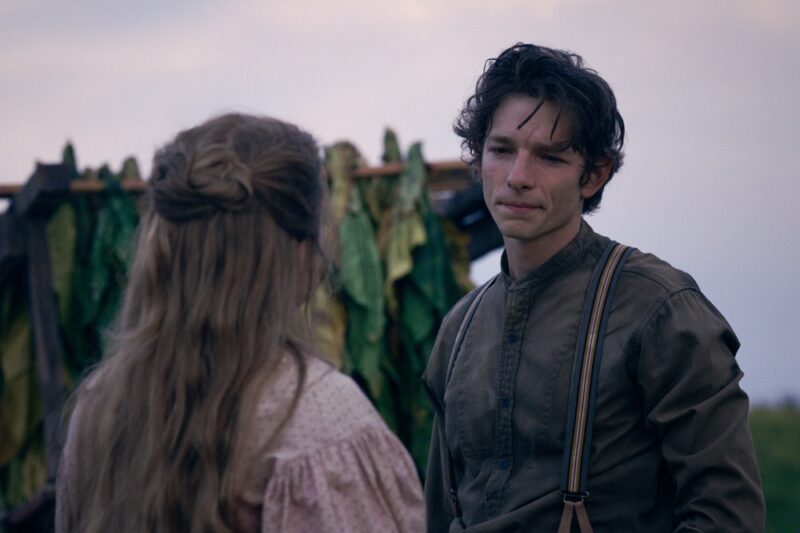
In a story where the sins of one generation threaten to become the inheritance of the next, Netflix’s adaptation of John Steinbeck’s East of Eden explores the complicated relationship between love, resentment and the darkness we come to believe exists within us. Spanning generations of the Trask family, the series stars Florence Pugh as the enigmatic Cathy Ames, Christopher Abbott as Adam Trask, and Mike Faist as Charles, Adam’s troubled half-brother, whose desperate longing for paternal affection gradually curdles into bitterness and violence. Yet beneath Charles’ cruelty lies something perhaps even more tragic: a man so consumed by the belief that he is fundamentally undeserving of love that he begins to mistake suffering for atonement. Speaking with our Peter Gray, Faist reflected on the blurred lines between inherited darkness and learned behaviour, the emotional consequences of a lifetime spent carrying shame, and how an unexpectedly painful pair of shoes helped him understand a character whose greatest punishment may ultimately be the one he inflicts upon himself.
I wanted to ask about the emotional heart of Charles, because what I find really heartbreaking about him is that he spends so much of his life trying to earn a love that Adam receives quite effortlessly. Did you see his cruelty as something inherent in him? Or as something that developed because he was never given the affection he needed?
That is the question. That is the question. We do hear from both Adam and Charles’s father, this idea that he says there is something inside of Charles that needs to be buried, which is why ultimately the father decides to send Adam to war and keep Charles on the farm to tend to the house and everything. I think that there’s potentially some truth to that.
I think ultimately this series and all of these characters do bring about this question of: “Are you born with darkness, or are you nurtured into the belief of having a darkness?” And there’s something about this character that I just immediately fell in love with and empathized with, and that I was curious about. I felt very lucky to be able to explore those curiosities and ask those questions with him.
We talk about these characters and the damage they inflict on other people, but I wondered whether you ever thought about the damage he inflicts on himself simply by refusing to let go of that resentment. Did you feel there was a point where his anger stopped being a response to what happened to him and just became a choice he was making every day?
I think after that violent act that he did to his brother, he’s then left on this land to live in isolation for years. I think that there was something innately interesting for me of this idea of what does it look like for a boy to then become a man and live and carry that shame every single day for the rest of his life. I think there is something interesting, and then we see the adult version of him trying to make an attempt at repairing the damage that was done.
There’s stuff that’s written in the original novel that (John) Steinbeck (author) says about Charles, where every single dollar that he made went into building the farm and improving upon the farm. He never kept the house clean. He never spent any money on himself, or new clothes, or anything like that. I remember when I was working with the costumers, they gave me these really beautiful shoes that they made for me. They hurt like hell!
I remember Florence (Pugh) asked me, because she saw me limping around one day in these shoes, “Are you all right?” It’s these new shows, they’re killing me. I remember going back and remembering that phrase that (Steinbeck) had written; “He never spent any money on himself.”
I said, “Well, of course his shoes hurt,” because it adds to this masochistic belief of carrying the shame. It’s one more thing that he is going to punish himself (for), which ultimately doesn’t help anyone.
All episodes of East of Eden are available to stream on Netflix.
