

Ben Reilly’s version of Spider-Man has already lived through the kind of disillusionment most superhero stories spend entire trilogies building toward. By the time Spider-Noir begins, the idealism is gone, the city has worn him down, and what remains is a weary private investigator muttering lines like, “With no power, comes no responsibility” – a sentiment that lands somewhere between cynical joke, emotional defence mechanism and quiet tragedy.
Based on the Marvel comic Spider-Man Noir, the series stars Nicolas Cage as Ben Reilly, a down-on-his-luck detective forced to confront his former life as New York’s only masked vigilante after a deeply personal tragedy. Equal parts hard-boiled noir, comic-book pulp and melancholy character study, the show exists in a fascinating tonal space – one creator Oren Uziel describes as constantly balancing “this side of silly and that side of overly serious.” It’s a balancing act perhaps best embodied by Cage’s own description of his performance: “70% Humphrey Bogart and 30% Bugs Bunny.”
Speaking with our Peter Gray ahead of the show’s global launch, Uziel reflects on building a Spider-Man story that begins after the “Chinatown disillusionment moment,” why noir demanded a hero already emotionally exhausted by the city around him, and how the show’s ambitious dual presentation – available in both black-and-white and colour versions – creates two entirely different emotional experiences. The result is something dreamlike, pulpy and unexpectedly romantic; a superhero story filtered through cigarette smoke, existential dread and old-Hollywood shadows.
I know that you’ve described Ben Reilly as someone who already his “Chinatown disillusionment moment” years ago, and most superhero stories build towards the loss of innocence, but this starts after it. What interested you about beginning with a hero who already believes the city can’t really be saved?
That was everything for me. I’m not a high-school kid anymore, and I’ve seen that version of Spider-Man a number of times, and I think by making him older and a little more jaded, or a little more down on his luck, it both gave me the opportunity to work with Nic (Cage) on it and create a character with (him), but it also felt truer to the genre that we’re doing. This is noir. You start with a character that has seen some things, been through some things, and just trying to get by. That’s film noir. So, it made more sense.
Mentioning Nicolas Cage, I know he said that he approached Ben as “70% Humphrey Bogart and 30% Bugs Bunny,” which somehow makes perfect sense for noir and comics at the same time. Did that tonal tightrope between pulp sincerity and surreal become the key to unlocking the series at all?
Oh, completely. Riding that tone and being the policeman of that tone is the job. Nic is pretty careful too, and he knows his stuff. Together, we always would talk through everything and make sure that we’re always keeping it on this side of silly and that side of overly serious. We want the show to be fun, but it hits a lot of different things. It’s comedic, it’s mysterious, it’s melodramatic, it’s romantic…it’s the whole thing. I think Nic is an actor that is uniquely capable of pulling all that off.
There’s a line – “With no power, comes no responsibility,” and it’s cynical, funny, and tragic altogether. Was it a challenge to figure out whether Ben still believes heroism means anything anymore? Was that something you looked at?
We talked about it all the time. One of the touchstones of this was Rick from Casablanca. He starts off the movie saying, “I don’t stick my neck out for anybody,” but you know that deep down he’s probably going to stick his neck out for somebody. He’s just trying to convince himself he won’t. I think Ben Reilly is in a similar position. He’s insisting on a thing that we know he doesn’t really believe in his heart.
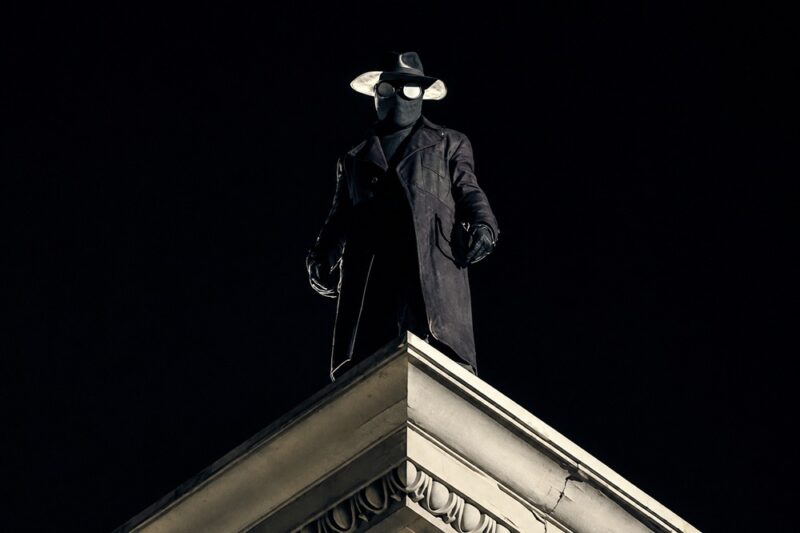
And the monochromatic and colour versions of the show – which is such a fantastic idea to be able to give people both versions – the black-and-white genuinely feels like it can sit beside classic noir cinema, while the colour is heightened and dreamlike. Did you think of them as two different emotional experiences rather than just two visual versions?
Absolutely. There’s a very different feeling watching these two versions, and I am excited for people to watch them both and figure out how that feels, what it makes them feel, and which one they might prefer. It’s a great compliment to hear it could sit with those old noirs, because we worked really hard to match that aesthetic and not mimic it, but just create our own little world that sits in there with it. I’m excited about people getting to watch both ways.
Do you have a personal preference? Or even a recommendation?
Watch the one you feel really inclined to watch first, and then if you like, give the other one a shot. It’ll surprise you. You might find that the black-and-white is a little moodier, and you might the colour version a little more fun, a little pulpy and silly. It’s hard to say, but they’re both worthwhile. For me, it’s mood-based.
The black-and-white release fascinates me because actors usually rely so much on subtle visual realism. Did knowing the show would exist in monochrome affect how there was an approach to movement, expression, or even stillness?
It is something we thought about. For the actors themselves, I think they’re doing what they’re doing, but it’s in the edit that we rode the line. Even in the sound mix, sometimes we played around with mono versus surround. In black-and-white, you couldn’t go as far, because it started to feel a little weird, because we had already deprived you of certain senses. The whole thing was about finding a balance.
Spider-Noir will premiere globally on Prime Video – in both Authentic Black & White and True-Hue Full Colour – on May 27th, 2026.
