

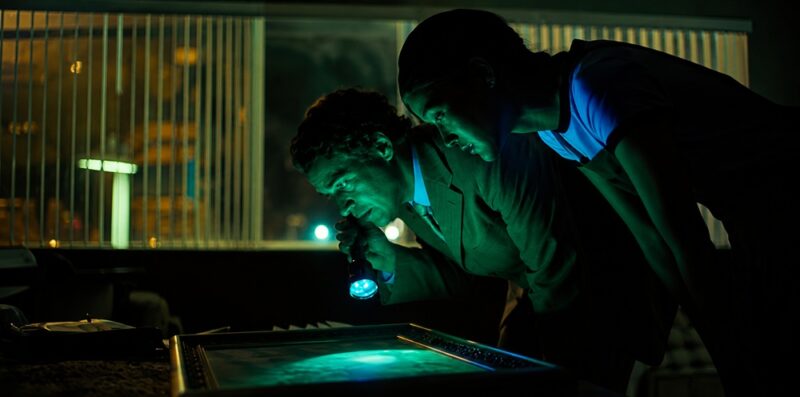
Jing Ai Ng’s Forge slips into the art world through the side door. There are no velvet ropes, champagne-soaked auctions, or globe-trotting thieves in tuxedos here. Instead, the film plants itself in the sticky Miami heat, inside cramped motel rooms and a family-run dim sum restaurant where exhaustion hangs heavier than ambition. What emerges is less a glossy crime thriller and more a melancholy character study about people trying to counterfeit a version of success they were never invited into.
At the centre are siblings Coco and Raymond Zhang, played by Andie Ju and Brandon Soo Hoo with a weary chemistry that feels lived-in. They aren’t criminal masterminds. They’re hustlers. Coco has genuine artistic talent, but instead of galleries or recognition, she spends her nights distressing fake paintings with coffee stains and pins so wealthy buyers can pretend they’ve discovered forgotten masterpieces. Raymond handles the charm offensive, floating through Miami with the kind of smile that only barely conceals panic. Together, they sell illusions to people rich enough to buy authenticity as a status symbol.
That idea – art as performance, value as fabrication – runs through Forge in fascinating ways. Everyone in the film is selling something fake. Coco and Raymond forge paintings. Holden Beaumont, the reckless rich heir played with slippery arrogance by Edmund Donovan, tries to forge legacy and sophistication after allowing his grandfather’s priceless collection to rot in a flooded basement. Even the FBI feels performative, with Kelly Marie Tran’s Emily Lee constantly sidelined by colleagues who underestimate her expertise.
Tran gives the film its emotional spine. Her performance is beautifully restrained, quietly capturing the loneliness of someone transplanted into a city where she knows no-one. The scenes where Emily drifts into the Zhang family’s dim sum restaurant become some of the film’s strongest because they reveal what Forge is actually interested in: not crime, but belonging. The restaurant hums with warmth and familiarity – chatter, food, routine – while Emily exists on the outside of every room she enters. Tran plays that isolation with subtle precision, never overreaching for sympathy.
Ng directs the film with confidence, leaning into atmosphere over momentum. Miami is rendered not as a glamorous neon playground but as something humid, faded, and strangely intimate. Mansions decay. Wealth looks hollow. Even the nightlife scenes feel sleepy and detached, as though the city itself is exhausted from pretending. Visually, Forge has a sleekness reminiscent of David Fincher’s colder thrillers, while the electronic score pulses underneath like distant anxiety.
But for all its thematic richness, the film occasionally feels too emotionally cautious for its own good. The relationship between Coco and Raymond is compelling, yet the screenplay rarely digs deep enough into the fractures between them. There are hints of resentment, dependency, and buried frustration, but the film often pulls away just as scenes threaten to become truly raw. The same restraint affects the pacing. Forge deliberately avoids explosive thriller mechanics – no shootouts, no chaotic FBI raids – which is admirable, but it sometimes leaves the story feeling emotionally undercooked when it should be tightening the screws; this never more applicable towards the film’s ending.
Still, there’s something refreshingly specific about the film’s perspective. In an era obsessed with replication, AI-generated content, and manufactured authenticity, Forge asks what makes art meaningful in the first place. Is value tied to the creator? The emotional connection? The illusion of rarity? One of the film’s sharpest ideas is that the wealthy collectors purchasing these works often care less about art itself than the prestige attached to owning it. Coco may be the criminal, but she’s also the only person in the room actually creating something.
That tension gives Forge its identity. It’s a heist film uninterested in spectacle, more concerned with the emotional cost of survival than the thrill of getting away with something. At times, it reaches for profundity it doesn’t quite earn, but Ng’s debut still lands as an assured, stylish, and quietly thoughtful drama about forgery in every sense of the word – forged paintings, forged identities, forged versions of the American Dream.


THREE STARS (OUT OF FIVE)
Forge will open with week-long theatrical runs in Los Angeles beginning May 15th, 2026 at the Landmark Nuart Theatre, followed by New York beginning May 22nd at Quad Cinema, with additional select markets rolling out nationwide in the weeks ahead.
