

More than a quarter of a century after Memento announced Christopher Nolan as one of cinema’s most audacious storytellers, the fractured psychological thriller is being pulled apart and put back together once again – only this time, rhythm is rewriting the equation.
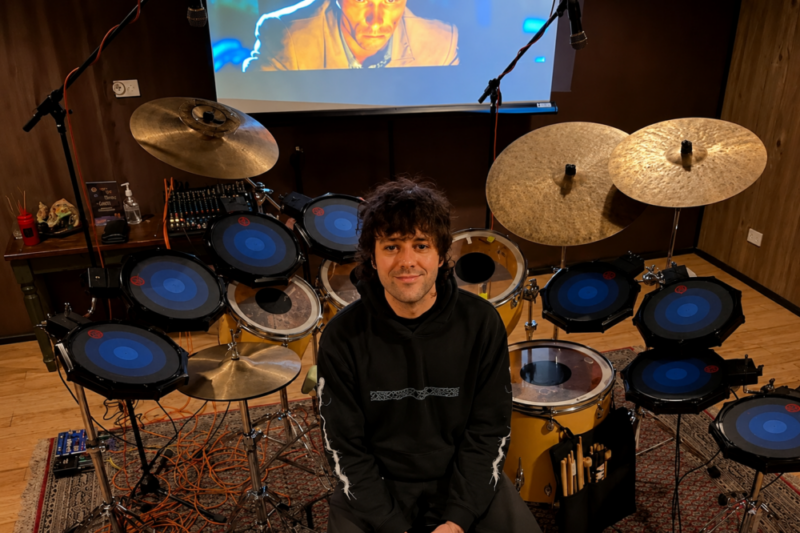
For the latest presentation from Hear My Eyes, Michael “CAVS” Cavanagh, drummer for King Gizzard & The Lizard Wizard, is stepping out from behind the band and going it alone, performing an entirely new score to Nolan’s 2000 cult classic across multiple drum kits and electronic instruments. It’s an appropriately daring proposition for a film built around uncertainty: one musician, one notoriously intricate movie, and a live performance where neither performer nor audience can entirely hide from the moment.
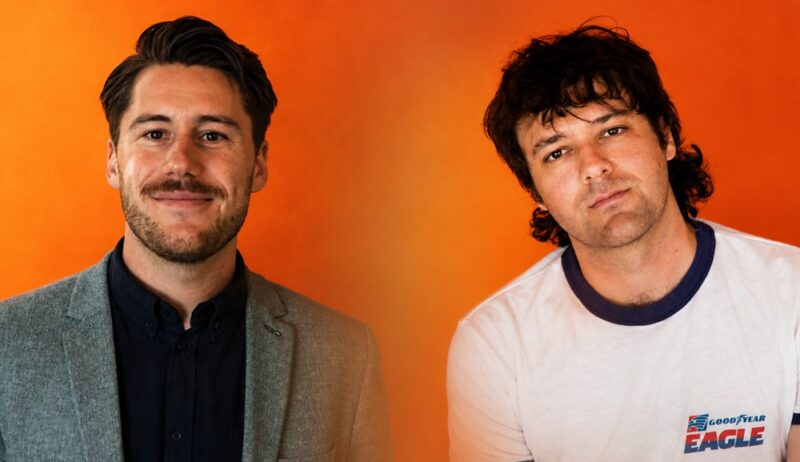
Speaking with Peter Gray, Cavanagh and Hear My Eyes founder and artistic director Haydn Green discuss the trust inherent in asking audiences to experience a familiar film differently, finding emotion within an entirely percussive score, and the strange freedom of Cavanagh being alone on stage. They also reflect on the ephemeral beauty of creating something audiences may only ever experience a handful of times, whether there’s something deliciously rebellious about interfering with Christopher Nolan’s meticulously constructed world, and the films they’d love to get their hands on next.
One of the central questions in Memento is “Who do you trust?,” and in live performance there’s a similar leap of faith, because the audience has to trust the musicians will take them somewhere worthwhile. Do you both think about that relationship when you’re on stage?
Michael “CAVS” Cavanagh: Yeah, no, definitely. I mean, as I’ve been writing, that’s what this project is, right? You want to take the audience on a different journey through the film, whether they’ve already experienced it or maybe they haven’t. Making that translate live is quite a challenge as well. But yeah, we definitely have that in our minds. I do, but I’m also writing instinctively and approaching it a bit more primally in terms of the writing.
Haydn Green: Yeah, yeah, I definitely think about that, Peter, from a curatorial point of view. It’s an experiment. People don’t know what the new music is going to be. You can describe it in the marketing copy, but they don’t really know what genre it’s going to be, what era or what the sound palette will be. So there’s a lot of trust.
I think we’re very appreciative that the audience trusts us so much to come on this journey with us. I’ve always felt that. I’ve been doing Hear My Eyes for 11 years now, and I think this is the 24th feature film, and I’m always surprised at how many audience members keep coming back and loving it. I’m incredibly grateful for that trust, and for them being open and brave and not knowing what’s going to happen.
Michael’s working incredibly hard, and we put a lot of time and effort into this. We’re not going to let them down, and they’re going to have an amazing time. But there is that leap of faith, yeah. So it’s a nice little connection that you’ve drawn between the film and the experience itself.
Well, going off that, Haydn, Memento has been analyzed endlessly as a puzzle film. I’m wondering if people sometimes miss how emotional it is. When you’re programming, are you chasing films that audiences know intellectually, or films they still haven’t finished feeling?
Haydn Green: Yeah, it’s a good question. I think there has to be rewatch potential. There has to be an angle that’s exciting for audiences to revisit. There are some films that I think about programming for Hear My Eyes, and then after sitting with them and rewatching them for the first time in decades, I realise there’s just not that much to bring back. I always ask myself: “Why am I choosing this film? What’s the purpose, and what will audiences get from it?” Is there entertainment or intellectual value? Are there philosophical questions? Is it so incredibly beautiful that, even aesthetically, it’s worth revisiting on a big screen? That kind of rewatch value is definitely part of the thinking when choosing the films.
And Memento is one of those films that you can analyze endlessly, but you can also just watch it so many times. During this process, Michael and I would have watched Memento dozens and dozens of times already, and we’ve still got many more watches to come through rehearsals and performances. We’re still picking up on little things, putting pieces together and enjoying the ride.
I think because of its editing structure, it doesn’t wear in the same way a more conventional film does. It’s harder for your brain to map out the journey, so it continually manages to feel fresh.
And Michael, people often think of drums as instruments of momentum, but Memento constantly interrupts momentum. Did that force you to rethink what percussion can actually do?
Michael “CAVS” Cavanagh: Yeah, good question. Not really, not really. I feel like the film actually still does have momentum, even though the timing is crazy.
Every Hear My Eyes performance only exists once. Memento is about somebody desperately trying to preserve information before it disappears. There’s something poetic about pairing that film with an art form that’s so ephemeral. Was that contrast something you both thought about?
Haydn Green: I don’t think I’d drawn that specific link, but the ephemerality of Hear My Eyes is definitely something I focus on. I love the idea of not putting these experiences out again on streaming or online, and continually urging people to come and see them. It’s like a love letter to cinema – seeing a film on a big screen, in a big room, with lots of people packing it out. That classic cinema experience.
Sometimes it feels a bit bittersweet. We put so much time and effort into something that happens just a handful of times, but that’s also what makes it very magical and special. So that’s something we think about quite a lot. But I hadn’t drawn the link between the fact that his memory is consistently fading and the ephemeral nature of the experience. There is a poetic connection there.
Michael, you’ve written albums that build their own worlds, but you’re entering Nolan’s world here. How do you decide where your voice ends and the film begins?
Michael “CAVS” Cavanagh: I don’t know. I mean, it’s the first time I’ve done this, so I don’t really know. As I said, I’m just approaching it purely instinctively. What you see on the screen and then what you hear coming from the drums is literally just what I feel.
Haydn Green: I think the scene dictates it as well. Some scenes allow Michael to lean in and be freer, while others have emotional weight, lots of dialogue, or an editing structure that he really has to duck and weave around and integrate into. So it really depends scene by scene. From being in the room with him and watching him compose, I can see Michael being incredibly expressive and free, and really championing his own sound. Other times, he’s really collaborating with every element of the film.
The Memento score is so sparse and atmospheric. Did you both have to deliberately avoid listening to it while composing this? Or did you embrace it as part of the conversation?
Michael “CAVS” Cavanagh: I deliberately avoided watching the film with the score. I have seen it with the score before, but since we’ve been working on this project, I haven’t watched it that way. That said, I do know the score and how sparse it can be. We hit some of those sparse moments as well, not because I’m trying to pay homage to the original score or anything, but because, scene by scene, that’s what the film calls for. Some of the scenes are actually really quite sad, so there are moments where that sparseness feels right.
Haydn, you’ve described Michael as a virtuoso carrying the whole experience. Were you interested in him because he’s one of the world’s greatest drummers? Or because the way he thinks about rhythm as composition?
Haydn Green: I think because he is one of the world’s greatest drummers, out of those two options. I’d say it’s a little bit of both, because I’ve seen him do experimental work before. Michael and I worked on a project back in 2020 with another five musicians and a 12-person choir, where we rescored Dario Argento’s Suspiria. I got to work with Michael on that project and see his range, the breadth of his skills and his background. You get to see a lot of that in Gizzard (King Gizzard & the Lizard Wizard), but this is a project purely dedicated to drumming, so there’s a lot of freedom.
Michael suggested back then that he would love to score a film on the drums, and that always stuck with me. I thought it would be such an amazing project. We’ve just come from Terminator 2, where there were six vintage synthesisers on stage, an acutely composed score and this whole laser show. This is almost the polar opposite in many ways – it’s one person, largely on acoustic instruments. There are synthesised pads as well, but it feels really ambitious and exciting to try to score a film that way.
There are references like Antonio Sánchez’s work on Birdman, which I’m a big fan of, and he also did The Studio. I really like that style of tightly wound, anxiety-ridden, intense percussive score. I just thought this project had so much potential to be something truly unique and special, and I’m really glad to say that it is.
After spending so much time with Michael and landing the score, we’re now confidently in rehearsal mode, and I’m just so proud of it. I’m so proud of what Michael has done. It’s very, very special. I think people will leave feeling pretty wild, because it’s quite a journey.
Most film scores are designed to disappear into the movie. Hear My Eyes almost does the opposite. You’re asking people to become very aware of music as a storyteller. Has that changed the way that both of you watch films?
Haydn Green: It definitely has changed the way I watch film. I can’t watch a film without thinking about the score really intently. I guess I’m a bit of a maximalist, and I like really big, in-your-face, loud, aggressive film scores. I also love quiet, restrained, subtle scores, but I want them to have a voice. I want them to be saying something artistically and emotionally. The ones that are just meandering in the background often leave me quite disappointed.
But they’re fundamentally different, Peter, as you’ve outlined. This is a project where the score is performed live, so it becomes theatrical. The audience is aware of the musician; they’re looking at him. We’ve deliberately put the score louder in the mix, so it’s on par with the dialogue and Foley. It’s a real instrument in the room, for lack of a better word, and it’s deliberately that way. But if you mixed a film like that for a traditional cinema release, it would just feel clunky and odd. It wouldn’t quite make sense.
