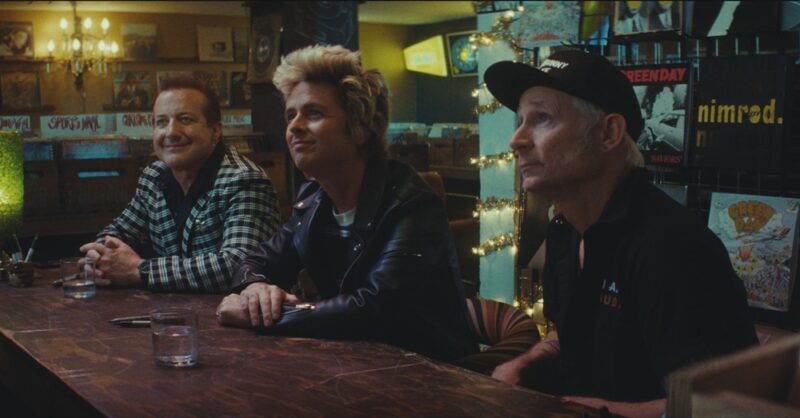

A certain amount of beautiful stupidity comes with believing your teenage band could actually become something. That blind conviction – the kind that tells you stealing a car and driving across America might somehow be a perfectly reasonable response to an invitation to open for Green Day – sits at the heart of Nimrods, writer-director Lee Kirk’s rowdy, affectionate ode to big dreams, loud music and the wonderfully irrational confidence of youth.
Inspired by stories from Green Day’s years spent touring long before Dookie transformed them into global superstars, Nimrods follows Tommy and his bandmates as they race from Kansas City to Los Angeles after he receives what he believes is the opportunity of a lifetime: opening for Green Day on New Year’s Eve. What Tommy doesn’t know is that the invitation is an elaborate prank courtesy of his older brother, turning their cross-country adventure into a fool’s errand that may ultimately prove more meaningful than the destination itself.
Rather than simply recreating Green Day mythology, Kirk uses pieces of Billie Joe Armstrong, Mike Dirnt and Tré Cool’s history as the foundation for something distinctly its own; a coming-of-age film where cassettes, VHS tapes, flip phones and homemade flyers evoke an analogue adolescence without trapping the story in nostalgia. And, perhaps most importantly, it’s a film that refuses to tell its young characters to become more sensible. Sometimes being unreasonable enough to chase the ridiculous dream is precisely the point.
Speaking with our Peter Gray as the film releases across theatres, Kirk discussed finding the line between Green Day fact and fiction, making analogue nostalgia accessible to a generation raised on social media, the real-life story that inspired one of the film’s sweetest threads, and why he hopes Nimrods might make some teenager pick up a guitar.
I know you’ve described building the fictional story (of Nimrods) out of the DNA of Green Day’s history. Was there even anecdote from Billy Joe, Mike, or Tré they loved so much when they told you, but you ultimately realised this is too specific or too sacred to fictionalise in any way?
Oh, that’s interesting. You know, nothing felt too sacred. Something that was very sacred to the story was Billie Joe meeting his wife, Adrienne, which is how we ended up having the Olivia character in the movie when the band stops.
The story that Billie Joe told me was that they had stopped in Minnesota and were playing a show, and he met Adrienne there. They hit it off, and he said, “I’m gonna come back. We’ll reroute the tour to come back,” you know? So that’s how that happened in the film. Those were kind of the seeds of that piece of the story.
And they were telling me that, on the day when he met Adrienne, the other guys were shooting bottle rockets and fireworks at him. They were shooting them and hitting him and Adrienne with these fireworks. I wanted to do that in the movie, but I wasn’t allowed. It was just too dangerous to be shooting fireworks in the movie.
So there’s a scene when the ice cream truck is leaving, and Fred’s character is hanging out. He’s got sparklers that he’s kind of waving around, and that was the seed of that idea. So that’s how I got the fireworks in there.
There’s something interesting about making a film for young people that esthetically remembers a world before they were born. How conscious were you of making nostalgia inviting rather than exclusionary? So that a 15-year-old doesn’t feel like they’re watching somebody else remember being 15?
Sure. Yeah. No, I was very aware of that, and I was trying to find, you know, there is an interest in analog that’s really happening with young people right now, so that worked in my favor for sure. But I had to figure out a way to tell this story without cell phones, really.
There’s a moment in the movie when Tommy asks Olivia for her number, and she writes her number on his shirt. Well, I don’t really think that happens very much anymore. I think it’s more, “Can I Snap you?” or “You Snap me,” or something like that, you know?
So there was a little bit where I was hoping that the audience would go with it, especially with Tommy being a character who doesn’t really have social media. He has a flip phone. He’s not really involved in that. So he’s just kind of paying attention to what’s going on around him in the tactile world and less on a screen.
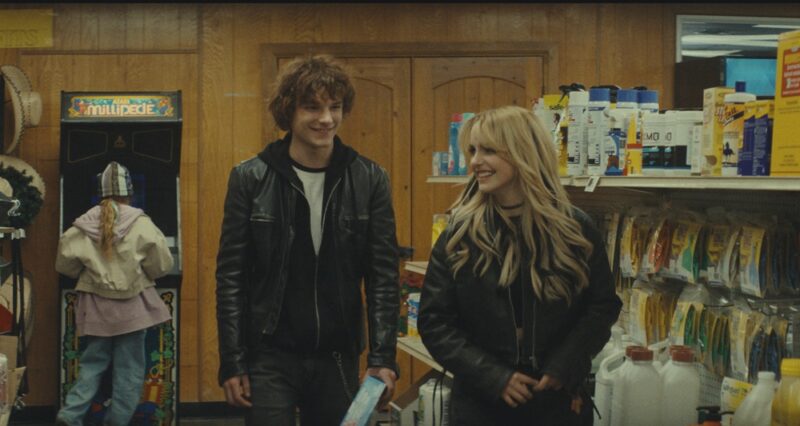
It was nice to see the older technology here. The VHS tapes and the cassettes. I feel like teenagers can watch this now and it doesn’t feel like it’s necessarily 1986 or 1996 or 2006…it feels like everybody can relate to it. It really walked that fine line.
Man, that’s fun. Yeah, you know, talking to Billie Joe and Mike and Tré about those days, you had to get out and drive. You had to go around, you had to make flyers, you had to just play your songs everywhere and give out cassettes and stuff. And there’s something so fun about that, you know. There’s something about being resourceful as a young person and having to do that. So it felt like a really fun idea to explore in this film for these kids, where it’s like, you want it, you’ve got to go get it. You can’t just put it on your phone. You’ve got to actually go after it, you know?
I feel like so many coming-of-age films eventually tell young people to grow up and be sensible. To leave dreams behind. This argues the opposite. That there’s value in being unreasonable enough to chase something ridiculous. Was that important to you?
Absolutely. I mean, that was something Billie Joe talked about in one of our early conversations. He talked about how you have to be a little crazy. You have to have crazy dreams. I mean, to get to where he’s at, they had to dream big and dream crazy and be unreasonable in their dreaming. You know what I mean?
I’m sure there were people around them who thought, “You guys are just crazy kids. You’re troublemakers.” But they had a vision for what they wanted to do. And, yeah, I would love it if a kid sees this movie and says, “You know what? I want to dream big too.”
I mean, I have kids. My kids are 12 and 14, so hopefully that rubs off on them as well.
Tommy’s journey starts with something that’s objectively quite cruel. But then the lie ultimately pushes him towards something genuine. What interested you the most about building the film around a contradiction like that?
Well, honestly, that started with a lot of the movies that Billie Joe and I talked about from those eras, you know, the ’80s and ’90s. They had an older brother character who was kind of an important piece of them. So when we decided to do the movie this way, and I realised I had an older brother character, I thought, well, this should be part of the story. It should set off the whole thing.
And then one of the questions was: “Should the audience know that these guys are on a fool’s errand?” or should I hold that until the very end of the movie? But it felt to me like it wasn’t necessarily about whether or not they’re going to open for Green Day. It’s about the journey, you know. It’s about the journey getting there.
I also really wanted to have the Wayne character kind of in pursuit and have their moment at the end of the movie. So, in order to have that, you kind of have to understand what’s going on in the story. I decided to do it the way I did, and I’m happy with how it feels. The goal was really just trying to find an ending that was still satisfying, but didn’t work out the way that maybe the audience thought it was going to work out.
I can see the version of the story where you keep that a secret, but I think it ultimately works better because it gives the audience more of a push to really want these guys to succeed. And, obviously, Green Day’s fingerprints are all over this without it being a Green Day biopic. Was there a point during writing where you established a rule for yourself about how much Green Day was too much Green Day?