
From The Wedding Planner and Bringing Down the House to the gloriously larger-than-life musicality of Hairspray, Adam Shankman has spent decades making studio comedies designed, above all else, to entertain. But for his latest film, Stop! That! Train!, the director traded the machinery of a major Hollywood production for a 19-day independent shoot, a train full of RuPaul’s Drag Race royalty, and the freedom to make something proudly, unapologetically ridiculous.
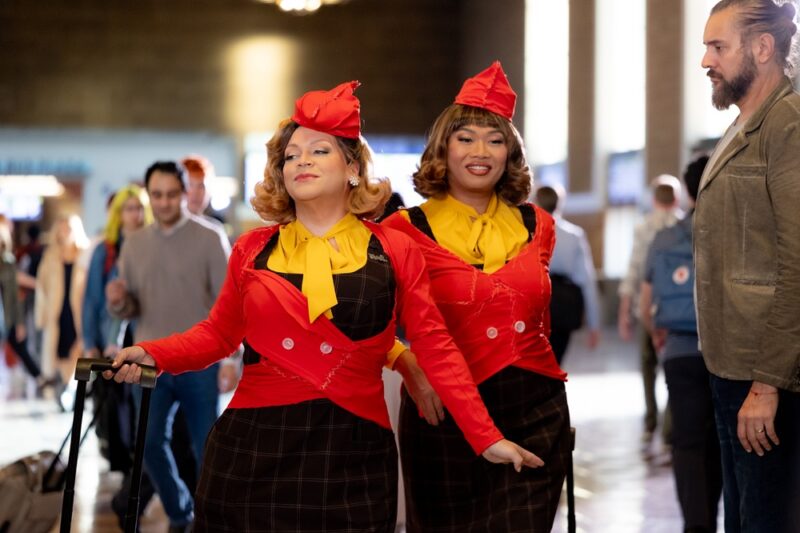
Taking its cues from the rapid-fire absurdity of Airplane! and the heightened melodrama of disaster classics like The Poseidon Adventure, The Towering Inferno and Earthquake, Stop! That! Train! stars Ginger Minj and Jujubee as train stewardesses Tess and DeeDee, whose glamorous new jobs aboard the Glamazonian Express are interrupted by a catastrophic “Stormaganza.” With the high-speed train hurtling towards disaster, they’re forced to team with their first-class counterparts and RuPaul’s President Gagwell to save the day.
Yet beneath the slapstick, sight gags and gleefully stupid jokes is something quietly significant for Shankman: his first overt contribution to the queer cinema canon. Rather than making drag itself the punchline, Shankman treats his ensemble as characters inside a disaster movie who happen to be played by drag performers. There’s no coming-out narrative or queer trauma to overcome; instead, the film allows its characters to simply exist, fall in love, panic, fight and try to stop a train from crashing into Florida.
Speaking with our Peter Gray ahead of the film’s Australian theatrical release, Shankman reflected on the creative liberation of making an independent comedy without a studio second-guessing every joke, why the precision of broad comedy often means knowing when not to move the camera, the disaster movies that helped shape the film’s camp sensibility, and the importance of asking his cast to play the absurdity completely straight.
Before I get to Stop! That! Train!, I’m just going to quickly say thank you, as in 2007, with Hairspray, you brought Michelle Pfeiffer back to the big screen in many ways, and I absolutely adore her…
You’re very welcome, and the pleasure was all mine. I love that woman with all of my heart. We had an incredible time making that movie together and, you know, she was really hesitant about playing that part, So, the fact that she went and threw herself into it was quite a thing. It was so much fun.
You’ve obviously directed these massive studio productions with every resource imaginable, and then you choose Stop! That! Train!, which is a 19-day, independent comedy. Was there something creatively liberating about stripping away the machinery and just chasing laughs with this?
You literally answered the question. I felt completely untethered and unhandcuffed. I wasn’t going to have an entire studio going, “That joke is too stupid,” and I didn’t have to answer that that was the point. So often a lot of these executives, it’s their job to second guess. It’s my job to not second guess. This one we could go boldly forward and throw it in front of an audience to see what they say. I think the deck is stacked a little bit, because I’ve done this a long time. I have plenty of standing in believing in myself and the people I was working with.
And the script was really funny when I read it. I immediately knew how to make it with such limited resources. It also harkened back, in a certain way, to my theatre days, before all of this, where it was very much, “Let’s get together with friends and we’ll put on a show in a barn.” That was really the spirit of it. And with such limited resources, it eliminates the ability for all of those other people around to have something to say. Those people get a right to say something because they’re putting the money in. So when I am in control of the amount of time we can’t go over, because there’s no more money and I run how it works…I’m here because they trust me. I felt very aligned with the World of Wonder team and Ru (Paul), and I wouldn’t have done it if we weren’t.
It’s hilarious! The Sarah Michelle Gellar running joke is incredible. I loved reading your comment that the film is joke-to-joke-to-joke. Comedy can look so effortless, but it’s so incredibly technical. What’s the biggest misconception people have about directing broad comedy?
When you’re doing something like this, I reached into the old days and asked, “Why do the old ones work so well?” I reached into my memory of them, because I’m such a huge fan of these movies. Everything from Mel Brooks’ Blazing Saddles and High Anxiety, and Young Frankenstein…those satires. Then you get into Airplane and Top Secret, and all that. We’re not utilising humour here that punches at drag, queers, race, religion, or politics, really. We’re slapstick satire and good old-fashioned stupid.
My poor cinematographer wanted to show off with all of these things with the camera, (and) I said, “Nope. Park the camera right here because here’s how it’s going to cut.” Matt Rogers is going to say to the press room, “Alright, you leeches,” and we’re going to cut to a still shot of a chair covered in leeches. Then we’ll cut back to Matt Rogers. That’s the joke. It’s not a pan over. Because every time you move the camera. you get distracted from the actual specificity of what the joke is supposed to be – unless you’re trying to reveal something. I barely move the camera in this movie. Moved it a bunch during the musical numbers, because they move, but it’s largely in the train and standing still. It drove a young cinematographer crazy.
I think that’s why so much of it works. It’s just setting it up and executing it perfectly. These disaster movies are so inherently camp, because they’re operating at maximum emotion…
They’re all just extra! They are all really campy. When people try to debate what is the definition of camp? It’s just extra. It’s big, you know? That’s what camp is. People have spoken about Airplane as an inspiration, and it did come from that, but it was also Towering Inferno, Earthquake, and The Poseidon Adventure. They were intrinsically just so high-strung. And it was in that golden era where it was just these cavalcade of stars. Nowadays, a disaster movie has a couple people in it, and it feels like the filmmakers – and the studios – just want to show you what they can represent through the CGI destruction of the world. Back in those days, it was all filled with melodrama. And the melodrama is really where we pull the satire from.
I’m fascinated by your philosophy that the joke is never that these characters are drag queens. The joke is the movie. Why was that distinction so important to you creatively?
It’s one joke, and they’re right at the beginning of the movie. You tell the big joke and then you’re done. You can’t sustain it. The sense of peril is so fragile in this because it’s so ridiculous, but that goes completely away once you’re like, “Oh, they’re drag queens.” My feeling was, if I can make it so that the audience experience these characters not as drag queens, but as people, as characters, as women…then I’ve succeeded. Then the rest of the movie will play. The romance will play. The jokes will play. The peril will play. That was a huge deal. When we first started testing the movie, I kept asking if I got away with it? The answer seemed to be a big, whopping “Yes.”
You’ve worked with dancers, movie stars, Broadway performers and television actors for years. Did this ensemble of drag performers surprise you in any particular way once the cameras started rolling?
It’s not that they surprised me. They just met and exceeded my expectations as actors. They were able to rein it in and be real actors. This is not a RuPaul’s Drag Race acting challenge. This is drama. You’re in a drama where these characters think what’s happening is real, and they’re afraid and trying to save something. They are trying to control something they can’t control. The mean girls are trying to keep control in their own way. Everybody’s got to act like it’s real. That was the assignment, and they really stepped up to the plate on that.
I think it’s the smartest thing. We’re watching drag queens, but we’re not watching drag queens because they’re selling these incredible performances. And you’ve said this is your first overt contribution to the queer movie canon. Given how much queer sensibility has existed throughout your work, did this feel like arriving somewhere creatively, or simply removing the need for subtext?
That’s a good question. I would say that I felt a sense of relief, because I can only make what I can make. I can only tell the stories that I know. I’m not a big screaming activist. No problem with them. I’m just (saying) I’m not one of them. I’m more shy than that, personally. I do have a sense of what’s right and wrong. I have represented my feelings about racism and otherism strongly in my movies. Even through my comedies – I mean, Hairspray and Bringing Down the House – they’re very anti-bigotry movies. I’ve been pretty loud about that, but I do it in my own way.
It would be difficult to say that the queer sensibility doesn’t leak through in all of my work, because I am the storyteller and I am telling the story. It is going to have some queerness to it, or at least some queer sensibility to it. Even if it’s just a sense of pageantry, or whatever it is I do. It’s always been there. But this (movie) was a cool way to be a part of the queer cinema community, because we don’t even talk about being gay. There’s no gay trauma in it, but the existence of the movie with RuPaul as the President is inherently anarchistic.
Yeah, RuPaul being the President says more than it needs to.
If a character had a monologue about how their parents rejected them, or how they were beaten up…there are so many brilliant filmmakers who can tell those stories. It’s just never been the kind of project that has crossed my desk. My own queer story is very personal, and it’s not like I’m willing to talk about it. I’ve talked about my conversion therapy on Las Culturistas. I’ve talked about my own trauma. I’ve talked about my alcoholism and my drug abuse. I have plenty to talk about, but that’s just not what I feel my best contribution to this point has been (cinematically).
Well, looking at what you’ve created, you have just put inherent goodness into the world with your films. I remember watching The Wedding Planner with your DVD commentary! You’ve just made films that have stuck with me. So, I want to thank you so much for the films you make and for taking the time to chat with me.
I really, really appreciate that more than you can ever know. I’m just trying to go to work and do a job and make stuff that will make people smile. Hopefully, people are going to connect in some way and not lose people money (laughs). So, to hear that, especially from someone in the queer community, makes me super touched. I appreciate that.
Stop! That! Train! is screening in Australian theatres from August 13th, 2026.
