

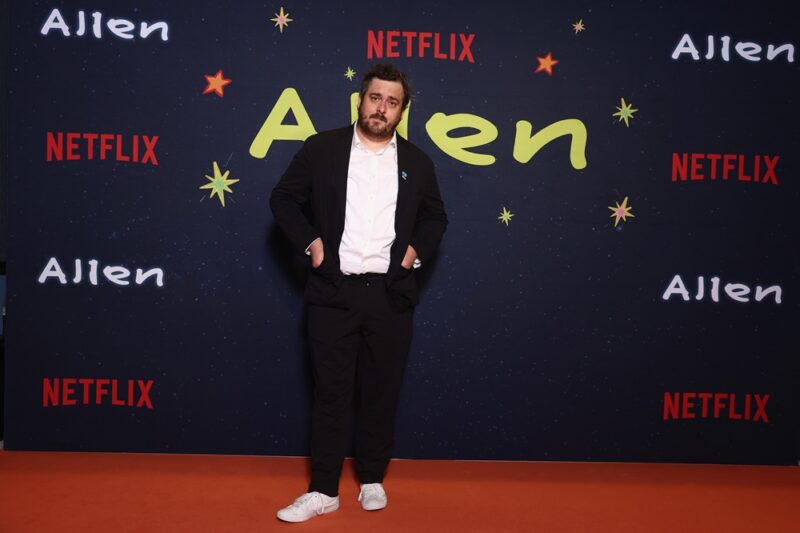
Growing up doesn’t necessarily mean letting go of the things that once made us feel alive. For Australian filmmaker Daley Pearson, that delicate balance between childhood wonder and adult responsibility sits at the heart of Allen, Netflix’s nostalgic, wonderfully offbeat adventure about a man who never quite recovered from losing his extraterrestrial best friend. Co-directed by Pearson and Jeffrey Walker, and co-written with Sophie Miller, the Ludo Studio production follows Petey (T.J Power), whose childhood friendship with a small alien continues to define him long after everyone else has seemingly moved on. Set against the sun-drenched backdrop of coastal Queensland, the film draws deeply from Pearson’s own upbringing on the Sunshine Coast, transforming personal memories, childhood obsessions and the lingering grief of losing his brother into a story about the people we miss, the versions of ourselves we leave behind, and the possibility of finding our way back to both.
Speaking with our Peter Gray ahead of the film’s Netflix release, Pearson reflected on the deeply personal experiences that shaped Allen, his own complicated relationship with nostalgia, and why growing up shouldn’t mean surrendering the fearlessness that once made anything seem possible. Their conversation also explored the extraordinary creative undertaking of bringing the film’s pint-sized alien to life, blending old-school puppetry with innovative Australian visual effects technology while deliberately preserving the handmade imperfections that made the creatures of Pearson’s childhood so memorable. From the emotional significance of a brother’s memory to the technical challenges of making an alien believable in broad daylight, Pearson reveals how Allen became both a celebration of the past and a reminder that holding on to our sense of wonder might be one of the most important parts of moving forward.
One of the things that interested me about the film is that it’s about learning to live in the past. You’ve meticulously recreated your own childhood. The toys, the music, the shop that you worked in. Was there a point during making the film where you realised you were doing what Petey was doing? And when did you know that nostalgia was nourishing you rather than holding you back?
Oh, all the time. I’m still obsessed with it! I know what you’re saying. I think the story we tried to tell was that it’s totally okay to be Peter Pan, but it’s also not saying, “You better grow up and be Peter Pan-ing from Hook. You better get your act together.”
We weren’t trying to take those two extremes. We were trying to say that, you know, he’s not promoted at the end, he hasn’t got a job, he’s not running the shop, he’s not married. He’s still getting by, but he’s carrying this stuff with him rather than letting it drag him down. So I think that was the aim of the story.
I was saying previously that the best people we knew held wonder and responsibility in equal measure. They weren’t dragged either way, and it’s hard to do. I feel like I can’t do it because I’ve got so much rubbish around my office that’s basically Petey’s basement!
But the best people hold both of those things in equal measure, and it’s something to aspire to. It’s definitely something Sophie Miller, who we wrote it with, and Charlie and I wanted to make a film about. Not necessarily telling you why this way is good to live or that way is good to live, but just showing somebody getting by at the end.
I know you’ve spoken about how losing your brother changed your relationship with your childhood, and you’ve spent years trying to find the person you were before. And I feel like Petey isn’t morning Allen. It’s more he’s mourning the version of himself that he was when he was with Allen. Did you look at that difference between missing someone and then missing the version of the person you were with them?
Yeah, totally. I know exactly what you’re saying. You were bolder, or more arrogant, when you were a kid. Arrogant in a good way, I think. Not like, “I’m better than anyone,” but you were just excited about anything and everything.
What’s that saying? Old golfers, not gophers, golfers, never win, and it’s because young golfers just take a chance. I don’t think I’d be in any position that I’m in now if I’d had an awareness of what the future held. And I do miss that part of me.
You know, I do say it’s about my brother, and it is. He was my best friend and all that sort of stuff. But this film was more about the perfume of him, rather than being literally about him.
And so, with Allen, for a while during development, we had this idea that maybe Petey had divorced parents, or he’d experienced a loss, and he’d also lost Allen. But there was something about that which never worked for comedy, because you couldn’t have his older brother yelling at Petey, “We met an alien!” and have him respond, “Yeah, but also Mum and Dad divorced.”
It had to be so ridiculous that he was saying, “We met an alien! Isn’t that incredible?” And his brother’s like, “But it happened. Get over it.”
There’s something, I hope, about that which lets an audience go, “Oh, I sort of feel like that’s me losing my dog when it ran away,” or whatever their particular experience was that pulled them out of childhood. I hope they understand that comedy metaphor.
But in terms of your question, yeah, I definitely think I miss the world as it was then. I know what you mean. I don’t carry myself with as much freedom or effortlessness anymore. I’ve touched the stove, in a way, and once you’ve touched that stove, you’re a bit more cautious.
But I guess those people who, like I said, achieve that balance of wonder and responsibility, if you’re holding on to that wonder, you do try new things despite knowing you might get burned. It’s like, “What else can I do? I’ve got to try it. I’ve got to touch it and see.”
So yes, I think I’m not quite at the point where I’m running around touching stoves again, but I’m getting there. I’m getting there.
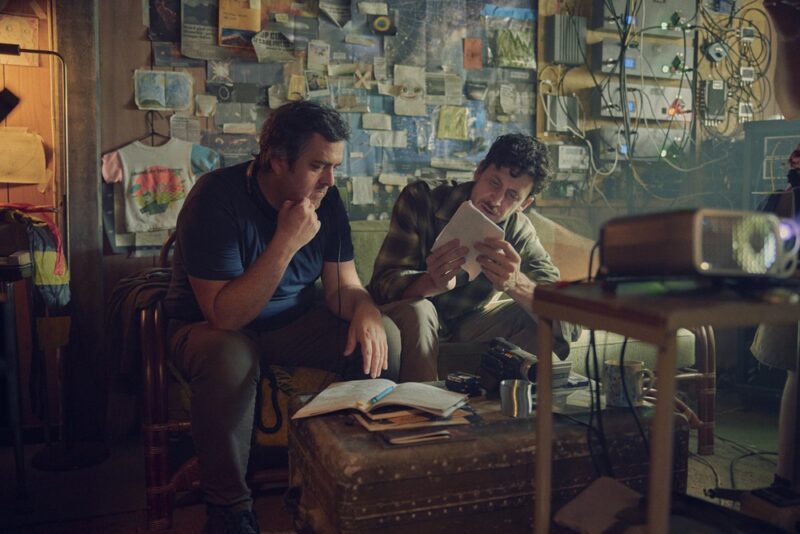
I was lucky enough last year to be invited to the set, so I saw Allen in all his practical glory.
Oh, cool. What we were filming when you were there?
It was the Kite Festival sequence. I’m sure there’s a photo of me kissing Allen’s head somewhere.
(Laughs) A lot of people kissed Allen!
One of the things that I loved seeing on set was the physicality of Allen. Obviously it’s mixed with digital, but seeing those live visuals…it reminded me if the imperfect creatures we all saw in movies and TV growing up. Did you find yourself resisting the temptation to make Allen too perfect to show that there’s human hands behind him?
I’m not sure if you’ve read my LinkedIn and are just saying things I want to hear, because that’s exactly it? (Laughs). I think I was excited to make a film where you could see the sticky tape and stuff, because there was something exciting about that, imperfections and all.
But in spite of that, Allen wasn’t lo-fi. It was a long journey of building Allen. Steve Boyle at Formation Effects and I designed him together, and Steve built him. We did about a million proofs of concept with Netflix, trying various skins, eye colours, animatronics, puppets and fewer puppets.
We had to get his neck right. Allen was originally very small, and then we had to make him a bit bigger so a puppeteer’s hand could fit up his neck. So we went through all these trials and tribulations to get him there, and when we finally felt we’d got him right, we were really proud of it.
It was almost like making a live-action film and then making a whole animated film afterwards to complement him. We had a guy called Jordan, who’s just the most incredible artist, from Alt VFX, and they came in and complemented what Steve and his team were giving them, and what we were giving them from the set.
But you’re right. Everything we shot with Allen, we then shot without Allen, and then we shot with Elgin, who was this incredible actor playing Allen. Daniel Schultz, who runs Ludo with Charlie and me, has an older brother who ran this place called Propsy on the Gold Coast, which was trialling that technology. And Murray Pope was our visual effects producer, so it was all about laying the tracks down.
Despite all the best planning in the world, we still found ourselves a few weeks before filming, trialling Elgin in this empty room, trying to make him perform as Allen. We knew we were making a relatively low-budget, kitchen-sink film, but with this big conceit of Allen. We had this huge element, with incredible support from Netflix, but it was also a fairly lo-fi film in other respects. It doesn’t have huge, crazy action sequences. There are no big sword fights. It’s more of a human drama and comedy, or a family comedy.
But we were testing out this technology with Elgin performing as Allen, and I got to see him perform in two different ways. When TJ was on set, playing Petey, I could see Elgin, who’s about five or six feet tall, performing over here, but then I could also see Allen as this three-foot character in front of TJ.
So you almost got to see the finished scene, with this sort of early Tomb Raider version of Allen, while Elgin was acting alongside him. It was a huge risk that paid off, but it was also this brand-new technology being tested in Australia alongside the old-school puppetry of Steve Boyle and his team. It was this big melting pot of artists and technology coming together to achieve Allen, and I’m really proud. I think they’ve done the most incredible work.
There are about six Allens. I think they might even be here tonight for the screening, hanging around. Six versions of the puppet, and then little hand puppets that we had as well. So whenever you see Petey and Allen interacting, it’s someone’s hand coming into the shot. I think a lot of the practical stuff made it through, but then every now and again, it’s complemented by incredible visual effects from Alt VFX.
I think the other terrifying thing was that we wanted him in broad daylight as well. We weren’t trying to hide him behind lamps or behind a bookshelf. We knew we wanted him, like you and I, sitting here, completely exposed. And that’s a much bigger ask of the team than just having this magical eye peering out from behind a fish tank or something.
We knew he eventually needed to be able to sit there, like you and I are talking now, and not be ridiculous. Well, be ridiculous, but not ridiculous in the wrong way!
Allen premieres globally on Netflix on November 12th, 2026.
