
There’s something inherently unsettling about the suburbs in the films of David Robert Mitchell. Familiar streets, quiet houses and seemingly ordinary neighbourhoods have a way of suggesting that something strange might be lurking just beyond the frame. With The End of Oak Street, the filmmaker behind It Follows and Under the Silver Lake takes that fascination somewhere considerably bigger – and more prehistoric.
Led by Anne Hathaway, the film centres on the Platt family, whose ordinary suburban street is torn from the world by a mysterious cosmic event and transported somewhere entirely unknown. Suddenly surrounded by an environment they don’t understand – and creatures that definitely weren’t part of the neighbourhood before – the family discovers that survival may depend less on understanding where they are than on refusing to let their circumstances pull them apart.
Remarkably, Mitchell traces the beginnings of the film back to an image as strange as it is wonderfully mundane: a dinosaur digging through suburban rubbish. From there emerged a collision between childhood memory and blockbuster spectacle, where the supposed safety of home encounters something ancient, enormous and unknowable.
Speaking with our Peter Gray ahead of the film’s release in cinemas this week, Mitchell discussed why suburbia remains such fertile territory for his imagination, drawing upon his own childhood memories to recreate the film’s 1980s setting, and why carefully composed frames and longer takes remain essential even when dinosaurs are involved.
I wanted to ask about the image before the movie, because I know that you’ve said the entire film really began with a single image of a dinosaur digging through suburban rubbish. It wasn’t a plot. It wasn’t a character. It was just an image. Do you trust images more than ideas? When you get something that vivid in your head, how do you know whether it’s just a passing thought or it’s the beginning of a film for you?
I think both are incredibly important. It probably wasn’t just the image. It’s always a long list of things that I’d like to do. I’ll always have a writing folder for how I’d like to make a movie like this. I thought it would be cool to try and make a dinosaur film, but I wasn’t sure what the way into it was. Then seeing and feeling that image, I understood that it really had to be about the sort of mundane suburb and what is safe about our home colliding with these large animals.
Without giving anything away, I have to say that snake sequence? The stillness of it. The cheekiness of it. And what’s fascinating is that these dinosaurs, they’re not really invading the city. They sort of become a part of the neighbourhood, and the film almost asks us to imagine humans as the ones who suddenly don’t belong anymore. Was that reversal something you were consciously interested in? Or did that kind of naturally emerge as you wrote it?
I think it’s just a result of the way in which the plot mechanism unfolds. They are placed within this other environment. They’re surrounded by it, so that other world is ultimately going to encroach and overtake that in time.
Suburbia has appeared in your work before, and every time it feels slightly haunted, like even before something supernatural happens. What is it about suburban streets that you find so cinematic? Do you think they’re naturally mysterious, or have we stopped looking closely enough?
I’m just calling back (to) that feeling I had as a kid, where I could be in the yard looking over to the dead-end street nearby, looking down into the woods. There was this old brick or rock wall, and it was just imagining what’s in the shadows, you know? What’s beyond the chain-link fence? As a kid, just thinking about the films that I had seen, the storied I’d read, and imagining those things in my own suburban world, and then as an adult trying to remember that feeling. I do think it’s a little bit burned into my brain – that feeling – and there’s all different ways you can express that tonally.
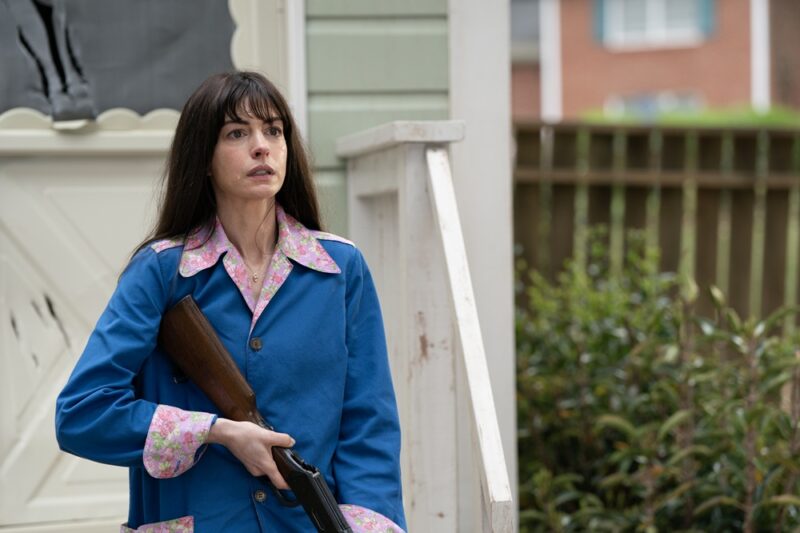
At the forefront of this suburban family, we have Anne Hathaway. I know that you’ve mentioned she reached emotional places that you hadn’t seen from her before. Was there a particular day on set where you remember thinking, “This scene is becoming something completely different because of what she’s bringing?”
I don’t know if it’s so much that the scene is different, but what I’m feeling from the character is that the scene is operating at the highest level is the best way to express it. Even just a moment, like where she discovers Mrs. Huddleston and she’s making her way through the kitchen, and the expression of fear and resolve, and all the things that we’re feeling through her…I thought that was pretty fantastic.
One thing I wasn’t expecting was the 1980s setting. I just had assumed going into the film it was modern day, but then as I was watching I realised it wasn’t at all. I was trying to pinpoint where it was. You created this neighbourhood with such affection that it almost feels preserved in a way, but then this story is about displacement. I wondered if the period setting is about memory itself? That every childhood neighbourhood eventually becomes something you can never quite return to?
That’s interesting. I think there’s something valid to that. I was a kid in the 80s and it was probably a little bit of personal expression and a bit of memory. This story is not autobiographical, of course, but there are elements of memory within the family and things that did inspire the story. I think that’s an important part of it.
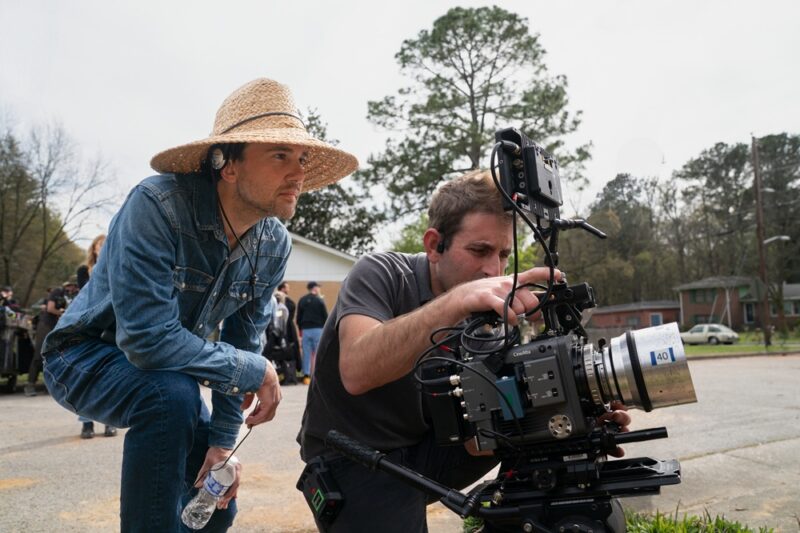
I know that you’ve said that you deliberately avoid excessive coverage and wanted scenes to play out in longer takes. I feel like that’s a brave choice with a film that has as much spectacle as this. Was that discipline partly about trusting the audience to discover things inside the frame instead of constantly directing their eye?
Yeah, it’s a lot of things. One, it’s just my job as a filmmaker to make choices. I think that sometimes if you make a choice early on, you put your energy into making that frame the best frame, as opposed to having six cameras going on something and then (just) picking. There’s nothing wrong with that approach, and plenty of great filmmakers do that. I’m not knocking that, but I like to put a lot of love into the camera placement and whether something is subjective or objective. Or what does that framing make you feel? And what is happening within it? Are we seeing everything? Are there things outside of this frame? To me, that’s part of the fun of putting a film together.
I think there’s value in letting things play out. Sometimes there’s a value in extensive coverage over certain scenes. I don’t think either is wrong. It just depends on what you’re trying to do. We weren’t really scared so much doing that with some of the action or danger or dinosaur moments, because we definitely had a pretty detailed plan for a lot of that. Some of those things worked out. We spent a lot of time working with my cinematographer and some really talented storyboard artists – they’re an important part of the process too.
And just before letting you go, I feel like your films leave audiences debating what they saw long after the credits roll. Do you enjoy that uncertainty? Or is there secretly a moment when you hope someone finally asks the question that unlocks everything you were trying to say?
I love people exploring work and seeing things that either are intended or unintended. I like that maybe not everything is completely resolved for some people. That maybe they have to think about it for a moment, or watch the film again, or that if you do love the film that another viewing can unlock a little more. I like that with really anything that I make, including this movie. You can just watch this and experience a ride. You can have moments of suspense and drama, and frightening moments, and shocking moments, and joyful, funny moments. But there are more layers to it as well that some people will want to find.
The End of Oak Street is screening in Australian theatres from August 13th, 2026.
