
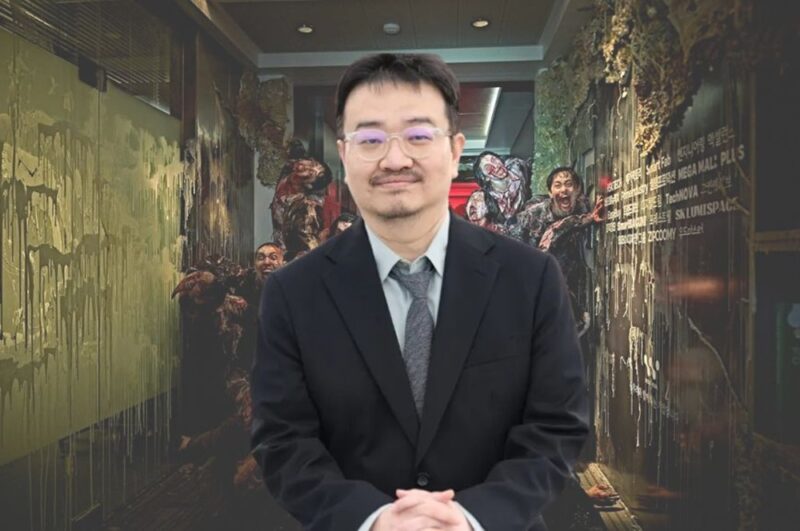
Few filmmakers have done more to redefine the zombie genre than Yeon Sang-ho. Nearly a decade after Train to Busan transformed a familiar horror concept into a razor-sharp reflection of modern society, the South Korean filmmaker returns to the infected with Colony, an ambitious new thriller that asks a far more unsettling question: what if the zombies aren’t dying, but evolving?
Set within a biotech conference thrown into chaos by a rapidly mutating virus, Colony follows Professor Kwon Se-jeong as she navigates an outbreak that begins to blur the line between infection and transformation. Beneath its nerve-shredding horror, the film explores anxieties surrounding artificial intelligence, collective thinking, scientific advancement, and the growing fear that individuality itself may be under threat.
Ahead of the film’s release, Yeon spoke with Peter Gray about the evolution of the zombie genre, the dangers of conformity, the duality of scientific progress, and why the monsters in Colony may be far more human than we expect.
I wanted to ask about evolution and infection within the film. One thing that makes this film feel different is that most zombie stories, the infected are not dying, they are evolving. Here, what point does a zombie stop being a monster and become a new form of life?
To my understanding, my references come from Romero’s Dawn of the Dead. I always found that zombies were a symbol for dormant danger outlined in our society. I’ve always seen it as a life form that represents the world I live in right now. I wanted to question what is the dormant danger. That could be AI. It could be our need to become a coalescent society. Those were the things I wanted to explore with this film.
Talking about fear of change, I know that you’ve said you began with the question, “What are the anxieties of the era we’re living in now?” What answer did you eventually arrive at? And what do you think most people are afraid of today?
I wanted to explore the nature of modern society, where information is exchanged faster than ever before. While this rapid flow of ideas can connect people in powerful ways, it can also accelerate groupthink and mob mentality, creating echo chambers that reinforce dominant viewpoints. We’ve seen this influence everything from public discourse to the rise of technologies like AI.
What concerns me is that individuality seems increasingly fragile in this environment. More and more, people are being told what to think rather than encouraged to think for themselves. As certain schools of thought become increasingly mainstream and amplified, there is a risk that independent perspectives are pushed aside. For me, what makes us human is our individuality – our ability to form our own beliefs, challenge ideas, and see the world through a unique lens. That’s something I worry may be at stake.
I really loved the imagery of when all the zombies are merging together. It made me think how in so many zombie films the monsters stay the same and the humans adapt. In Colony, both humans and the affected are changing. Were you interested in the idea that survival itself can transform us into something unfamiliar?
The film started from the perception that the more we become a group, the more we approach the group mentality and go with the flow of the zeitgeist of what’s popular at the time. It’s a very scary place to be for humans. It’s the perfect world for communication, and that’s what the film’s antagonist believes. There is no jealousy in this world. There is no human thought that interferes with the collective mindset. And Seo Young-cheol, the antagonist, believes that’s the case. Sometimes humans find that we only agree because we are more afraid of being alone, and that’s why zombies are a representation of a collective where your individuality and fear of being left out is the cause of why you align yourself with the mob mentality. Now, Kwon Se-jeong, the main character, she’s not afraid to be alone, and that’s why she’s able to oppose the zombie horde.
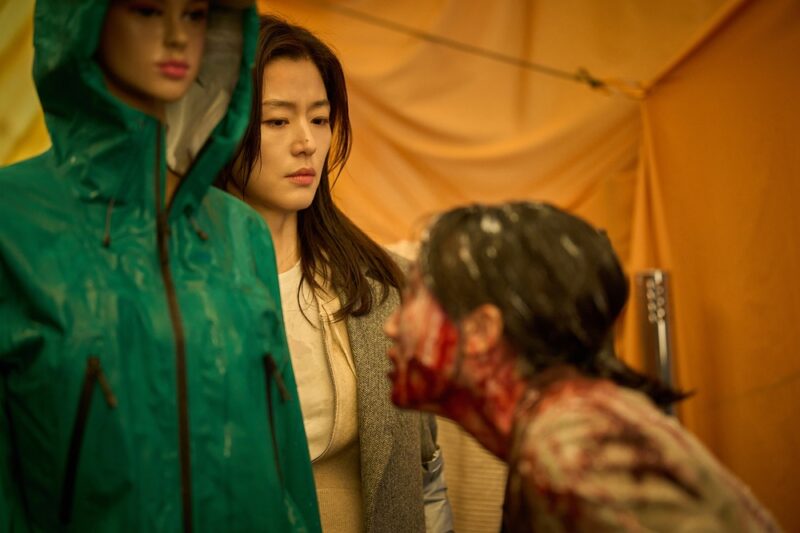
Speaking of Kwon Se-jeong, as a biotechnology professor…do you think modern science creates more hope than fear? Or have those two things become impossible to separate?
I think most things have a duality to them. There are pros and cons to almost every advancement we make. I recently read an article about scientists creating an organoid brain – a genetically and medically engineered brain grown in a laboratory. On one hand, I see it as an incredible medical breakthrough with the potential to transform healthcare and our understanding of the human mind. On the other hand, it raises complex moral and ethical questions that don’t have easy answers.
I’ve also read about AI systems becoming capable of designing viruses. The developers argue that this technology could help scientists identify potential threats, develop vaccines, and prevent future outbreaks. But in the wrong hands, that same technology could be used for harmful purposes and pose a significant risk to society.
Ultimately, I think it comes down to how we, as humans, choose to use these advancements. Whether it’s artificial intelligence, genetic engineering, weapons, or even something as fundamental as the discovery of fire, none of these developments are inherently good or bad. They are tools, and their impact is determined by the intentions and values of the people using them. That’s why I believe there will always be benefits and dangers to every scientific breakthrough – it all depends on how we approach it.
That speaks to the changes we’ve seen in the 10 years since Train to Busan. Audiences saw zombies as the threat with that film, and now watching Colony I found myself wondering if the real subject has become evolution. How has your view of “the zombie” changed over this last decade?
In Train to Busan, the protagonist is a fund manager whose world revolves around stocks and investments. To me, that’s one of the most purely capitalist professions our society has produced. His job is built around commodifying the hopes, ambitions, and financial futures of others who are participating in that system. What interested me was what happens when that system suddenly collapses.
Once his family is threatened and the structures that underpin his life begin to fall apart, all of those capitalist ideals and assumptions become meaningless. The horror of Train to Busan comes not just from the zombies, but from watching the foundations of society crumble and seeing how people respond when the rules they’ve relied on no longer apply.
Over the last decade, the world has changed dramatically, and it’s continuing to change at an accelerating pace. Many of us are struggling to adapt, and it’s becoming increasingly difficult to predict what the future will look like. There’s a real horror in that uncertainty – in not knowing what’s coming next.
That’s a feeling I think many people share today, and it’s something I wanted to explore and amplify in Colony. Beneath the monsters and the chaos, the film is really about the anxiety of living in a world that feels increasingly unstable and unpredictable.
Is there a fear or social anxiety that you still haven’t found the right film to explore yet?
I wanted to make a zombie film that goes beyond the traditional conventions of the genre. In most zombie movies, the rules are very clear: zombies are a threat, and the objective is to kill them. They’re treated as monsters, and there’s rarely any question about their place in the world. What interests me is a different question: is a zombie still human? And if so, what responsibilities do we have toward them? Rather than focusing solely on zombies as creatures to be feared or destroyed, I wanted to explore the complexities that exist beyond that simple dynamic.
If we were able to cure zombies, what would happen next? How would they be received by society? Would they be welcomed back, feared, discriminated against, or held accountable for actions they committed while infected? Those questions open up a much richer conversation about identity, humanity, forgiveness, and social reintegration. For me, the zombie genre has reached a point where it can evolve beyond pure survival horror. I wanted to use the familiar framework of a zombie story to explore what comes after the apocalypse and what it really means to be human.
Colony is now screening in Australian theatres.
