

Few television series are as fearless as Star Trek: Strange New Worlds. Across its first three seasons, the Paramount+ Original has redefined what modern Star Trek can be, embracing everything from courtroom drama and sweeping romance to a full-blown musical, all while never losing sight of the optimism and humanity that have defined the franchise for almost six decades. It’s a series unafraid to take enormous creative swings, but one that always ensures those risks serve the characters first.
With Season 4, Captain Christopher Pike (Anson Mount) and the crew of the U.S.S. Enterprise once again venture into uncharted territory, facing new worlds, familiar faces, terrifying adversaries and deeply personal reckonings that continue to shape the people destined to become the icons fans know from The Original Series.
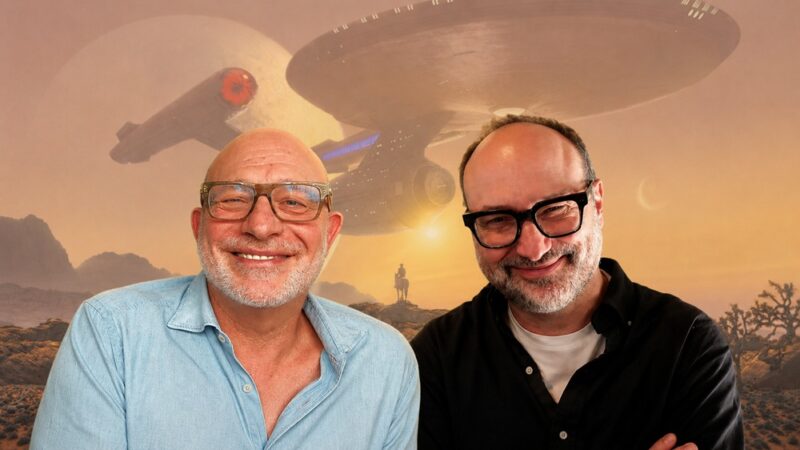
Ahead of the new season, our Peter Gray spoke with co-showrunners and executive producers Akiva Goldsman and Henry Alonso Myers about why Strange New Worlds continues to push the boundaries of genre storytelling, the philosophy behind its boldest episodes, and why embracing change has always been at the heart of the series’ five-season journey.
I wanted to ask a “Why now?” question, because Strange New Worlds has become known for taking these enormous swings. We’ve had courtroom drama and a musical/comedy crossover episode. Akiva, how do you decide when a crazy idea is earning its place rather than becoming a gimmick?
Akiva Goldsman: Well, I think that’s what we try to do. I mean, first of all, it’s right there in our title, isn’t it? We are Strange New Worlds. What we try to do is use our different worlds – which are really different genres – to put a lens on storytelling that might be a little atypical for Star Trek. In every one of our genre episodes, there’s some enhancement of the emotion. If you’re asking about the puppet episode, for example, what’s a better way to swirl chaos around a Vulcan who’s wrestling with the duality between order and disorder than a bunch of puppets? It goes back to the musical, where, as Henry used to say, what’s great about a musical is that you sing your subtext. We’re always trying to use the genre to tell the kind of Star Trek stories we love, just through a different way in.
Fans come into every season wondering, “What’s the episode everyone’s going to be talking about?” Henry, is that expectation exciting creatively? Or does it sort of become a little bit intimidating at the same time?
Henry Alonso Myers: Well, I think we really try to see each episode as its own little movie. A friend of mine I used to work with liked to say that we sit with a story until we’re jealous of it. By the time we’re jealous of it, we know it’s good. There isn’t an episode this season that I’m not jealous of. I’m jealous of every single one. There’s not an episode that I don’t think is a big swing in its own way. They all touch my heart, and I feel like that’s really the key. My real job is to watch it and feel it.
I feel like that’s how I want to watch every episode – as something to be jealous of.
Henry Alonso Myers: We get to do 10 episodes. You really got to make them good. Not what we don’t want to ever make them good. It’s just that we want to…everyone has to try something. You really have to think about the purpose and the why.
And with character-first storytelling, you’re putting these characters through years of accumulated trauma. Was there a point writing Season 4 where you realise you can’t just give these characters another adventure? You actually have to let this story change them?
Akiva Goldsman: No, we wanted to change them all the way through. In one sense, we were obliged to, because we didn’t start them out as the characters you see in The Original Series. Fundamentally, change was built into the premise from the very beginning. We also have a job to do, which is set up in Season 4 but really delivered in Season 5, when it comes to both the characters we know and the ones we don’t know as well from canon. Where did they go? How did they get there, and why? In some ways, the watchword of our show is change. It would’ve been impossible for these characters to remain static, because we already know what’s coming.
Henry Alonso Myers: But if you come into every season – or every episode – and ask the characters to do the same thing they’ve been doing all season, then you really haven’t done your job. Your job is to work with genuinely talented people and ask them to try things they may never have tried before. If all they’ve been dealing with is trauma, maybe it’s time to give that actor something new to explore. I think that’s always the challenge of a fourth season: don’t do the same thing. Rise to the occasion and try something new with everybody.
It’s so awesome to have a show like that feels like something we know so well, yet continues to surprise every season. Thank you for keeping this genre and spirit of TV alive. Takes me back to the shows I watched growing up.
Henry Alonso Myers: We are delighted that it has (that). That’s literally what we are doing – we’re trying to bring the thing that made us get through childhood.
Star Trek: Strange New Worlds Season 4 premieres its first episode on Paramount+ on July 23rd, 2026, with each subsequent episode airing weekly before the season finale on September 24th.
