
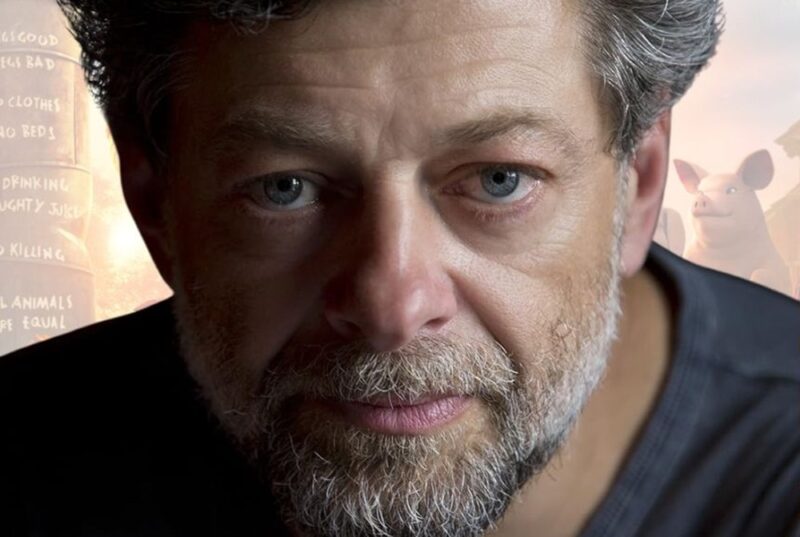
Andy Serkis has spent much of his career exploring what power does to those who wield it. From Gollum’s all-consuming obsession in The Lord of the Rings to Caesar’s reluctant leadership in Planet of the Apes, his work has repeatedly examined the fine line between idealism and tyranny. Now, the acclaimed filmmaker turns his attention to one of literature’s most enduring political allegories with an ambitious animated adaptation of Animal Farm.
Featuring an all-star voice cast including Seth Rogen, Gaten Matarazzo, Steve Buscemi, Glenn Close, Woody Harrelson, Kieran Culkin and Laverne Cox, the film reimagines George Orwell’s timeless novella for a new generation. While remaining faithful to the novel’s core warning about authoritarianism, Serkis reshapes the story into a contemporary, family-friendly fable that confronts misinformation, manipulation and the seductive nature of power in today’s world.
When our Peter Gray spoke with Serkis, their conversation went well beyond talking animals. They discussed why Animal Farm feels more urgent now than ever, the challenge of adapting a book that has become part of our collective cultural memory, why he chose hope over Orwell’s famously bleak ending, and what 15 years of bringing the project to life taught him about leadership, empathy and the enduring relevance of one of the twentieth century’s greatest cautionary tales.
I wanted to ask about adapting Orwell, because “Animal Farm” is one of those rare books that I think people feel like they remember it perfectly, even if they hadn’t read it in years. Did you feel you were adapting Orwell’s actual text, or the cultural memory of Orwell?
That’s a really great question. It’s one of those books that’s sort of eternally relevant. I read it when I was a kid and I didn’t fully understand it, other than really emotionally responding to it and finding it terribly moving that these animals had created a perfect society and it all went horribly wrong. It was hard to bear, and then, of course, what happens to Boxer and his desire to work harder. I found it really moving. When the chance came to make it…it was actually on the back of years later, as an adult, I had read it a couple of times in between, and I’d seen the 1954 animation and the Henson animatronic version in the late 80s or 90s, I believe.
As an actor, I found myself playing Caesar in the Planet of the Apes movies, and there’s a bug theme where Caesar leads the apes to go break out of the facility that they’re in, and it suddenly dawned on me that here was an opportunity now to make a version of the film that, with all the technology available, could possibly speak to a young modern audience. Although we weren’t going to drift thematically from the book, and we worked with the Orwell Estate on this, we felt it was necessary to not talk about totalitarian Russia 80 years ago. We wanted to talk about what it is where oppression lies today and how it operates. That was the take. It was written originally for children to start to grapple with darker, more adult themes, and how do we make this accessible? Not just for young inquiring minds, but if it would resonate with parents and their grandparents. We wanted it to be cross-generational, and yet to feel very modern and relevant. That was how we approached it.
The original novella is relentlessly pessimistic, and your film ends with uncertainty and hope. Was that a creative choice, or do you think audiences in 2025 require a different emotional contract than readers did in 1945?
That’s very interesting. Obviously, in 1945 it was believed totalitarianism would never go away, and to a certain extent Orwell wasn’t wrong. Oppression still exists around the world in many different forms – some subtle, some brutally obvious – and there are regimes that have remained in power for decades. What’s changed is the way manipulation operates now, the way power is pursued and, once it’s gained, how it’s exercised. That’s very close to what Orwell was writing about: misinformation and disinformation as tools for controlling people. Today, leaders aren’t always out-and-out dictators you can clearly identify. They often hide behind layers of institutions and narratives, allowing them to operate for longer through the erosion of truth.
That was really the starting point for us. We weren’t moving away from what Orwell was exploring. At his core, he was an anti-authoritarian. He stood against many things rather than being unequivocally for any one ideology. He grew up in a lower middle-class background, went to Eton, worked as a colonial police officer in Burma where he witnessed extraordinary brutality, lived down and out in London and Paris, fought in the Spanish Civil War and ultimately found himself opposing communists as well. He was always searching for a way to explain how authority oppresses people in its many different forms. That’s why we kept asking ourselves: what would the targets be now? What are the conversations we’d be having today?
That probably answers this next question, because I feel like most adaptations ask, “How do we stay faithful?”, and I’m more interested in asking the opposite question. What did you deliberately choose not to be faithful to because you felt cinema demanded something different?
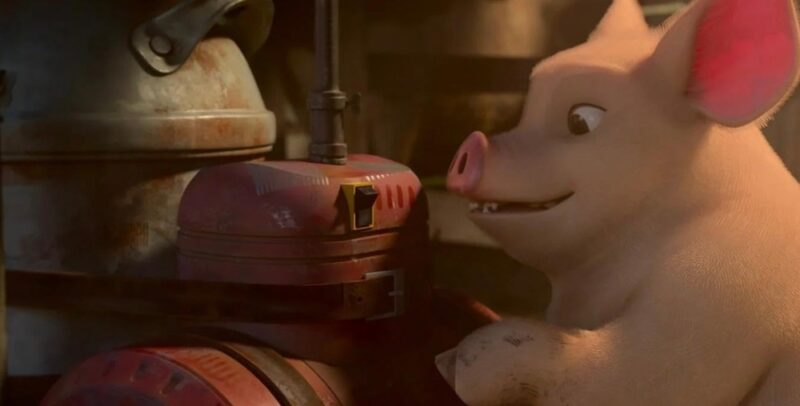
There were two main things, really. In the book, as you’ll know, there isn’t a central character that you follow, so there’s no real protagonist. In a film, you need that. We wanted the moral maze of the story to centre on how a young child might respond if they were put in that position. So we created the character of Lucky, played by Gaten Matarazzo. He allows younger audiences to ask themselves, “Do I see myself as just another animal – part of the larger group – or as something different?” If you’re told that because you’re a pig you’re better than everyone else, do you accept that, or do you question it? That’s the journey Lucky goes on.
It also allowed us to explore the world of the pigs, who are largely off-screen in the book. The information comes down from them, but you never really see how they operate. I wanted to go right into the belly of the beast and see that machinery at work. Following a young mind that can be corrupted, as Lucky is, until the scales fall from his eyes and he realises he’s made a mistake by backing the wrong leader, felt like a compelling way into the story.
The other major change was the ending. We chose not to finish the story in quite the bleak way Orwell does. The novel ends with the animals looking from pig to man, and man to pig, unable to tell the difference. It’s an extraordinarily powerful ending, but it’s also incredibly bleak. There isn’t really a conventional third act, and we wanted to say to younger audiences: now that you’ve seen how everything went wrong, what would you do differently? So rather than giving it a neat Hollywood ending, we wanted to leave the question open. The conversation doesn’t stop when the credits roll – it continues with the audience.
And looking at Napoleon, because one of Orwell’s most frightening ideas is that tyranny doesn’t arrive looking monstrous; it arrives looking very practical. How did you approach Napoleon so that audiences might understand him before they fear him?
That’s exactly what we were trying to do. Casting someone like Seth Rogen – who’s funny, lovable, affable and incredibly talented – felt like the perfect choice. We thought, what if he’s genuinely entertaining? He’s a great comedian, someone who wins people over because he makes them laugh.
That’s the kind of world we’re living in now. Many leaders see themselves first and foremost as entertainers, using that as a way of gaining influence. At the same time, they don’t feel bound by the truth. We see it and hear it every day in the news, and that approach has really proliferated as a means of control. You make people feel like you’re their friend – their best friend – and that’s how you earn their trust and, ultimately, their loyalty.
Looking throughout your career, from Gollum to Caesar to now, I feel like you’re fascinated by characters that are transformed by power. Have you reached any personal conclusions about why power changes people so consistently?
That’s a huge question (laughs). I think, for me, we live in a world where leaders have stopped listening. They’ve stopped being empathetic. I was talking about this earlier in relation to Caesar, who continues to teach me things even now. Here was an ape who was raised by humans before being thrown into a facility with other apes, where he felt like an outsider. Yet he found a common language that brought everyone together. He tried to bridge the worlds of humans and apes because he was a good listener. He understood the value of keeping his ears open, and that’s something so many leaders lose once they gain power. That’s one of the reasons Caesar remains so close to my heart. Sometimes you genuinely learn from the characters you play, and he’s definitely one I’ve learned from.
And if ‘Animal Farm’ were written from scratch today, not as Orwell’s novel, but as an original story, what animal do you think would become the symbol of power now? Do you feel it would still be pigs?
Interestingly, pigs are actually very friendly, social and affectionate animals. They look after one another, so in a way Orwell was misrepresenting pigs. That’s a difficult question, though – which farmyard animal would fit instead? It’s interesting because, in the book, Orwell includes the cat, who’s only a small character but a fascinating one. The cat doesn’t really engage with the rules or the wider cause. It just does its own thing. There’s a wonderful moment where it tries to befriend the birds, not because it wants to make friends, but because it wants them to come close enough to eat them.
So, in a way, I’d probably say the cat. And I’m a huge cat lover, by the way. But cats can be manipulative and very good at getting their own way (laughs). You don’t necessarily mistrust a cat, and I think that’s quite reflective of the way leadership often works now.
And just before letting you go, I feel like 14 years is enough time for a child to become an adult. You’re finally letting this film go into the world. Is it the film you set out to make? Or is it the film that the journey insisted on?
That’s a great question. It’s strange because when we first started approaching this, about 15 years ago, our goal was simply to make it for a broad family audience. That never changed.
What’s changed is the world around us. All of the design choices – the way we approached the animals, the world itself, even the neighbouring farm, Pilkington’s – were conceived years ago. Yet somehow they’ve become even more relevant. The same goes for the use of technology, surveillance and the spread of information. Those things have existed for decades, but they feel far more central to everyday life now.
Some people have accused us of making a politically partisan film, but that was never the intention. We didn’t want to attack any one leader, regime or system of government. The film is really about how leaders can pull the wool over the eyes of the people they lead. That’s the central idea, and it’s only become more relevant with advances in technology and the way information is created, shared and consumed.
Animal Farm is now screening in Australian theatres.
