

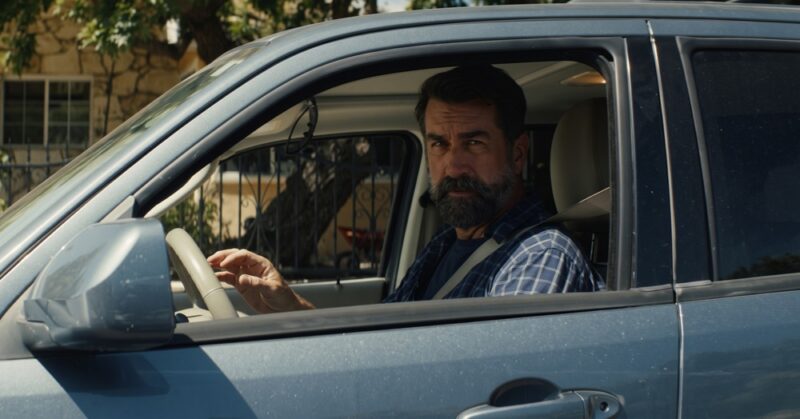
Nickels is the type of film that could have very easily overwhelmed itself. A story about grief, possible reincarnation and the signs we attach meaning to could have exploded into melodrama or lengthy monologues about faith. Instead, director Spencer King approaches the material with admirable restraint, allowing uncertainty to hang over the film and trusting the audience to decide how much they want to believe.
Rob Riggle stars as Tom Monroe, a successful entrepreneur and devoted family man who has never fully recovered from losing his older brother as a teenager. The death left wounds that remain decades later, including an estrangement from his sister, Deborah (Rebecca Gayheart). When his neighbour’s son, Mitch Diller (Aaron Holliday), survives a devastating motorcycle accident, Tom gradually becomes convinced there may be something of his brother within the young man.
Whether Tom has stumbled upon something extraordinary or is simply seeing what he desperately wants to see is where Nickels finds its most interesting tension. King doesn’t force an answer, nor does he treat Tom’s growing conviction as objective truth. The possibility of something spiritual is always present, but the film is ultimately more interested in what believing does to Tom than proving whether his belief is justified.
That distinction prevents Nickels from settling comfortably into the conventions of a traditional faith-based drama. Faith is part of its narrative fabric, but it isn’t prescribed to the viewer. Tom doesn’t seek validation from a priest or a reincarnation expert, and the screenplay doesn’t continually reassure us that we should interpret events one particular way. Instead, King leaves enough space for audiences to bring their own relationship with spirituality, coincidence and loss to the story. How much you believe ultimately informs how you interpret Tom and Mitch’s increasingly complicated connection.
That ambiguity is enhanced by a quiet sense of unease that King maintains throughout. Even seemingly ordinary domestic scenes carry an underlying tension, as if Tom’s comfortable suburban existence has shifted slightly off its axis. King and cinematographer Luke Dyra make particularly effective use of light and shadow, while occasional stylistic flourishes reinforce the idea of competing realities existing simultaneously. Tom can believe one thing while everyone around him sees something entirely different.
Riggle proves particularly well suited to such restraint. His comedic persona naturally brings expectations of a certain energy, but King largely strips that away. Tom isn’t constantly cracking jokes to conceal his sadness; he’s a wounded, recognisable man who has learned to function around an absence he never truly resolved. Riggle plays that pain without reaching for obvious emotional signposts, often letting a slight change in expression or vocal inflection carry more weight than a grand breakdown ever could.
It’s an impressive dramatic showcase for an actor whose comic timing arguably helps him understand precisely when not to push a moment. His natural likability also becomes important as Tom ventures further down a path that increasingly concerns those around him. We may question his conclusions, but Riggle ensures we understand why he needs them to be true.
His chemistry with Elizabeth Tulloch, as Tom’s wife Liz, gives their marriage an appropriately lived-in quality, whilst Holliday proves an effective counterpoint as Mitch. Their scenes become increasingly loaded because Mitch is simultaneously a young man in his own right and, through Tom’s eyes, the potential embodiment of somebody who has been absent for thirty years. Holliday smartly avoids playing too heavily into either possibility.
The supporting characters aren’t always afforded quite the same depth. Odessa A’zion provides solid work as Tom’s daughter Harper, though she doesn’t always convincingly register as a high-school student, whilst Tom’s estrangement from Deborah feels like particularly fertile emotional territory that could have been explored further. The repercussions of Tom and Mitch’s relationship across both families similarly suggest a messier, more complicated film sitting just beneath the surface; Tom Arnold and Vinessa Shaw round out the impressive ensemble as Mitch’s parents, similarly turning in nuanced work that elevates their limited appearance.
That ultimately speaks to the larger limitation of Tim Tuchrello’s screenplay. Nickels introduces compelling ideas surrounding grief, guilt, reconciliation, spirituality and second chances, but doesn’t always dig deeply enough into them. For a film so comfortable sitting with uncertainty, there are moments where you wish it would sit with its characters just a little longer.
But King’s refusal to inflate the material ultimately works in the film’s favour. Even the titular nickels – ordinary objects imbued with extraordinary significance – speak to something recognisably human. We find patterns, objects, songs and coincidences that remind us of people who are no longer here. Whether those moments are genuinely signs from somewhere beyond us or simply the ways our memories refuse to let somebody disappear is a question Nickels is smart enough not to answer.
And perhaps an answer would defeat the point. What matters is what those signs mean to the person who finds them.
Quiet and sincere without becoming saccharine, Nickels understands that hope can be as destabilising as grief itself. The possibility of getting someone back might sound comforting, but it also means reopening everything you’ve spent years learning how to survive. Riggle brings an affecting stillness to that idea, whilst King allows the supernatural to remain secondary to something considerably more tangible: the strange, deeply personal ways the people we lose continue to live alongside us.
Nickels may not fully excavate every idea it introduces, but its emotional sincerity and refusal to dictate what its audience should believe give the film a quiet power. It isn’t really asking whether Tom’s brother has returned. It’s asking what happens when a grieving man finally allows himself to believe that he might have.


THREE AND A HALF STARS (OUT OF FIVE)
Nickels is screening in select theatres and On Digital in the United States from October 2nd, 2026.
