


For Connor Finch, the key to understanding Jack in Bookish has always been deceptively simple: he’s a working-class kid who learned to survive because nobody gave him much of an alternative.
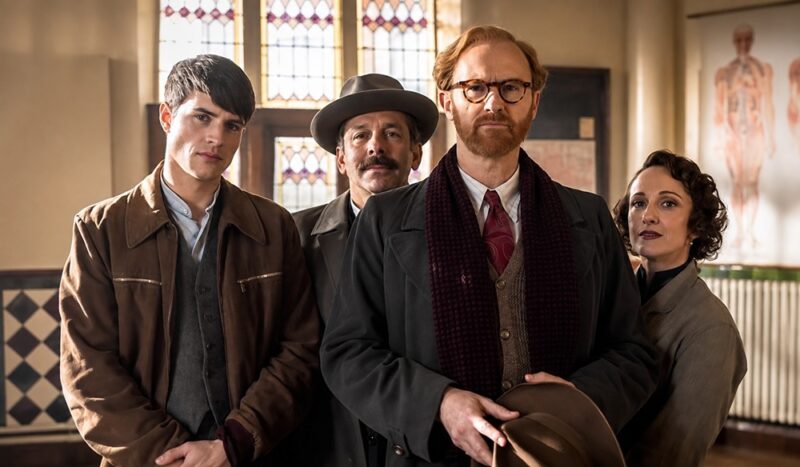
Created by and starring Mark Gatiss, the richly atmospheric detective drama returns to post-war London, where eccentric bookseller Gabriel Book once again puts his literary mind to work solving an assortment of increasingly tangled crimes. But alongside its mysteries, Bookish has quietly built one of its most compelling relationships between Gabriel and Jack, the recently released ex-convict who entered the bookshop looking for a second chance and unexpectedly found something resembling a home.
As Finch tells Peter Gray to coincide with the forthcoming second season release on HBO Max, Jack’s journey has never simply been about rehabilitation. Having grown up without parents, moved through foster care and ultimately landed in prison, his idea of “normality” is less about conforming to post-war expectations than finding something he has rarely experienced: stability. And as the revelations of the first season force Jack to reconsider both his past and his relationship with Gabriel, the upcoming season finds the pair working increasingly closely together, even if trust between them remains more complicated than either might admit.
First of all, I wanted to ask about Jack, because he spends so much of the first series wondering, “Why me?” He seems to know almost immediately that Gabriel and Trottie’s generosity doesn’t quite add up. When you’re playing somebody who knows he’s being lied to, but doesn’t yet know what the lie is, how much suspicion do you allow into the performance without giving away where Jack’s head is going?
Yeah, I think a lot of the driving thought behind that was simply that Jack has never really had anyone. He doesn’t have any family or a real support system, and he’s reached his mid-twenties in that frame of mind.
So, initially, it’s a very genuine question of, “Why me?” Out of all the people (Gabriel) Book could have chosen to help, why has he chosen Jack? After 25 years of essentially being on his own, why would somebody suddenly pick him up and seemingly do everything they can for him? It just doesn’t add up in Jack’s mind.
I think that genuine confusion drives him at the beginning, and then gradually it starts to develop into something more suspicious: “Well, is there another motive here?”
Following on from that, Jack arrives believing he’s essentially been handed a job and a second chance, but by the end we understand that Book has actually been looking for him. Once you knew the truth about why Jack was there, did that change the way you looked back at those earlier scenes and Jack’s relationship with Book?
I think the difficulty was actually trying to forget that. As an actor, you know what’s coming, but Jack doesn’t. If you look at the end of episode four in series one, Jack discovers a photograph of Felix, his dad, in one of the bedrooms of the bookshop. But for everything leading up to that moment, I had to completely forget what I knew and make sure I wasn’t playing into the reveal.
In a way, that actually helps you build the arc of Jack’s thought process. There are moments where he’s angry, moments where he’s upset, and moments where he’s confused, and you can gradually see those feelings developing as he gets closer to the truth. The actor’s knowledge is one thing, but when you step into the character, you have to put that knowledge aside completely.
Looking at that, and this feels like a good way to bridge the two seasons, there’s something almost cruel about Jack finally discovering where he comes from at exactly the moment he has to reconsider the people who’ve given him a sense of belonging. Do you think finding out the truth ultimately makes him feel more secure, or does it initially leave him feeling even more alone?
Yeah, it’s a really difficult thing, isn’t it? He’s reached this point where, going back to the first question, he’s finally found people who genuinely have his best interests at heart. He has a support system and this sense of a found family that he’s never really had before.
But then he’s presented with this information and the possibility that he could go and find out where he came from. I imagine that’s an incredibly difficult position to be in when you’ve spent so much of your life simply accepting that you don’t know, and perhaps not even wanting to find out.
Then suddenly you have this found family alongside all of this new information, and it becomes a question of: Do I look into it? Do I really want to open that door?
Looking at that sense of outsiderness, you have this post-war melancholy running through the series, Jack carrying the label society has given him as an ex-convict, and Gabriel concealing his sexuality because revealing who he is could destroy his life. Do you think that shared experience of being outsiders is partly why these two men understand each other so instinctively?
Yeah, definitely. It’s funny because, again, it comes back to that distinction between what’s useful for the actor to know and what the character actually knows.
I think an important part of the first series was how unsure and unnerved people were around Jack. Only Book, Trottie and Nora actually knew why he went to prison and the circumstances behind it. Everyone else simply knew him as someone who had just come out of prison, so there was immediately this judgement attached to him.
For a long time, Jack also doesn’t know about Book’s own arrangements. And Jack doesn’t necessarily want to talk about his time in prison. When he needs to, he can, but you can see how uncomfortable and uncertain it makes him because he knows that being in prison doesn’t define who he is.
I suppose it’s the same with Book. His sexuality doesn’t define the entirety of who he is either. So there is that shared understanding between them of, ultimately, why should it matter?
Jack has obviously experienced imprisonment before we meet him, but losing Book’s trust almost feels like a greater punishment for him. Was that something you considered in the performance – that, by this point, losing the trust of someone he loves and respects could hurt Jack more deeply than prison ever did?
Absolutely. It was heartbreaking when we see Jack in episodes five and six of the first series. He’s left the bookshop, and even when he sees Book, he tries to maintain that stiff upper lip, but it doesn’t really work.
He’s finally found someone who not only trusts him, but whom Jack trusts completely. He’s allowed himself to let those walls down with Book, probably for the first time in his life, and then suddenly that relationship is gone.
So, yeah, I think there’s an enormous amount of pain that comes with Jack walking away. He’s opened himself up to someone in a way he never has before, which makes losing that trust incredibly painful.
And when you filmed that final scene, how much were you carrying the six episodes that had brought Jack to that point? Did it feel like, in that one conversation, he was suddenly having to reinterpret everything he thought he knew about his life?
Yeah, it was never really intended to be an emotional scene, but it ended up becoming one. Initially, I thought it was simply about Jack discovering this information, but because he’d been on this journey with Book – and I, as Connor, had been on that journey with Mark (Gatiss) – it became incredibly open and vulnerable in that moment.
Jack isn’t someone we’d really seen cry. He gets angry, and I think anger is often his way of covering up how upset he actually is. So I went into the scene thinking, “He gets angry. He gets angry.”
But then, naturally, because of the words, the connection between Jack and Book, and also the connection Mark and I had developed playing them, it became much more emotional than I’d expected.
And without giving anything away about season two, what’s fascinating about finally learning where you come from is that it doesn’t necessarily tell you who you are. Is that the distinction Jack has to confront now – that he may finally be getting answers about his past, but he still has to decide what kind of man he wants to be?
Absolutely. It’s that question of, “If I find these answers, will they actually change the person I am? Do I need those answers, or am I happy with the life I have here?”
Honestly, if Jack hadn’t met Book, and if it weren’t for the relationship Book had with Felix, I don’t think Jack would ever have dug much deeper into his family, his family tree or his past. He’d spent his life accepting that he didn’t know.
But now Jack and Book have this shared interest in finding those answers, and I think that heightens everything. If it were only Jack searching for his past, that would be one thing. But now there are two of them invested in discovering what happened, and that gives him a reason to open that door.
I think it’s the first episode of season one where there’s that line, “Normality is overrated,” and it almost feels like a thesis for the series. You have Britain trying to return to normal, Jack trying to build a normal life after prison, and Gabriel’s version of normality is partly a performance. What do you think “normal” actually means to Jack?
That’s great. I think it’s stability. That’s what “normal” means to Jack, and I think that’s why the line “normality is overrated” resonates so much. He’s survived this long without it.
Nothing in Jack’s life has really been normal. I feel for the lad so much. He had no parents, he was in and out of foster care, he’s been in prison, and he’s done whatever he’s had to do to survive.
So when he suddenly finds himself with a job and people who like him, and it’s cosy and there’s a dog and everything is lovely, it’s almost strange to him. As much as he’s always wanted that stability, when it’s finally presented to him, there’s still that question of, “Well, maybe normality is overrated.”
And extending from that, everybody talks about Britain returning to normal after the war, but Jack doesn’t really have a “normal” life to return to. Is there something almost freeing about that – that, unlike everyone trying to reclaim what they had before, Jack potentially gets to build his life from scratch?
There is. Even when we first meet Jack in series one, he’s been sent there through the Prison Reform Society, so for him there’s already this sense of, “This is my second chance. This is what I get to do now.”
In that sense, there is something quite freeing about it. What life has Jack really had before this? What has he ever been able to call home? It was interesting to think about what “normal” would even mean to him when everyone around him — the whole country — is saying, “Brilliant, let’s get back to normal,” and Jack is essentially going, “But what is that? What do you mean?”
There are probably aspects of that normality he doesn’t understand or even agree with because he’s never experienced them. He’s also young, which changes his perspective. Whatever normality meant to Book, Trottie or (Inspector) Bliss before the war is going to be very different from what it means to Jack.
Was there anything in Jack’s backstory that wasn’t necessarily on the page – whether through conversations, material that didn’t make it to screen, or something you created yourself – that became your key to understanding him? Something where you thought, “This is where it started for him. This is why he is the way he is”?
Absolutely. I said this at every opportunity when the first series came out, but the immediate thing I connected to when I read it was that Jack is a working-class lad who has had to do whatever he could to survive. Bookish has so many different and important stories within it, but that was Jack’s story for me. He accepts that he’s done wrong along the way, he accepts that he has to serve his time, and then he genuinely wants to turn his life around.
At no point do you hear him saying, “This isn’t for me. I need to go back to stealing.” He doesn’t want to return to that life. He wants to change; he just finds this new life confusing at times. So that was always my connection to him: he’s a working-class kid who was given no opportunities and was left to fend for himself. Everything he’s done has grown out of having to survive.
And in creating Jack, I feel like so much of his intelligence comes through in the way he watches and listens to the people around him. How difficult is it to make that intelligence visible in a performance when the character isn’t necessarily verbalising what he’s thinking?
I think that was one of the really exciting parts for me – exploring how someone can simply stand in a room or sit on the corner of a chair, have no input in the conversation, and yet their presence can still be incredibly loud.
With Jack, it’s not about how much he says, but what he says. He’s almost like a fly on the wall. You see people come into the bookshop, sit in the little kitchen area and talk to Book, and they can be unnerved by Jack because they’re thinking, “If he’s not saying anything and he’s not writing anything down, why is he here?”
But Jack is a listener. Some people don’t really listen; they’re just waiting for their opportunity to talk. Jack genuinely takes in what people are saying, and if he feels the need to respond, he will. If he doesn’t, that doesn’t mean he isn’t taking everything in.
Series one is really asking whether Jack can trust Book. Now that they’re working much more closely together, does this season almost reverse that question and ask just how much Book can trust Jack?
Potentially, yeah. We spent so much of series one watching Book try to gain Jack’s trust, and now that trust is there. But you can’t help thinking that Book also kept a lot from Jack. So there’s potentially a part of Jack going, “Hang on, you didn’t tell me any of that. What else aren’t you telling me?”
And as much as Jack wants to turn his life around, he still has quite a short fuse in certain situations. Sometimes that works in his favour because he’s incredibly quick on his feet. He can think of something immediately, make the decision and act on it.
But it also means he can be impulsive. He doesn’t always think things through — it can be, “Bang, decision made. I’m going with it.” So he’s probably quite a difficult person to completely trust when you tell him, “Don’t say anything when you go into that room,” because all Jack needs to hear is one particular sentence or word and suddenly he’s diving straight in.
Jack corrects the grammar on Book’s bookshop sign almost immediately. Do you think that might actually be the bravest thing he does all season? You’ve just got out of prison, you’ve been given a second chance, and you’re already correcting your new boss’s apostrophe.
Yeah, and that’s what I loved about him. It says so much about Jack as a character. He’s got this address in front of him, he’s just come out of prison, and this person is potentially giving him his first real job. But instead of saying, “Lovely shop, sir,” he immediately goes, “Why are there all these spots on the book? And your shop sign is spelt wrong.”
Jack is very much what you see is what you get. In the situations where he does have to put on a different hat — like when he has to act as a bodyguard for the princesses – it doesn’t sit naturally with him because he is who he is. That’s something I love about him. He never means any harm or offence when he says those things. There’s no malice behind it. That’s simply Jack.
You’re working opposite Mark while he’s simultaneously your co-star, writer and the creator of the series. By this season, have you worked out which version of Mark you’re supposed to argue with when you disagree with something creatively?
I’d rather you asked which one’s my favourite! (Laughs) No, look, there was an immediate bond between Mark and me very early into filming the first series. He became a mentor, a friend and everything in between, so I often forgot about all those different hats he was wearing.
It was useful in certain situations because I could say, “Well, I don’t know – Jack’s from South London. He wouldn’t really say that. Mark, what would you say?” I’d suggest something, and he’d go, “Oh yeah, that’s good. Use that.” Having that freedom was always really helpful.
Maybe behind the scenes, once we’d all gone home for the day, that’s when Mark had to put on the producer or writer hat. But when we were working together, I never really saw a difference between those versions of him. So maybe I just got lucky.
Bookish season 2 will be available to stream on HBO Max in Australia from late August 2026.
*Images provided.
Related Posts:
- Interview: David Thewlis on the second season of The Artful Dodger, his…
- Interview: Ke Huy Quan on the importance of second chances and leading…
- Interview: Jennifer Garner, D'Arcy Carden, Gemma Chan and Chloë Sevigny…
- Interview: Anna Friel on new Australian medical drama The F Ward, second…
- Film Review: Nickels; Rob Riggle finds dramatic weight in a quietly…
- Exclusive Single Premiere: Jordy Burns "Second Chances" (2024)
