
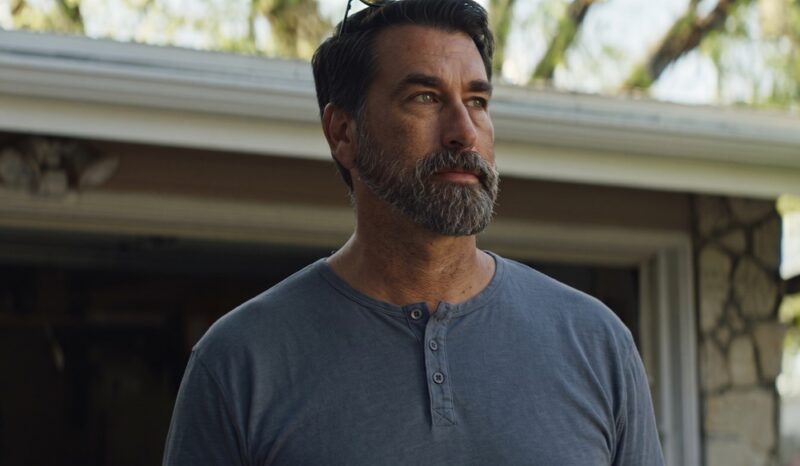
Rob Riggle may be best known for his comedic work, but in Nickels, the actor taps into a far quieter and more dramatic register as Tom Monroe, a successful entrepreneur and devoted family man still carrying the grief of losing his older brother as a teenager. When, three decades later, his neighbour’s son Mitch (Aaron Holliday) survives a devastating motorcycle accident and begins suggesting he may somehow be connected to Tom’s late brother, the possibility of a miracle threatens to destabilise the life Tom has built around that absence.
Inspired by a true story, Nickels marks something of a departure for director Spencer King, who has predominantly directed his own material. Working from Tim Tuchrello’s screenplay, King found his way into the story through its ambiguity: not simply whether Mitch could truly be Tom’s brother, but whether the young man believes what he is saying or is subjecting a grieving man to an extraordinarily cruel deception. It’s a question King deliberately refuses to answer, allowing audiences to bring their own ideas of faith, spirituality and coincidence to the film. Pasted text
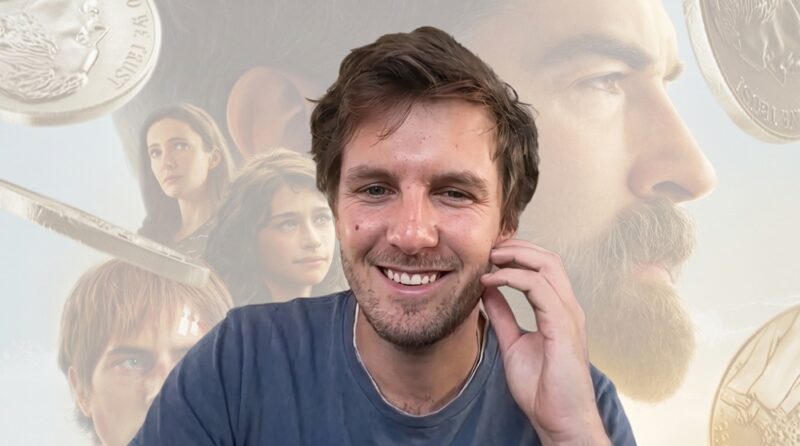
Following their previous conversation around The Wilderness, Peter Gray spoke with King again about returning to grief from a very different perspective, finding his authorship within somebody else’s screenplay, the visual unease that runs throughout Nickels, and what he amusingly agreed should have been the film’s tagline: “the frightening side of hope.”
When we spoke for The Wilderness, you spoke about grief and how people resist showing what they’re feeling. Watching Nickels, it was a return to grief, but from this very opposite direction. Instead of trying to suppress it, Rob Riggle’s character, Tom, follows it somewhere extraordinary. Is there something that keeps bringing you back to characters who don’t quite know where to put their grief?
Yeah. Well, I’m really into making films that are great for marketing, so I love making dramatic films about grief (laughs). No, I mean, that is something I’m drawn to – how people deal with grief.
It’s funny you mentioned that, because I made a film called Time Now when I was younger. It was the film I made before The Wilderness, a very independent feature I made with my friends. It was my first feature that opened some doors for me, and it was very much about grief. The producer of this film, Tom Ortenberg, had seen Time Now, and he actually hired me for this because of that film. This wasn’t my script, as you probably know. He knew I had just wrapped The Wilderness, but before he had even seen that, he brought this project to me because of Time Now.
That film was more of a suburban drama about a woman who loses her brother. They had become estranged, and she’s trying to figure out who he was during that period when they’d lost their relationship. So it makes sense why Tom thought of me for this.
What really drew me to this project was that the grief is so present, but there was also the question of whether we could add suspense to it. Early on, there was this idea of, “Is Mitch actually his brother, or is he just messing with him?” That’s what really intrigued me. I don’t know if that answers your question, but yeah, the grief is definitely there, and Rob Riggle did an amazing job of really diving into that.
Yeah, because earlier this year at South by Southwest I saw The Pirate King with Rob, and it’s been so great seeing him in this more dramatic phase of his career. We’re so used to seeing him as that comedic presence, so it’s really interesting to watch him bring something completely different to these roles.
And despite the supernatural premise here, I feel like the film could have pushed the reincarnation element much harder. Instead, you leave us questioning what Tom is actually experiencing. Do you feel like that sense of restraint is becoming almost a signature of your filmmaking voice?
Yeah, I think at this point in my career, I’m making sub-$5 million films, and sometimes with these independent films, it’s stronger to leave things for the audience to figure out.
When Tim Tuchrello, who wrote the script, and I did the director’s pass, that was the thing I wanted to push the most. It sounds counterintuitive, but I wanted less information – giving little tidbits here and there, not over-explaining moments, and allowing the audience to piece things together along the way.
I think the film is most successful in moments like that, when you’re trying to figure out who this kid is and whether it’s a case of the boy who cried wolf.
And as you said, you’ve predominantly directed material that you’ve written yourself, whereas here you’re interpreting someone else’s screenplay. Does that give you a different kind of freedom? When you’ve written something, you know why every line exists, but here an actor’s interpretation could reveal something in the material that you perhaps wouldn’t have discovered yourself. Did you find that happening with this script in particular?
I remember during The Wilderness, working with some of those great actors, Hunter (Doohan) would say, “This doesn’t make sense,” and there’d be a little part of me thinking, “But I wrote it!” With this film, there was a lot more freedom.
I just think films are better when there are as many creative eyes on something as possible and people feel empowered. I find that when I write something and send it to someone, they always understand something in it that I didn’t because they’re looking at it with fresh eyes. I really enjoyed having that perspective purely as a director. It definitely was maybe even more fun.
Was there a particular scene, image, or even an idea where you first thought, “Oh, I know how I would make this”? Something that allowed you to find your own authorship within a story that you hadn’t authored on the page?
Yeah, the moment I was really sitting with the script and trying to figure out my angle on it was when I started leaning into the question of, “Is he messing with him?” That’s when the story became really interesting to me.
The question is still, “Is this true? Is he actually the brother?” But for me, it became more about whether Mitch Diller is messing with him or whether Mitch genuinely believes he is the brother. The audience can bring their own views on faith and spirituality to whether or not it’s actually true, because that’s much more personal.
That was when I really found my way into it. Visually, I also wanted to make the film in the shadows. As much as it presents itself as a suburban family drama, I wanted to push it towards these uncomfortable contrasts. We tried to shoot either in really bright daylight with hard sun, or in very dark, shadowy environments. That contrast was intentional because we wanted to add this underlying sense of unease.
No, absolutely. There was a certain discomfort to everything, where almost every scene had this underlying sense of unease. That made me think about the visual language of the film, because you use techniques like the split diopter, which allows us to see two planes simultaneously. In a film where Tom is constantly trying to reconcile two possible realities, were you consciously looking for a visual language where two truths could occupy the same frame?
Yeah. This was my first time using a split diopter, and I’m actually happy we waited until about two weeks into the shoot because I probably would have pushed to use it more.
A great DP once told me that every kind of visual trick you use is best used once, because if you use it too many times, it can start to lose its impact. Luke Dyra, who shot the film, picked exactly the right moment for it, and I thought it was really cool.
There definitely was that element you’re talking about – that dual perspective – because there’s also this question throughout the film of whose perspective the story is actually being told from.
Yeah, and when you have audiences emotionally following Tom, while the other characters can’t necessarily follow him because he’s seeing connections that no one else can, how did you balance keeping us emotionally aligned with him without making his conviction automatically become the film’s objective truth?
Yeah, that’s a good question. I guess I wanted him to be the – what’s the word? Maybe an inconsistent protagonist? I guess that’s actually a question for you. Did you believe his character throughout, or did you feel like he was going down paths that you couldn’t necessarily follow?
I think it’s one of those things where you look at him and think, he’s held onto this grief for, what, 35 years? So you do wonder whether he’s just trying to find any reason not to let it go. But watching the film, I believed that Tom genuinely thought there were some remnants of his brother in Mitch.
Because he’s either onto an incredible miracle, or he’s the victim of a really sadistic prank. It’s one or the other.
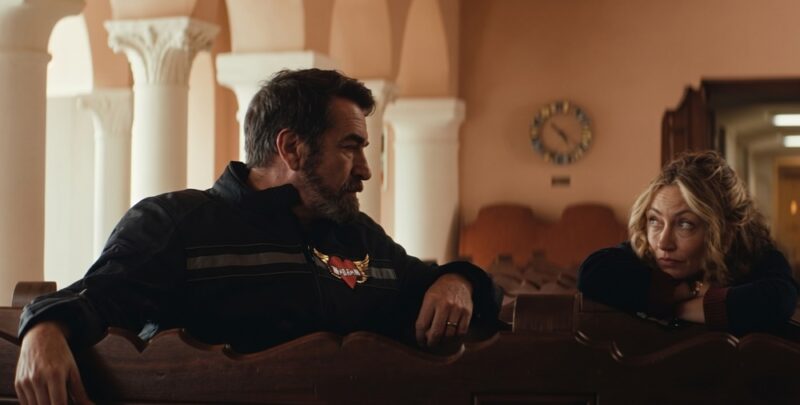
Looking at that, I guess it’s almost the frightening side of hope. The possibility of a second chance sounds comforting, but this film suggests it can also be incredibly destabilising. If someone you’ve spent your life grieving suddenly came back in some form, you’d have to reopen everything you’ve learned to live with. Was that frightening side of hope something you wanted to explore with the film?
That should have been the tagline for this movie: “The frightening side of hope.” I love that. That’s really interesting, and I think it plays into a lot of the different themes, including spirituality. There’s a frightening side to starting to believe something, because if this is true, then there are other things that could also be true.
I think Tom is primed for this. He really wants to believe. A lot of us probably have some version of that. A number of people involved with the film had similar experiences – they might see a butterfly and think, “Oh, that reminds me of my grandma,” or see it as a sign from someone.
That was actually the impetus for this film. The writer would always see these nickels that he believed were signs from his brother. So I don’t know if the frightening side of hope was something I consciously explored, but it’s definitely in there.
Speaking of the nickels, the title takes this very ordinary object and gives it this almost spiritual significance. Were you interested in that human instinct to turn mundane objects or coincidences into signs when we’re desperate for reassurance that somebody we’ve lost is still with us?
Yeah, totally. And I’m also interested in the question of whether they actually are coincidences. That’s a really interesting thing to explore. There are a few things happening in the film. First, there are the nickels. When his brother initially died, Tom would find all these nickels, and then eventually that stopped. Years later, he starts seeing them again. Then there’s the element of his neighbour supposedly claiming that he is Tom’s brother. And then there’s this third question of whether those two things are related.
Is the neighbour somehow behind Tom finding these nickels, or are the nickels actually a sign of his brother’s return? That was something I was very interested in exploring. I think we all have people we’ve lost who we continue to find reminders of in different ways.
When we spoke last time, we touched on how losing someone can change you, and this film asks an almost impossible question: what if the person you lost somehow came back? After making this film, do you think second chances are about getting another opportunity with the person we’ve lost, or about finding a different way to live with their absence?
Yeah, it’s funny. Maybe these films somehow exist in the same universe (laughs). The grief we talked about in The Wilderness was more immediate grief, whereas this is returned grief. And I guess the question is: did Tom actually move on and then this came back, or was it always present and he had simply learned how to live with it? Then, the second there was an opening, he fully chose to dive back in. So yeah, it’s an interesting question.
And on the topic of Tom, Rob has such a strong association with comedy that audiences naturally arrive with certain expectations of his energy. Did that history become useful precisely because Tom requires such stillness from him?
Yeah. A lot of my favourite performances are comedians doing something more serious. Eternal Sunshine is one of my favourite films, and Adam Sandler has done it a few times as well. There’s Stranger Than Fiction with Will Ferrell. That was something Rob and I talked about going into this – it felt like an opportunity for him to do something like that.
Comedians are so great at timing. That’s such a fundamental part of their trade: building towards the punchline and knowing exactly how to deliver it. I felt like Rob had this natural understanding of the “punchline” of each scene.
There’s a scene with Tom and Liz in the bedroom, where they’re sitting on the edge of the bed and she’s really pushing him to give her something. I haven’t seen the film in a year – you’re the expert on the movie at this point – but he just builds throughout that scene as she keeps trying to get something from him.
And then he gives the slightest change in his inflection, and it carries so much weight. It was clear that he was building towards that moment. I know Rob delivered an amazing performance, and I think he was the right casting for this role because he has this inherent likability. Then he was really able to dive deep and go down the rabbit hole that his character does. I loved his performance.
Nickels is screening in select theatres and On Digital in the United States from October 2nd, 2026.
