

Few texts are as closely associated with a single era – or as widely mischaracterised – as The Great Gatsby. In truth, the two go hand in hand; the imagined glamour of the Roaring Twenties often serves to obscure just how deeply cynical and pessimistic the novel is.
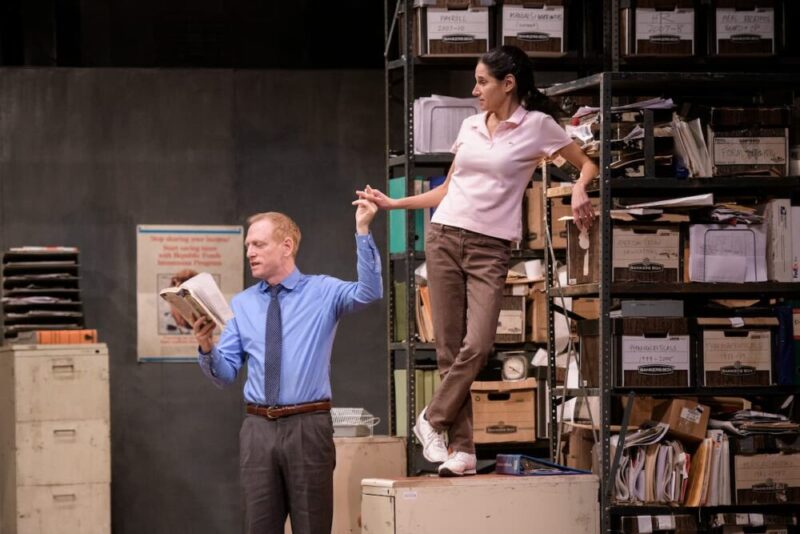
Despite its brevity, abridged adaptations inevitably prioritise a moonshine-fuelled Jazz Age aesthetic over the internal world of the narrator. Perhaps that’s why celebrated New York-based theatre company Elevator Repair Service decided to relocate the action to a drab office building while reading the entirety of the text onstage, giving the audience no choice but to linger on F. Scott Fitzgerald’s text.
While waiting for a computer to load up, Scott Shepherd starts to read the classic novel as work continues around him. At first, he voices the dialogue for every character, but his co-workers soon become drawn into the story and take on the major roles. As this is happening, the soundscape slowly evolves from distant traffic noises to the sound of frogs chirping outside Tom Buchanan’s country house and the swinging jazz of a wild gala at Gatsby’s house.
Once all the main roles have been filled, Shepherd inhabits the role of narrator Nick Carraway (along with several minor characters), and the performance falls into a natural rhythm. Wild parties and scenes with snappy dialogue give way to Carraway’s internal world, when Fitzgerald peppers the page with astute witticisms and the sometimes overwrought prose of a man who thought himself the Jazz Age Oscar Wilde. His bon mots draw wry chuckles from the audience, while the cast adds to the levity by overemoting to embody each adjective. Putting the focus on the original text also highlights how remarkably prolix Fitzgerald could be, despite Gatsby’s relatively short length.
The cast of 13 covers most of the main characters (except Meyer Wolfsheim, a broadly drawn stereotype of a Jewish gangster), and there is no heed paid to superficial resemblance – Jim Fletcher’s Gatsby is tall, bald and strikingly uncharismatic. But Shepherd is the undisputed heart of the show and delivers a knockout performance.
Recurring technical issues with the microphones are noticeable but not overly disruptive, though the inclusion of a racial slur in the recitation draws a shocked response. It feels completely unnecessary, especially given the way Shepherd disavows some of the casual misogyny in the text with an apologetic look, while the cast pointedly stops the action before Tom Buchanan breaks his mistress’s nose.
Gatz’s greatest asset is its ambition, and the eight-and-a-half-hour runtime is broken up by three intermissions, including a 90-minute dinner break. That it keeps the audience engaged for so long is a testament to the quality of Shepherd’s performance, though admittedly the fourth act drags a little, and by the time he puts the book down to deliver the deeply pessimistic final pages, the crowd is noticeably tiring. Nevertheless, when that final pessimistic line is delivered, they still have enough energy to rise to their feet and celebrate the epic achievement.


FOUR STARS (OUT OF FIVE)
The reviewer attended the performance on 14th March. Gatz runs at Her Majesty’s Theatre until 16th March.
Headline photo supplied and credited to Ian Douglas.
