

If the defining question of Blade Runner was what it means to be human, then Blade Runner 2099 poses an equally compelling one: what becomes of humanity when it is no longer the dominant force in its own world? Under the creative stewardship of showrunner Silka Luisa, the eight-episode limited series expands the philosophical and visual language of the iconic science-fiction franchise, exchanging its rain-soaked dystopia for an oppressive, sun-drenched Los Angeles where the traditional power dynamic between humans and replicants has been dramatically inverted.
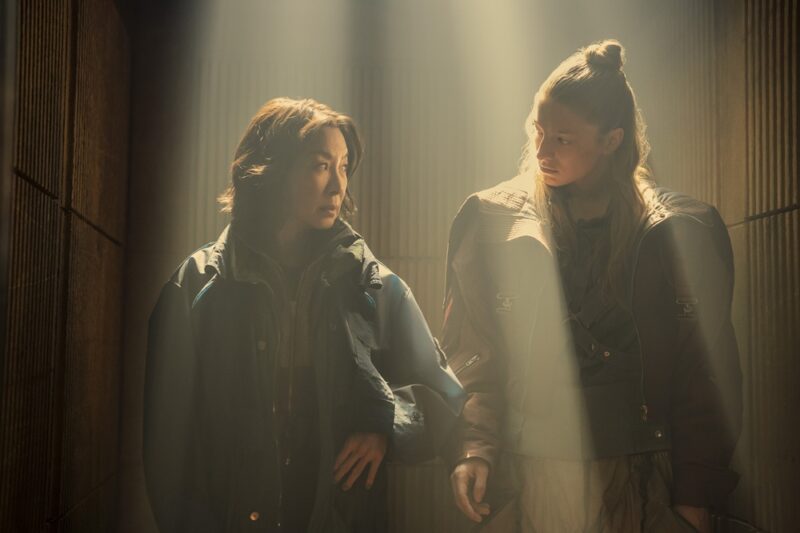
Set fifty years after the events of Blade Runner 2049, the series follows Cora (Hunter Schafer), a fugitive who assumes the identity of a Blade Runner in a desperate attempt to stop running. Forced into an unlikely partnership with Olwen (Michelle Yeoh), a replicant confronting the final days of her existence, the two pursue a runaway whose secrets threaten to destabilise an already fragile society. In bringing together a woman who must conceal her humanity to survive and an artificial being coming to terms with her mortality, Luisa finds a fascinating emotional contradiction within the franchise’s enduring fascination with identity, belonging and the desire for connection.
Speaking with our Peter Gray as the show streams on Prime Video, Luisa reflected on the moral complexities of empowering a formerly subjugated population, the cinematic influences behind her distinctive “sunshine noir” aesthetic, the creative freedom afforded by telling a finite story, and her deeply personal connection to the original film’s exploration of otherness. But perhaps most pertinent to our own increasingly technologically dependent existence was her consideration of empathy – not simply as a defining characteristic of humanity, but as something we may be in danger of losing ourselves.
I know you’ve spoken about building the character of Olwen out of your own long-standing empathy for replicants, but you’ve set this story in an era where replicants won the war and hold this institutional power over humans. How did putting them in charge complicate or test your empathy for them? And what interested you about watching a formally subjugated group inherit the machinery of control?
Well, I think what’s so interesting is that even though they have so much more agency, there’s still so much of the human experience that they don’t have access to. They won’t grow old with someone. They won’t be able to have babies and be pregnant. And you always want more than what you’re given, right? That desire is limitless. It was nice to still have those touchstones of, when she’s dying, how does she confront her mortality? In those questions, there’s a lot of empathy for her.
But then, as you were saying, now that they have power and can make decisions for themselves, what is their vision for Los Angeles? What did they think humans should have been doing that they can now do? I think that’s an interesting canvas because there are obviously positives and negatives. We will hand the baton to something else at some point, and it will be negative in some aspects and positive in others.
I like the idea that you’re arguing both sides all the time, especially as a writer. There were some days when I was very pro-human, and then other days when I was pro-replicant, and you always want to be balancing between the two.
I know you’ve described the setting as “sunshine noir”, and like the classic noir of the Blade Runner films, which made rain, fog, and shadow very much their own entities, here there’s a post-war coastal LA under this harsh, sticky daylight where the architecture has its inside turned outward. When you were mapping out this mystery, how did stripping away the literal darkness change the way secrets and paranoia operate?
Well, I still really wanted to keep a lot of the noir tropes, and there are definitely characters that are quintessential noir archetypes, which was really important to me to retain. In terms of light and shadow, there’s great noir like Chinatown that has this really white-hot light that’s equally as oppressive as darkness. Something we (executive producer Michael Gree) talked a lot about early on with Rob Hardy, our DP, and Jonathan (van Tulleken), who directed the first two episodes, was how to create hard light and deep shadow, honouring the noir of it all but also introducing light into it.
One of the things that I got from this is how you seem drawn to women forced to navigate shifting realities or shifting identities. This culminates in Cora taking on the system she’s running from. Because you’ve written these eight episodes as a complete closed story, how did knowing the exact final frame let you take bigger swings with the ambiguity early on?
It’s really a gift to know for sure that this is going to have a beginning, middle and end because, as you’re saying, it becomes much easier to track the arcs at the beginning of the process. You can really say, “Okay, I know where I want to start, I know where I want to end. What can we do in between?” I’ve only done two limited series, so that structure is what I know. In that sense, you kind of have three story arcs, and it’s a way my brain can structure the series. And I did that for all the characters, obviously.
It’s so nice to watch something and have it feel complete. So many times we watch something and it feels like a second season is what it’s playing for, and that season just never comes. It’s nice this had a sense of finality to it.
It was a really tricky balance between taking something that is so cinematic in every sense – visually, narratively – and translating it to TV. We were just trying to figure out, “Okay, how far can we stretch the rubber band in ever sense where you don’t completely break it.”
Between pulling deep cut Philip K. Dick figures onto the screen for the first time and trading the rainy cyberpunk for this sun-drenched coast, there’s this personal fingerprint on such a massive canvas. After five years living inside 2099, what question about human nature do you walk away with less certainty than when you first started?
I think it was buried in the Philip K. Dick book, this idea that empathy is really fundamental to humanity, and that we’re in danger of losing it because of technology, our sense of loneliness and our inability to connect with each other. When I look around, particularly as someone who has two young kids, that lack of empathy is what frightens me most.
It’ll be nice if this show can truly connect and viewers can get off their phones, watch this show, learn something. And just before letting you go, as Blade Runner examined artificial beings yearning to feel or pass as human, the character of Cora here has to suppress her humanity and perform as a replicant just to survive. Psychologically, what drew you to locking a young woman who’s hiding everything about herself into a partnership with an ageing replicating confronting death without a mask?
I think that concept is baked into the first film. For me, what was so horrifying about Rachael was that you look like everyone else, but you’re different, and you know that you’ll never really fully be a part of everything around you. Psychologically, that’s just so terrifying, right? And it’s very relatable because we all feel like that at times. You can never fully articulate your own experience to another person. It was really thinking about Rachael’s story, which connected so much with me personally, and then asking, “Well, how do I do that within this new power dynamic?”
All eight episodes of Blade Runner 2099 are now streaming on Prime Video.
