
Seduction is rarely just about sex in Corpus. It’s about power, desire, vulnerability, and that dangerous willingness to ignore the warning signs when what’s waiting on the other side is attractive enough.
Set against the sultry haze of upstate New York in 1998, Corrin Evans’ feature directorial debut lures Sayo (Jeff Wahlberg), his increasingly famous longtime friend Vince (Brodie Townsend), and their boisterous pal Ross into an isolated mansion inhabited by three mysterious women whose intentions prove considerably darker than the promise of a debaucherous weekend. But rather than rush towards the horror, Corpus luxuriates in the anticipation of it, allowing attraction and unease to become increasingly difficult to distinguish.
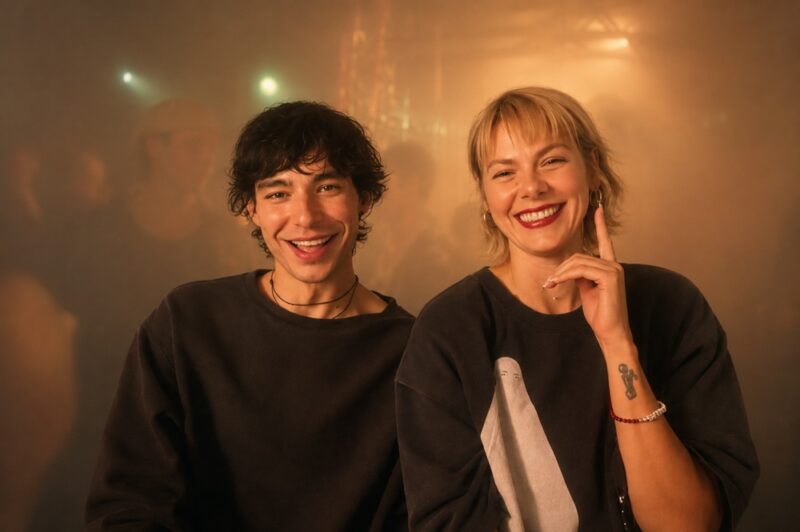
For co-writer, producer and star Lily Cowles, who plays the enigmatic Billie, and Brodie Townsend, that ambiguity proved particularly fertile territory. Speaking with Peter Gray ahead of the film’s MIFF screening, the pair discussed the eroticism of shifting power dynamics, why Vince’s charisma isn’t necessarily as calculated as it appears, the freedom and danger afforded by the film’s pre-social media 1998 setting, and the contradictions that make desire such an effective pathway towards horror.
And, thanks to Cowles, we may have also found a considerably more provocative term for the cinematic slow burn.
I was fortunate to see this film for Fantasia Fest, so I want to say congratulations first of all. I love a good slow burn, and I love how this took its time.
Lily Cowles: Thank you so much, Peter, we appreciate that because there’s a pressure, particularly when you’re working in horror to make it propulsive all the time. Personally, I love the tension and release, and tension and release…it’s a little bit like edging (laughs). How much tension can you build before you get to that release?
Brodie Townsend: And I know an edger when I see one, Peter.
That is now how I will refer to slow burns, as edging.
Lily Cowles: I’d like to think so.
One of the things I found fascinating here is that the horror doesn’t really begin when something supernatural happens, it starts much earlier when we see the desires that make people start ignoring what they already know is wrong. Do you think the film is ultimately more frightened of monsters or the things people willingly overlook because they want something bad enough?
Lily Cowles: I love that. I love that question. I think it’s different for every person. I think it’s open to interpretation. I certainly think, is it the monster without or the monster within? Maybe those things are related. What is the thing that scares us? Is it the desires or the impulses? Is it these urges that come from within ourselves?
Brodie, I feel like Vince is charismatic enough that you understand why Sayo carried this love for him. But there’s also something dangerous about the way he knows the effect he has on people. Did you see his charm as something instinctive? Or something he’s learned to weaponise over time?
Brodie Townsend: I didn’t see it as a weapon. I think it’s instinctual. We are all using tactics that we get because we’re not being seen in the way we want to be seen, but then we want the opposite to be seen in the ways we don’t. It’s just a natural kind of instinct. I don’t think he’s aware of what he’s doing, but there’s something deeper there.
Lily Cowles: What I love about Vince, and I think it’s something everyone finds difficult, is that we all have that desire to be able to influence people or be able to draw people to us. We all have the desire to be wanted. To be seen. But I think it’s something that we often want to swallow down. I love anybody who’s looking out for himself, and I think Vince is someone who moves a little closer to the surface.
As soon as he came on screen, I was like, “Yeah, I get it. I’d probably follow him to the end of the Earth too.”
Brodie Townsend: Follow me, Peter, follow me.
And Lily, as a co-writer, producer, and actor, you’ve helped invent your character before you even had to inhabit her. Was there something about her that became less understandable to you once you actually put her in your body?
Lily Cowles: I love that question. It was interesting because I wrote the character, and I didn’t necessarily want to write a character like this, but I’m sure there was some part of me, some element of my personhood that wanted to be expressed. As an actor, I don’t get to a lot of auditions that are like (this character) Billie. It was a wonderful opportunity to create this for myself.
Although it wasn’t like I was going to do this just for (that), but I think some intuitive part of me wanted to express this. But I wrote her, planted the seed, and then I went into producer mode. For a year-and-a-half I was focusing on such a different part. I was waiting for Billie to be embodied. I was working on my body a lot. But I was so deep into producing that I didn’t have a lot of time to sit and just be with Billie until about two weeks before production. That’s when I took my hands off the wheel and told the other producers, “Guys, you got this. I gotta be with Billie.”
And dropping into Billie at that point, it was a big shift in understanding the weight and the stakes of what is going on with (her). I think that shocked me. I didn’t realise how hard it was going to be, or how dense it was. That took me by surprise as I got closer and closer.
Brodie Townsend: We were seeing all these glimmers together in real time. I feel like it was happening with every character, because there’s a lot of play on contradiction, which I think is inherently human. I know Lily and Corrin (Evans, director and co-writer), we had a lot of talks about, not even Corpus, but just in our personal life what draws us to everything. Polarity is such a fun thing to play.
In building Vince, because he’s becoming famous at that age where I feel like somebody starts confusing being desired with being loved. Did you think about that distinction when building him?
Brodie Townsend: Oh, man, that’s a big part (of it). If I find something relatable, then hopefully other people do, because the more I talk to people in this world, we’re all just striving for connection all the time, but you never fully get it. At the same time, we’ve all experienced the same thing in different ways. There’s always this thread of aiming for desire, because you want to be loved. I think Lily and Corrin have such an understanding of human nature and how the scariest part of this (movie) is that we’re all our own worst enemies. And that’s terrifying.
Lily, when you write a character, you have the luxury of understanding why they do everything they do. As an actor, mystery can sometimes be more useful than certainty. Did you ever have to deliberately forget something that you knew as a writer to play Billie truthfully?
Lily Cowles: Yeah, totally. I think, even as an actor, you have the full script and you know what the full story is, and then you have to be like, “I don’t know that part yet,” so I can’t be foreshadowing things here. I’m sure to a greater extend as a writer I have these understandings of everyone else’s machinations, but I think most actors who read a script get to that level too.
But there’s actually one part in the movie, and I’m not going to tell you which, but when I watch it it’s me misunderstanding Lily, the actor, delivering something that Billie didn’t know. I was playing it with the understanding that I knew…but I don’t think anyone else noticed (laughs). But I noticed.
I really appreciated that the film never makes intimacy feel neutral. Every touch seems capable of becoming affection, manipulation, surrender, violence, all depending on what happens next. How much of your performances were built around deciding who holds power in a physical moment?
Brodie Townsend: I think that’s the thing. Corrin and I really connected early on. And what I saw in her was how she finds power dynamics in human nature inherently erotic, and that’s something that I’m always seeing in the world. It’s a way to perceive the world. I don’t know if it was intentional, but the flip of power is constant. You could read it as Vince has all the power here, but is he fighting for power or is he fighting for love? Are they the same thing? Can they exist in the same realm? That’s what we’re all figuring out all the time.
Mentioning eroticism, because the movie is set in 1998, which is before people could constantly document and locate and verify one another. Do you think part of the film’s eroticism and danger, Lily, comes from belonging to a time when disappearing with beautiful strangers could still genuinely mean disappearing?
Lily Cowles: I love that. And absolutely, yes. You said that very articulating and beautifully, there was a mystery and you didn’t have access to people. You couldn’t stalk somebody. Not everyone’s on social media (now), but many of us are, and you can really find out a lot about a person. It was a different era.
Brodie Townsend: And playing Vince as an up-and-coming actor, it was when you could be up-and-coming and still be perceived as cool. But I love the cringey moments of Vince. I love that because it’s the 90s not everyone is seeing those moments. Sayo only gets to see glimmers. The audience sees glimmers. But if you were to stalk him or see him in an interview, people would watch and just think he’s a fucking loser. We’re all losers. But I like this mystery of people idolising the 90s and 2000s glamour, and Hollywood eating their salad on the street after a night out, and it looks like the coolest thing ever. They’re probably chatting to the wait staff saying the most diabolical shit (laughs), and everyone’s thinking, “Who is this fucking guy?”
When you create a story that revolves around seduction, the audience has to want to move towards the danger rather than run from it. What did each of you think your character was offering that made the danger worth approaching?
Lily Cowles: I love that. I think for Billie, I remember two scenes that I felt really showed (her) cunning, her skill at, “I’m going to make you feel safe.” It’s a little bit of a strong mommy, but it’s not just female per se, it’s that feeling of, “Come here, I’m strong and very safe. You’re good. I’m going to look after you.” You see it in that scene (that opens the film) with the model. “Oh, you’ve got such a good face.” It was really a vocal thing. That was something I realised, Billie had to be so good at making people feel at ease, making people feel safe and that they could open up. Allowing that vulnerability so they can drop their defenses. Disarming people with their warmth.
Brodie Townsend: Yeah, Lily, as a person, I dropped all my defenses straight away.

Corpus screened as part of this year’s Melbourne International Film Festival, which is currently running between August 6th and 23rd, 2026. For more information and session times, head to the official site here.
