


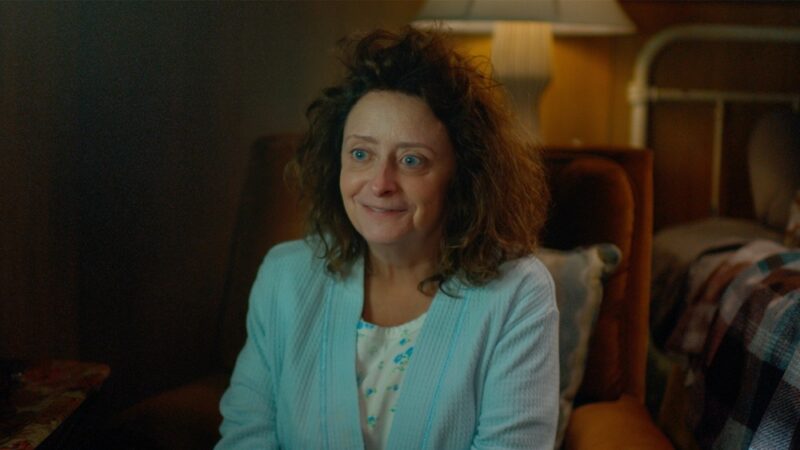
What happens when the only person who still loves you is someone you can’t stand? That’s the deliciously twisted question at the heart of Loves Company, writer/director Jason Laurits’ darkly comedic subversion of the obsessive-fan thriller. Jack Plotnick stars as Blake De Troy, a washed-up, flamboyant former game show personality whose fading celebrity has left him with little more than a carefully constructed persona and a desperate need to be adored. When a car accident leaves him stranded in the Florida Everglades, he’s rescued by Antoinette Funk (Rachel Dratch), an eccentric recluse who just happens to be his biggest – and possibly last – fan. What initially resembles a Misery-style nightmare soon takes an unexpectedly absurd turn when Blake discovers that being held captive isn’t necessarily such a bad thing, especially when someone is willing to cater to his every whim. But beneath the film’s increasingly outrageous power struggle lies something surprisingly tender: a story about loneliness, the uncomfortable distance between admiration and genuine connection, and the identities we construct to feel loved.
Speaking with our Peter Gray, Laurits, Dratch and Plotnick reflected on the film’s playful reversal of victim and villain, the emotional vulnerability hiding beneath its more outrageous humour, and the bittersweet legacy of queer entertainers who were celebrated for their flamboyance while being denied the freedom to openly embrace their identities. From the challenge of finding humanity in characters who could so easily become caricatures to the unexpected heartbreak of discovering that someone you’ve idolised is nothing like the person you imagined, the trio explored how Loves Company uses its wonderfully dysfunctional central relationship to ask a deceptively simple question: is being adored really the same as being understood?
It’s always fun to take a story that we know, in this case a horror classic, and give it a little flip. One of the things that I found almost quite touching beneath all the absurdity is that the character of Blake desperately wants to be adored, whilst Antoinette desperately wants to feel connected to someone, but neither necessarily knows how to achieve genuine intimacy. For all three of you, do you think the film is ultimately about the difference between having somebody worship you and having somebody actually understand you?
Jack Plotnick: That’s so eloquently put.
Jason Laurits: We all have this common thread of wanting to be connected and loved, and whether it’s to be adored like a celebrity or just a partner in crime to keep you company, it’s all the same thing really. (The film) explores that on both ends and how we define it a little differently.
Rachel Dracht: In terms of my character, (she’s) living in the middle of nowhere, and it kind of taps into what you think the world of celebrity is like, like “Oh, these people have it all together. They’re so bright and shiny.” They’re a different species than (she is) and she just wants to hook into that. Then it’s finding out that’s all bullshit is part of her journey. But yeah, it’s just wanting the connection and then tacking it on to something that’s not real was (my character’s) experience.
This is probably more for you, Jason, because I know you’ve spoken about growing up loving personalities like Paul Lynde and Rip Taylor, who were obviously allowed to be flamboyant and outrageous on television, but they weren’t necessarily afforded the same freedom to be openly queer in their private lives. I wondered whether Blake represents something quite bittersweet about that generation of men who could be celebrated for their personalities without necessarily being fully accepted for their identities?
Jason Laurits: Yeah, the film questions whether Blake exploited his homosexuality, whether that was simply who he was, or whether he was doing what he had to do. I’ve always been fascinated by that era, when these characters were so obviously gay but couldn’t come out. Audiences loved watching them, but almost treated them like a different species – happy to be entertained by them without ever looking too deeply into who they really were. As a result, they became trapped in these shallow, one-dimensional versions of themselves, which is ultimately what happens to Blake. Now, looking at him through a 2026 lens, people might interpret his behaviour very differently without necessarily understanding why he became that person in the first place.
Jack Plotnick: Yeah, there was this fascinating kind of gay persona that wasn’t necessarily feminine. Take Paul Lynde, for example. Charlotte Rae from The Facts of Life had a similar voice, as did the woman from Bewitched. It was this particular voice they’d developed in college. Because he was gay, Lynde could play this eccentric character, but he couldn’t actually say he was gay. So I knew I had to create a persona for Blake, and thankfully Jason liked what I came up with enough to hire me. What was especially fun was acting opposite Rachel and watching her character gradually realise that this man wasn’t who she thought he was. Those moments of disillusionment were so much fun to play.
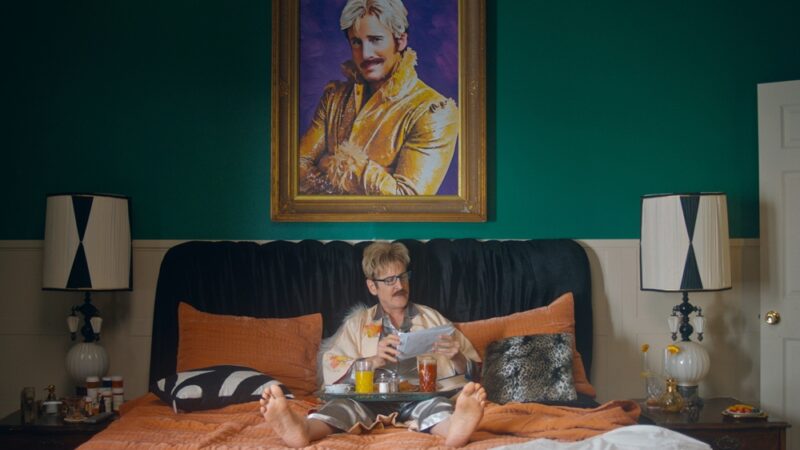
Jason, you created Blake partly as a tribute to that generation of queer entertainers. Jack, you’re playing someone who seemingly, as you said, is trapped inside that persona. Did you approach Blake’s flamboyance as something that began as a survival mechanism, but then almost just became like a prison of its own for him?
Jack Plotnick: Yeah, that’s really well put, and that’s what I had to find – this persona Blake had created that worked for him once, but perhaps doesn’t anymore. I had to figure out when he could let that facade drop, and when it would be funny to bring it back. That was something Jason really helped me navigate throughout filming.
Jason Laurits: Yeah, it was a challenge, and one I think Jack pulled off splendidly. Blake is trapped in this one-dimensional personality, but as an actor, Jack had to give him multiple dimensions. It could so easily have become a caricature, but Jack brought a real depth to the character, even when Blake himself doesn’t necessarily possess that depth.
I feel like there’s a version of this film where Antoinette could easily become the joke because she’s lonely, she’s eccentric, and she’s devoted to a celebrity who doesn’t know she exists. But there’s something much more interesting in treating that devotion as emotionally genuine. How important was it that we never laugh at Antoinette simply for wanting connection, and Rachel, how did you inform the way that you played her?
Rachel Dracht: I think that was already in the script. Initially, it feels more comedic, almost like a parody of Misery, with the sledgehammer and everything. But as the story unfolds, she’s genuinely trying to connect, opening up about the heartbreak surrounding her father. That emotional depth was already on the page, so playing it any other way wouldn’t have been true to the story.
Jack Plotnick: Yeah, but you’re so good at it, Rach. Everything you do has so much heart.
Rachel Dracht: (Laughs) You’re always (gassing) me.
Jack Plotnick: I’m such a fan of yours. I can’t help it.
Rachel Dracht: But I got to do all my scenes across from Jack, who is just being the most wackadoo, hilarious, but also so real. Then as he spins out into being more and more pathetic…it’s just all there. We didn’t have to do much because we’re just following Jason’s words.
Jason Laurits: I’m going to jump on the Rachel bandwagon here. I knew she’d bring a warmth to this character, as she does with all her roles, and that she could make her funny without us necessarily laughing at her. There’s an underlying sense of love that Rachel naturally brings to her performances. I got incredibly lucky with both actors because they brought so many layers and textures to these characters that I think you genuinely come to love them.
I don’t want to leave Jack and Jason out, but I’m going to do the same thing and jump on the Rachel bandwagon. I’m just going to quickly say with SNL, obviously Debbie Downer, but there’s a sketch you did with Jennifer Garner where you were conjoined twins. Hilarious! It’s one of the funniest things I’ve seen. The little face you do is great.
Rachel Dracht: (Laughs) Thank you.
And what’s so delicious about Antoinette is that she begins as potentially the most unhinged person in the room, but by the end of the film we’re very much on her side. Jason, did you always envision her becoming the more reasonable of the two?
Jason Laurits: Yeah, one of the things I wanted to do was flip the protagonist and antagonist. In screenwriting, you’re taught to establish a hero, follow their journey and not break that rule. But I thought it would be interesting to challenge that, especially with a premise audiences already recognise. I wanted to take whoever we assume is the antagonist and shift that perspective, perhaps even switching it back and forth a few times. At the midpoint, I really wanted to turn the story on its head and take it in a completely different direction. Because audiences already have certain expectations of this kind of story, I felt that approach could really work.
And the fact that this film did flip the Misery narrative, it made me think, for all of you, is there a movie that you would personally love to flip on its axis?
Jack Plotnick: I want me and Rachel’s characters to do The Shining. I’ll be Blake writing his memoir in the Overlook Hotel. Antoinette has the baseball bat. That’s our next one.
Rachel Dracht: I can’t think of anything to top that.
Jason Laurits: Why do I keep thinking Howard the Duck and how do I want to see it? Remember Howard the Duck? A lot of people didn’t see it. That’s the whole thing. No one saw it.
And what’s funny about watching it is that Blake initially thinks he’s been kidnapped, but once he realises he has nowhere to go, he effectively becomes the world’s worst house guest. Jason, at what point did you realise the funniest version of this story might be the one where the kidnapper actually can’t get rid of the hostage? And Jack, do you think Blake would ever willingly leave if Antoinette kept providing him room service?
Jack Plotnick: Oh, no, he’d stay. It’s such a funny thing that Jason did with the James Caan character, making him someone who doesn’t want to leave because he’s getting food and alcohol. No, I don’t think Blake would leave.
Jason Laurits: Blake’s getting exactly what he wants. He’s getting love and admiration. Why leave that? Sure, it’s sort of creepy, but it’s what he wants.
And before letting you go, given that this all began with the hypothetical kidnapping of Liza Minnelli, I have to ask all three of you: Is there a celebrity that you absolutely adore who you suspect would be a nightmare to spend a week with, and more importantly, how many days do you think you’d last before asking them to leave?
Rachel Dracht: Oh, that’s a good question.
Jack Plotnick: That’s a good question that I won’t answer (laughs). I mean, I love Quentin Tarantino’s directing, and I wonder what that would be like. I think he’d be a handful (laughs).
Rachel Dracht: I feel kind of lucky, because living in New York, having done SNL, I’ve met so many people. I don’t have this, “Oh, this far away person…,” I’m living where they all are. Does that make any sense?
Jack Plotnick: I know there’s a lot of them, but if there was an SNL guest that you wish you could take home because they’re awesome as a person…
Rachel Dracht: Oh, my gosh. I always think of the people that I grew up watching. Like, Steve Martin and Martin Short. Those people are my idols, and meeting them meant the world to me. That’s who I tried to be back in the day.
Jason’s just sitting there quietly…
Jason Laurits: (Laughs) Liza is mine.
Loves Company is available on Digital and On Demand in the United States from November 10th, 2026.
