

Some experiences are impossible to fully comprehend when we’re children. We might understand that something terrible has happened, recognise the fear in the adults around us, or sense that the world is no longer quite as safe as we once believed, but we don’t necessarily possess the language or emotional maturity to make sense of what we’ve witnessed. And sometimes, it’s only years later that we begin to appreciate how profoundly those moments have shaped us.
For writer-director Beth de Araújo, that complicated relationship between childhood trauma and adult understanding sits at the heart of Josephine, an extraordinary, emotionally bruising drama that explores what happens when a young girl’s innocence is violently interrupted, and how the people who love her struggle to protect her from something they cannot undo.
Inspired by de Araújo’s own childhood experience, the film follows eight-year-old Josephine (remarkable newcomer Mason Reeves), whose life is irrevocably altered after witnessing a brutal sexual assault in San Francisco’s Golden Gate Park. Unable to fully comprehend what she’s seen, Josephine begins exhibiting increasingly troubling behaviour, her fear manifesting through anger, paranoia and a desperate need to regain control over a world that suddenly feels threatening.
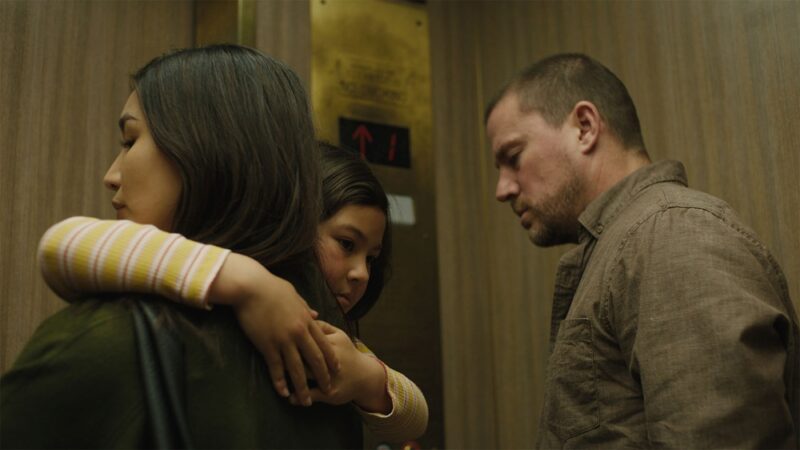
Her parents, Claire (Gemma Chan) and Damien (Channing Tatum), respond with the fierce, sometimes contradictory instincts of people determined to protect their child, even as they discover that love, however unconditional, cannot necessarily provide the answers they’re searching for.
It’s an extraordinarily difficult subject, but what makes Josephine so affecting is de Araújo’s refusal to impose an easily digestible emotional framework upon it. The film isn’t interested in offering the reassuring narrative of a family overcoming adversity, nor does it suggest that trauma can be neatly processed through the right conversations or parental decisions. Instead, it examines the uncomfortable spaces between what children experience, what adults believe they understand, and the things that remain unspoken between them.
Following its acclaimed premiere at the 2026 Sundance Film Festival, where it received both the U.S. Dramatic Grand Jury Prize and Audience Award, Josephine continued its international journey in competition at the Berlin International Film Festival. Yet, despite the considerable recognition surrounding the film, its emotional foundation remains intensely intimate.
And for de Araújo, bringing that intimacy to the screen meant eventually accepting that a story originating from her own life would need to become something beyond her personal experience.
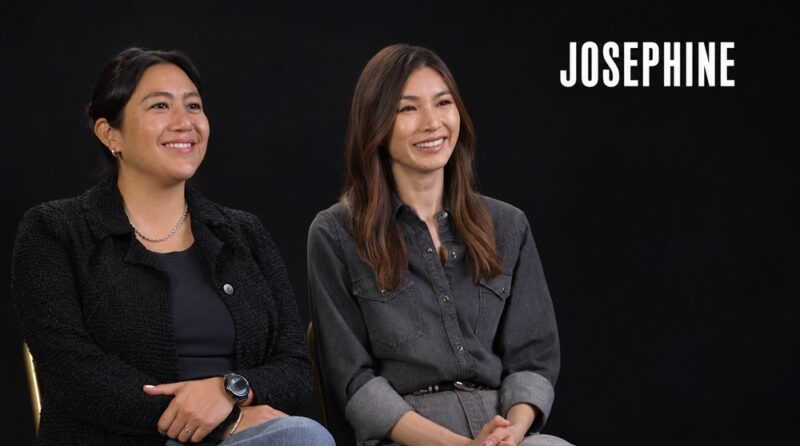
Sitting down with our Peter Gray at this year’s Toronto International Film Festival, where the film screened as a Canadian Premiere within TIFF’s Gala and Special Presentations lineup, de Araújo and Chan spoke about where their respective understandings of Claire and Josephine intersected, and where they remained deliberately different. After all, while de Araújo was revisiting something she had lived, Chan was approaching the material through the imaginative and emotional responsibilities of an actor, finding her own way into a character inspired by someone else’s mother.
For de Araújo, the distinction became increasingly fluid as the screenplay evolved.
“The more I worked on (the script), the more fictionalized I think it became,” she explained. “Also, once you pass over the script to your actors, it’s now theirs. The character is now theirs, and they take ownership and they bring really great, different ideas.”
It’s an observation that speaks to one of the more fascinating contradictions of autobiographical filmmaking. The closer a story is to its creator, the more difficult it might seem to relinquish control over how that experience is interpreted. Yet de Araújo found something unexpectedly liberating in allowing her actors to discover emotional possibilities she hadn’t necessarily anticipated.
“I think, for me, it was just so beautiful to see how Gemma would take certain moments that maybe I wrote in a different way, or a more flippant way. She would then have a real intention with it.”
She recalled one particular exchange between Claire and Damien, in which an ostensibly ordinary parental instruction revealed an entirely different emotional dimension through Chan’s performance.
“It’s my favourite thing when you see an actor try something and you stand up at the monitor and you say, ‘Wow, I didn’t realise she’d be so mad at her husband with that line.’ But when she’s saying, like, ‘No, Josephine has to go do homework and eat,’ she’s saying to her husband, like, ‘Fuck you,’ you know?”
“With that you could really feel all that subtext, and I really loved that.”
It’s a wonderfully revealing example of the film’s emotional complexity, particularly in its portrayal of Claire. Throughout Josephine, she is often the quieter presence within the family, a woman whose fear and frustration are rarely expressed through dramatic confrontation. Instead, those emotions emerge in the seemingly inconsequential exchanges of everyday domestic life, where a simple instruction about homework or dinner can become an expression of anger, exhaustion or disagreement.
That restraint is essential to Chan’s performance. Claire isn’t a mother defined by grand declarations or outward displays of suffering. She’s someone attempting to maintain a sense of normality even as the foundations of her family’s existence become increasingly unstable. And there’s something particularly devastating about watching a character continue to perform the familiar routines of motherhood when the very idea of keeping her child safe has become so uncertain.
For Chan, the responsibility of portraying Claire was heightened by the knowledge that the character was rooted in de Araújo’s family history.
“Gosh, I felt a real responsibility to try and just be as truthful as possible to do this story justice,” she told me. “That’s the job on every project, but particularly on this one.”
Rather than approaching Claire solely as an interpretation of de Araújo’s mother, however, Chan discovered aspects of the character that resonated with the women in her own life.
“This character is loosely inspired by Beth’s mum, and I felt when I read the script I could see bits of my own mother in her – my two grandmothers as well – and even my sister, and myself.”
It’s perhaps here that the film’s deeply personal origins begin to reveal something more universal. While Claire emerges from the specific circumstances of de Araújo’s childhood, Chan’s interpretation draws upon a broader understanding of the women who navigate difficult circumstances without necessarily receiving recognition for the emotional labour they perform.
The mothers who absorb their children’s fears while managing their own. The women whose resilience is so often mistaken for an absence of vulnerability. Those who quietly maintain the structure of family life even when they themselves are struggling to understand what comes next.
And, crucially, the women whose strength is not always immediately recognisable because it doesn’t announce itself.
“I feel that Claire may not be the character that screams or shouts the loudest, but she has this inner strength that I think, in the end, Josephine takes something away from.”
That observation feels particularly significant when considering the film’s relationship with female resilience. Although Josephine is unquestionably the emotional centre of the story, Claire’s journey offers a parallel examination of how women learn to navigate a world in which the threat of violence can become an ever-present consideration.
For Josephine, witnessing an assault introduces her to a frightening reality she is too young to properly understand. For Claire, the experience forces her to confront the limitations of her own ability to protect her daughter, while also navigating the emotional and psychological implications of what Josephine has witnessed.
The film doesn’t suggest that these experiences are interchangeable, or that Claire necessarily possesses all the answers simply because she’s an adult. Indeed, much of its emotional honesty comes from acknowledging that adulthood doesn’t automatically provide clarity, particularly when confronted with something as complicated as sexual violence and its aftermath.
What de Araújo and Chan achieve together is a portrait of motherhood that allows for uncertainty, frustration and even anger without diminishing the love that motivates those responses.
There’s also an interesting tension in the different ways Claire and Damien approach their daughter’s increasingly unpredictable behaviour. Both parents are motivated by a desire to help, but their individual responses reveal how differently people can interpret the same traumatic experience. What one understands as protection, another might perceive as restriction. What feels like necessary discipline to one parent can appear to the other as a failure to recognise a child’s distress.
Neither is equipped with a definitive solution, and the film is all the more affecting for refusing to manufacture one.
For de Araújo, however, the relationship between mother and daughter also contains the possibility of something quietly transformative.
“I think my intention with Josephine is that Claire starts to find some strength through her daughter too.”
It’s a small but important distinction. While much of Josephine concerns the ways adults attempt to guide children through experiences they cannot understand, de Araújo also recognises that this relationship isn’t necessarily one-directional. Josephine’s struggle to reclaim a sense of agency, however difficult or confronting that struggle becomes, can also challenge Claire’s understanding of her own strength.
And in that exchange, the film finds a different way of considering resilience, not as an uncomplicated triumph over adversity, but as something that can emerge through the difficult process of recognising another person’s pain.
What makes this particularly compelling is that Josephine never feels as though it’s asking audiences to admire its characters for their suffering. There’s no attempt to elevate Claire into an idealised portrait of maternal sacrifice, just as Josephine herself is never reduced to a symbol of childhood innocence. Both are allowed to be complicated, contradictory and occasionally difficult to understand.
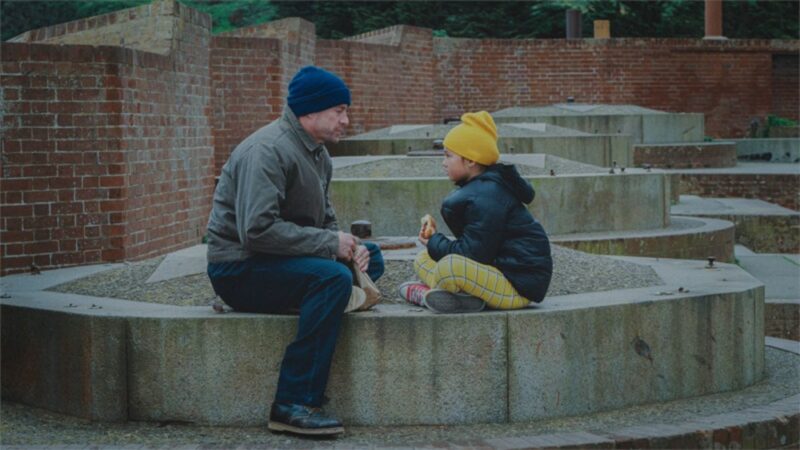
That complexity extends to the film’s extraordinary sense of perspective. Through Greta Zozula‘s unsettling cinematography, the world is frequently presented from Josephine’s physical and emotional vantage point, transforming familiar spaces into environments of overwhelming uncertainty. Adults loom over her, ordinary interactions become threatening, and the distinction between genuine danger and imagined possibility grows increasingly difficult to establish.
Accompanied by Miles Ross‘ disquieting score, the effect is almost that of a psychological horror film, except the terror isn’t rooted in anything supernatural. It emerges from the knowledge that something terrible has already happened, and that neither Josephine nor her parents can guarantee it won’t happen again.
It’s an approach that makes the film deeply uncomfortable to experience, but also remarkably compassionate in its understanding of how trauma can manifest through behaviour that others might struggle to recognise or accept.
And perhaps that is where the film’s greatest achievement lies: in its willingness to acknowledge that there is no universally correct response to something so profoundly destabilising.
Having seen Josephine without knowing the full extent of its narrative beforehand, I found myself reflecting on experiences and conversations that the film unexpectedly brought to the surface. What struck me most was the way de Araújo had taken something so deeply specific to her own life and created a story capable of inspiring reflection far beyond those circumstances.
As I expressed to both women during our conversation, the film feels particularly valuable because of the discussions it has the potential to encourage: about what children witness, what women experience, and the enormous gaps that can exist between our own understanding of the world and the realities faced by others.
These aren’t necessarily comfortable conversations, and Josephine certainly doesn’t make them any easier by offering reassuring conclusions. But that discomfort feels purposeful.
For a film that spent years in development, with Chan first becoming attached in 2019 before the project encountered delays during the COVID-19 pandemic, its eventual arrival feels especially meaningful. The fact that de Araújo’s screenplay had already been supported through the Sundance Institute’s screenwriting and directing labs in 2018 speaks to the long journey involved in translating such personal material into a finished work.
And yet, despite that lengthy process, what ultimately distinguishes Josephine isn’t simply the courage required to revisit a traumatic childhood experience. It’s de Araújo’s understanding that personal truth and artistic interpretation don’t have to be in competition with one another.
By allowing Chan to discover her own emotional relationship with Claire, the filmmaker has created space for a character who can simultaneously honour the woman who inspired her and exist as someone entirely her own.
In turn, Chan has found a way of expressing strength that doesn’t depend on making Claire the most commanding presence in the room. Sometimes, it’s found in the determination to maintain an ordinary routine. Sometimes, in the anger concealed beneath a seemingly innocuous sentence. And sometimes, in the unexpected recognition that a daughter struggling to understand her own fear might also teach her mother something about courage.
For all its harrowing subject matter, Josephine is ultimately a film concerned with the complicated ways we attempt to understand and protect one another, even when our own experiences make that understanding incomplete.
It doesn’t pretend that love can undo violence, that childhood innocence can simply be restored, or that every difficult conversation will lead to healing. What it does recognise is the importance of allowing those conversations to happen in the first place.
And perhaps that’s what makes de Araújo’s decision to share this story so profoundly affecting. What began as an experience belonging to one little girl has become a film capable of encouraging countless others to reconsider the things they’ve witnessed, the assumptions they’ve made, and the quiet strength of the women whose experiences they may never fully understand.
Josephine is screening in select theatres in the United States from November 20th, 2026, expanding wide on December 4th, before opening in Australia on February 18th, 2027.
