

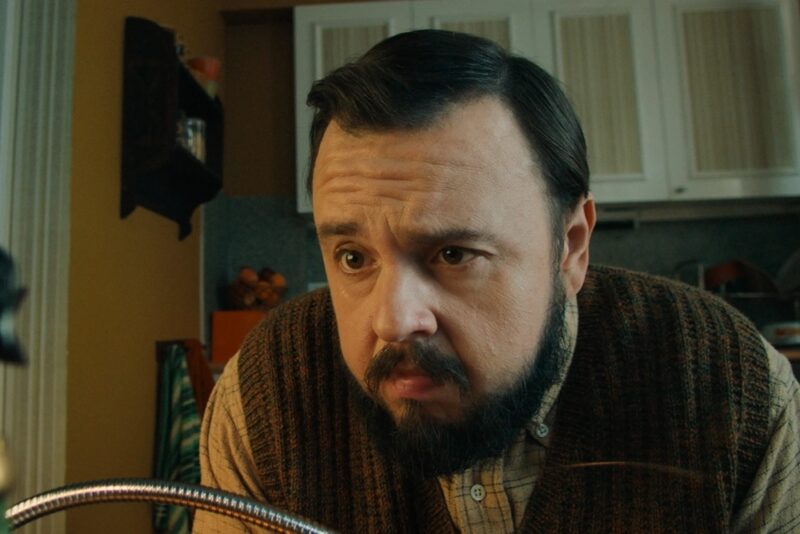
For some, Christmas is a season of joy, togetherness and cherished traditions. For others, it can be a painful reminder of everything they’ve lost, and the people who are no longer there to share it with them. It’s that quieter, often overlooked side of the festive season that sits at the heart of Merry Christmas Aubrey Flint, a tender, gently comedic exploration of grief, loneliness and the unexpected courage it takes to let happiness back into your life.
John Bradley stars as the titular Aubrey, a socially isolated Napoleonic history enthusiast whose childhood trauma has left him deeply resentful of Christmas and suspicious of the world beyond his carefully controlled existence. Content to spend his days painting miniature soldiers and avoiding human interaction, Aubrey finds his rigid routines disrupted when an encounter with the law leads him to perform community service at a retirement home. There, an unlikely collection of residents preparing a production of Charles Dickens’ A Christmas Carol gradually challenges everything he believes about connection, belonging and the dangers of allowing himself to care.
Directed by Jack Spring, the film brings together an impressive ensemble of British talent, including Celia Imrie, Richard E. Grant, Nigel Planer, Kiell Smith-Bynoe, Karl Pilkington and Dave Johns, with Jim Broadbent lending his voice as narrator. But beneath its eccentric characters and festive humour lies something considerably more poignant: a story about people who have been forgotten, the emotional walls we build to protect ourselves, and how those same walls can prevent us from experiencing life’s greatest joys.
Speaking with our Peter Gray, Bradley reflected on the heartbreaking psychology behind Aubrey’s attachment to his miniature army, the surprising paternal role Napoleon plays in his life, and why simply leaving the house can be an extraordinary act of bravery for someone who has spent decades shutting the world out. The actor also discussed a particularly revealing scene that didn’t make the final cut, the liberating experience of playing a man unconcerned with society’s expectations, and the film’s compassionate reminder that we should never be too quick to judge those whose unhappiness we don’t understand.
As Bradley beautifully observes, protecting ourselves from life’s lowest moments might spare us some pain, but it can also mean denying ourselves the possibility of its greatest happiness. And sometimes, the bravest thing we can do is simply allow ourselves to experience both.
One of the things I found really quite touching about Aubrey is that he spends so much time painting miniature soldiers and surrounding himself in these little worlds. There’s really something quite beautiful, but a little bit sad about this man who finds comfort in a world he can control when the real one has been so unpredictable. Did you see this hobby as an escape, or the one place where he still allows himself to feel something?
I think that’s a really smart assessment, and definitely along the lines of what I was thinking. We establish very early on that the pivotal moment in Aubrey’s life was losing his mum on Christmas Day when he was seven. He’s spent the rest of his life not so much recovering from that grief as holding recovery at arm’s length, because he simply can’t face it. He shuts out the world to avoid confronting that pain.
I’ve always said that Aubrey thinks he hates Christmas, but he doesn’t. He hates that his mum died. That’s what fuels everything. All his anger comes from being unable to face the pain of losing her so young.
His model army is essentially his way of creating a family that will never leave him. He knows all too well what it feels like to lose someone overnight, without warning, so he surrounds himself with people he can control. Napoleon isn’t going to die. Napoleon isn’t going to walk out on him. Apart from two key figures in his life, his model army represents the only people he can guarantee will stay for as long as he wants them to. And I think that’s his way of trying to process that trauma.
Yeah, I looked it as he’s not someone who dislikes Christmas. It’s more that he’s afraid to enjoy it again because of everything that’s happened to him.
I think he feels guilty about enjoying anything. His unhappiness is so deeply ingrained that he doesn’t even recognise it anymore. He lives with it every day and probably believes he’s perfectly happy sitting alone in his room, painting his models. It’s the audience and the outside world who look at him and realise, “You’re not happy at all.”
There’s a scene where he first encounters A Christmas Carol, and Dickens writes about loneliness, misery and letting life pass you by. For the first time, you can see that recognition on Aubrey’s face. He realises, “Actually, I’m deeply unhappy. I’ve just never allowed myself to acknowledge it.”
And that’s the turning point for him. From that moment, he begins to transform, because he needed to recognise his own unhappiness before he could truly begin to recover.
I was going to ask about the courage of letting people in, because you’ve played people who find extraordinary courage in situations where they don’t necessarily think of themselves as brave. With Aubrey, the bravery feels much smaller and more personal. Sometimes it’s just showing up, it’s letting someone in, or admitting you need people. Do you think there’s something particularly courageous about playing a man whose greatest challenge is allowing himself to be happy?
I think that’s a brilliant question. At the beginning of the film, Aubrey does absolutely everything he can to block out the world, right down to the clothes he wears. His cap becomes something of a comic device later on, but it was a very deliberate choice. He can pull it down over his eyes, and the flaps cover his ears. It’s his way of shutting everything out. He doesn’t have to see or hear anything he doesn’t want to.
He sees the world as a threatening, cruel place, and for Aubrey, simply going to the shops is an act of bravery. That’s an enormous barrier for him to overcome, and I think there’s something important in that about people who struggle with things most of us take for granted. Anxiety can make the simplest everyday tasks feel overwhelming, creating barriers that prevent people from living their lives fully. Aubrey is very much a character study of that mindset.
One of the film’s biggest lessons is that when you encounter someone whose behaviour seems strange, unpleasant or unhappy, don’t simply write them off. Try to look beneath the surface and understand what they might be dealing with, where that unhappiness comes from. Because if you dig deep enough, there’s usually a very good reason why people are the way they are.
Something I enjoyed about the character is that I don’t think he realises how funny he can be. He’s not necessarily trying to make anybody laugh, which somehow makes him even funnier. As an actor, do you enjoy finding the comedy in a character who’s taking himself completely seriously, especially in this world that’s becoming increasingly ridiculous?
Definitely. I found it quite liberating to play someone who doesn’t really follow society’s rules. It’s interesting when you think about humour, because it’s one of the ways we connect as human beings. Even two strangers in an elevator might crack a joke to break the tension and make the day a little easier.
But Aubrey has so little interest in other people that he doesn’t even recognise that convention. He’s not trying to appeal to anyone, impress anybody or make himself likeable. And that immediately marks him as an outsider, because it goes against so much of how we naturally interact as human beings.
There’s a scene with Kugan, Kiell Smith-Bynoe’s character, where Aubrey talks about not knowing how to make friends or even start a conversation. Those basic social interactions are completely foreign to him because he never really had anyone to teach him. He simply doesn’t know how to function in the world, and there are people who genuinely struggle with that.
As an actor, though, it was refreshing to play someone so unconcerned with those social expectations. In his own way, Aubrey is a renegade. A very low-key renegade.
Christmas is such a strange time, because we’re almost instructed to be happy, regardless of what’s happening. I think this film understands that, for some people, Christmas can actually make loneliness or grief feel louder. Did playing Aubrey make you think differently about the pressure we put on ourselves to feel festive?
I think so. Christmas is a joyful time, and there’s absolutely nothing wrong with embracing that. If you love Christmas, you should enjoy it, because life is hard enough. But I think we sometimes forget about the people who aren’t having such a wonderful time. People who are isolated, lonely or simply don’t have anyone.
It’s not just Aubrey. Many of the residents in the care home will spend Christmas there, disconnected from their families or, in some ways, forgotten by society.
I’ve often said that this isn’t a glamorous film in the way so many Christmas movies are. It’s a film about quiet sadness, about a group of people who are too often overlooked. They’re not necessarily the people you’d expect to see at the centre of a film, let alone a Christmas movie. But we felt their stories were worth telling, and that they deserved their moment.
And Aubrey’s fascination with Napoleon is such a wonderfully specific detail. Did you find yourself developing any theories about why that particular figure was important? Or did you leave the production with a newfound appreciation for miniature soldiers? Or have you left that firmly with Aubrey?
It’s an interesting relationship Aubrey has with Napoleon, and I think there are several layers to it. Early in the film, in that opening flashback, his new teacher explains to the class that Aubrey has come from France. He was born there to a French father and moved to England when he was seven, so he’s an outsider from the moment he arrives. When you’re being rejected at school for being French, having a French hero like Napoleon is something you naturally cling to.
As Aubrey gets older, particularly with the estrangement from his father, Napoleon becomes something of a father figure. There are moments when Aubrey looks up at Napoleon’s portrait before doing something he’s uncertain about, almost asking, “Is this okay?” Napoleon becomes his moral guide, that paternal arm around his shoulder that he’s never really had.
His attachment to Napoleon runs incredibly deep. Aubrey is searching for so many things – belonging, reassurance, guidance – and he finds some of them in this historical figure because he simply can’t find them in the world around him.
There was actually a scene we had to cut for time where Aubrey comes home drunk, stumbling around his apartment, and apologises to Napoleon. It’s a very sad moment, and a shame we couldn’t keep it. He looks at Napoleon and says, “I’m so sorry. I hate you seeing me like this.”
That sense of shame tells you everything about their relationship. The only person in the world Aubrey truly wants to impress is Napoleon.
Looking at disappointing actions, obviously Aubrey’s journey towards becoming a better connected human being begins with him getting arrested and having to do community service. It’s a very extreme way to encourage someone to socialize. Do you think Aubrey would have ever found his way back to people without that intervention? Or was he somebody who needed life to give him a very substantial shove?
I think that’s absolutely right. Aubrey would never have gone on that journey if it hadn’t been thrust upon him. He’s so obsessed with order and routine. His comfort zone is surrounded by a huge wrought-iron gate with an enormous padlock. He knows exactly where his boundaries are and has spent his life making sure he never ventures beyond them or puts himself in a situation he doesn’t think he can handle.
But there are moments, particularly towards the end of the film, when we see him begin to break free of that. There’s a wonderfully triumphant moment during the production of A Christmas Carol that he stages at the care home, where Aubrey acts purely on instinct, almost despite himself. It’s something he would never have allowed himself to do if he’d had time to think about it.
And just before letting you go, I feel like the film is ultimately about rediscovering the things that make life worth living, even when we’ve convinced ourselves that we’re better off without them. If Aubrey could give the John Bradley of today one piece of advice, what do you think he’d tell you?
I think it’s a lesson someone once taught me, and one that Aubrey learns quite sharply. If you shut people out of your life, you might avoid some of those two-out-of-ten days, because people can disappoint you and hurt you. But you also deny yourself the chance to experience those ten-out-of-ten days. Your life might be consistent, but it’ll be a consistent five out of ten. And I think the lesson is that you shouldn’t deny yourself the possibility of a ten simply because you’re afraid of experiencing a two.
Merry Christmas Aubrey Flint is scheduled for release in theatres in the United Kingdom on November 6th, 2026.
