

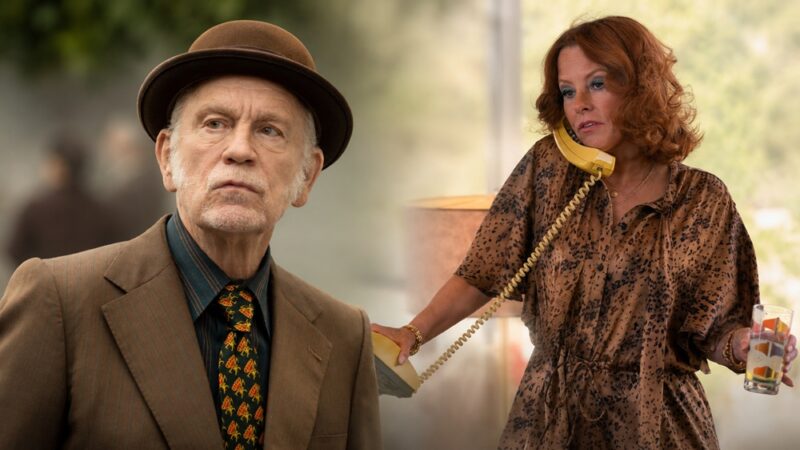
Friendship can be a strange thing, particularly when it’s forged through decades of deception, violence and the occasional disagreement over whether it’s appropriate to kill someone during a meal. In Martin McDonagh’s darkly comic Wild Horse Nine, the unlikely tenderness between two hardened CIA operatives becomes the emotional heartbeat of a story otherwise steeped in political conspiracies, moral reckoning and the uncomfortable realisation that a lifetime spent serving one’s country might not necessarily amount to a life well spent.
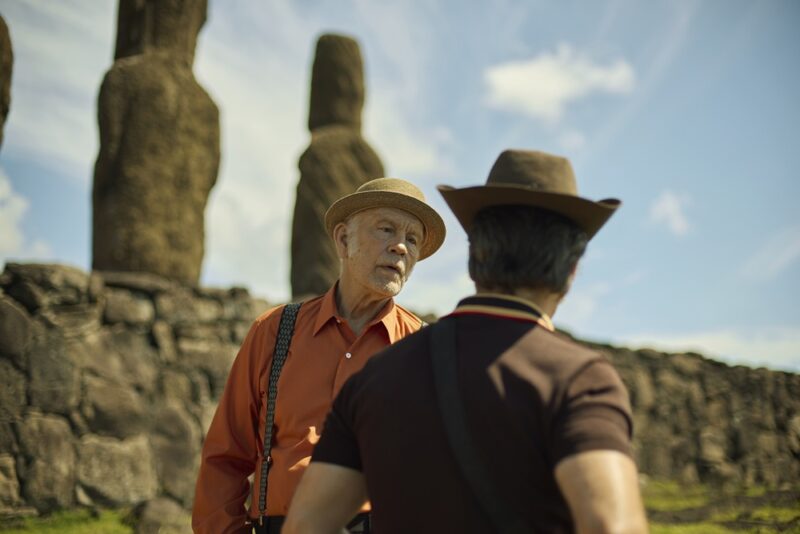
Set against the turbulent political landscape of 1973, shortly before the Chilean coup, the film follows longtime CIA partners Chris (John Malkovich) and Lee (Sam Rockwell), who are dispatched from Santiago to Easter Island by their bureau chief, MJ (Steve Buscemi). Surrounded by the island’s mysterious statues and haunted by the consequences of their past actions, the pair find their complicated friendship tested when Chris forms an unexpected connection with two rebellious students (Mariana di Girolamo and Ailín Salas). Meanwhile, Lee’s relationship with Margie (Parker Posey), whose presence is largely felt through a series of increasingly revealing telephone conversations, adds another layer of emotional complexity to McDonagh’s characteristically sharp examination of loyalty, regret and the absurdities of human behaviour.
Speaking with our Peter Gray at a recent press conference, John Malkovich reflected on the loneliness beneath Chris’s hardened exterior, the bittersweet reality of friendships that become increasingly precious with age, and the peculiar intimacy shared by two men who can debate the finer points of murder while barely questioning the morality of their profession. Parker Posey, meanwhile, discussed finding the humour and vulnerability within McDonagh’s richly layered writing, the freedom of trusting a filmmaker’s vision, and the unexpected joy of reuniting with Rockwell some three decades after their first collaboration. Together, their reflections reveal how, beneath the film’s caustic wit and political intrigue, Wild Horse Nine is ultimately concerned with something profoundly human: our need to be understood, even by those who know the very worst of us.
Mr. Malkovich, Chris speaks of not having a friend before Lee. I found that quite heartbreaking, because he’s clearly someone who’s spent much of his life surrounded by people without necessarily feeling connected to them. I wondered whether you saw his relationship with Lee as the first time he’s genuinely been loved before for who he is, and whether Lee has fallen in love – in a platonic sense – with a version of Chris that Chris himself no longer believes in?
John Malkovich: Yeah, good question. I suppose Sam would have to answer the latter question. But yeah, I take him at his word that it’s his first real friend. Sadly, I think in life, although I still have friends from my childhood, from kindergarten days, they’re getting thin on the vine at my age, because many have passed away, as have many of my colleagues from the cinema and theater. But I think (Lee and Chris) have a very close friendship.
Sam’s character refers to Chris as like this walking history of the CIA. At that time (1973), that probably gave him a kind of street cred, but he is beginning to question the merits of what he’s spent his adult life doing. But I think they have a great friendship, nevertheless. They argue about odd things, not so much whether one should kill people, but whether they should kill people while they’re eating (laughs), which might strike some as kind of gratuitous or beside the point, but these are the kind of fine points they argue about.
Or how gay is cheese in various countries (laughs), and why is it necessary for cheese to be gay? Clearly, they’re people who enjoy each other’s company, but also irritate each other greatly.
Parker, Margie is physically distant from the events on Easter Island, yet her phone calls with Lee seem to have this power that destabilizes his world. How did you approach playing a woman whose influence is felt largely through her voice? And how did use humour to hint at the deeper vulnerabilities or truths that she might be revealing, perhaps even unintentionally?
Parker Posey: Well, it’s just in the writing. It’s your service to (how) the scene is laid out for you to play. You plug into the words and rely on the director. I mean, there was so much prep for my one day of work. It was really fun. I don’t know how to answer your question (laughs). How do I do it? It’s there in the writing. You keep investing. The stakes are already really high, so being able to play so much at once is fun. Even though some of the people (are) doing terrible things, they love each other.
I love Steve’s (Buscemi) relationship to Lee and Chris. You see this pathos. (This) humour and pathos. Those classic things you see in plays and good scripts that are working to elicit a feeling from an audience. But when you have a great director, who’s (also) the writer, I’m going to slide down this mountain. I keep getting skiing images (laughs). (This) terrain. The writing is holding you, but you’re just pushing through to forget the words and play the scene live. You’re constantly refreshing and restarting the reality that you’re in.
I love Sam. I’ve known him for 30 years. We did a little independent movie called Drunks in the ’90s, and it was really special. It was a full-circle kind of, “Oh, I get to do this. I get to act with him.” I love him. He’s such a great actor and person and fan of movies. And you keep that energy up of being a fan of great writing. And it helps you get through any kind of insecurities belonging in the moment. I’m here. I’m here now.
Wild Horse Nine is now screening in Australian theatres.
