

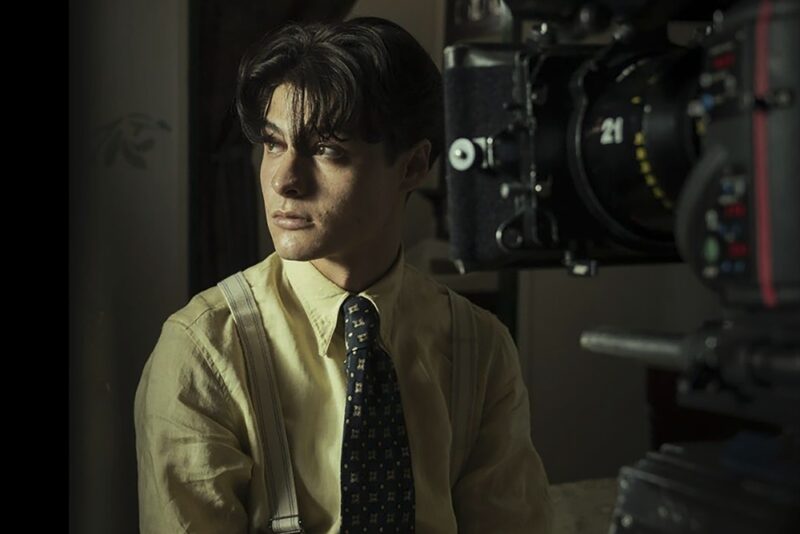
Winner of the Best Director award at the 2026 Cannes Film Festival, La Bola Negra, from filmmaking duo Javier Calvo and Javier Ambrossi, is an ambitious and deeply affecting exploration of queer identity, repression and the enduring legacy of love across generations. Unfolding across three distinct periods in Spanish history, the film examines how desire, grief and the struggle for acceptance transcend time, with the words and experiences of poet Federico García Lorca providing an emotional connection between its stories. At the centre of its 1932-set narrative is Carlos, played by newcomer Milo Quifes, a young man forced to choose between his authentic self and the expectations of a society determined to deny his existence.
Speaking with our Peter Gray as the film arrives in Australian theatres, Quifes reflected on finding the emotional truth of a character living almost a century before him, the surprising parallels between his own experiences and those of Carlos, and the challenge of conveying what cannot be spoken. The actor and published author also discussed his connection to Granada, the guidance he received from his directors, and how immersing himself in Lorca’s world proved to be a transformative experience, reminding him that the pain, love and longing of queer lives past remain profoundly relevant today.
I wanted to first ask about the weight of the black ball, because Carlos’s storyline centers around an institution demanding he verbally erase his truth to belong. Coming into this project as an author who uses words to define identity, what was it like to live inside the skin of a character who has to use language to deny himself?
When I first read (Federico García) Lorca in the summer of 2025 for the film, the first thing I understood was the desire, the pain, the frustration and the anger Lorca felt to be a part of 1932. It’s the same thing I understand today. I feel it like a child’s skin. It’s like pain. I used that to understand why my character is the way he is.
Watching the film as a gay man, it hit a lot for me. I know that (co-director) Javier Calvo mentioned that during editing, it was intentional to cut a lot of dialogue to let the unsaid live in the actor. As a writer accustomed to having text carrying meaning, how did you calibrate that silent interior?
The funny thing is, I think that was the hardest part. The Javis (directors Javier Calvo and Javier Ambrossi) are very flexible. They wrote the script over and over again. Whatever it needed. But I remember Ambrossi came to me, and told me to stay quiet. To say things with my eyes. It’s kind of complicated saying things with your eyes (laughs), but he was right.
It’s an incredible performance. And if my research is correct, you were studying biology in Granada when you answered this casting call? Did inhabiting 1930s Granada shift your relationship with the city itself? The city you walked every day as a student…
Granada means a lot to me. That’s the city where I was independent for the first time. The first place I established my career.
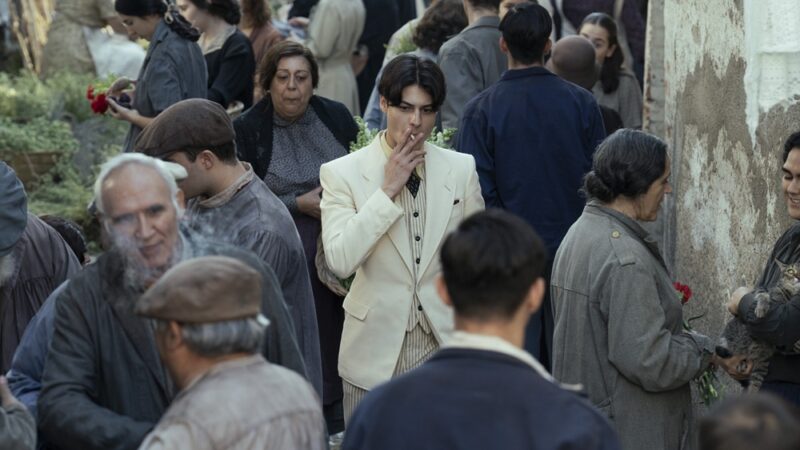
I know the directors noted that they loved casting non-professional actors because they bring an unconscious sense of self into a performance rather than relying on the technical tricks of an actor. Were there parts of yourself that slipped into your character that you didn’t consciously plan on or anticipate?
I found there were similarities between myself and the life of Carlos. His (religion), his grief, his love, his relationships with his parents. That was the easy part about Carlos. I didn’t know about the pain, so I had to understand the feelings and the memories to be true with my own story. I had to understand why he’s angry with his parents, cause that’s not something I have.
And having published Ultravioleta, you’re obviously used to being in control of characters and world building. Was it liberating to surrender that control to someone else and just be an actor in someone else’s narrative?
I don’t know if I consider myself a writer (laughs). I can consider myself around literature, culture and art. I try every day to be surrender to these things. I always ask Javier Calvo and or Javier Ambrossi about advice for writing characters. I was with them for a year and I learned so much.
Your timeline in the film is nearly a century ago, but your character’s experience is threaded into the modern day with the character of Alberto’s story. Did you and Carlos González discuss how your lives intertwine? Or did you purposely keep that process separate?
The first time you understand the lyrics and poetry of Lorca is the same moment you understand that the pain, grief and love he felt in 1932 is the exact same of what people understand today. It was easy to understand where both of these characters came from – from the soul of Lorca that lives within every queer boy.
And having experienced the discipline of writing and collecting memories on set. Has it changed how you write? Has it changed your relationship with the camera and screenwriting? What are you taking from this film with you going forward?
You can’t make a film like this without transforming yourself. If I have to look back, I’ll remember that I’m the same boy, but that I’ve learned so much about developing my feelings, how I connect this feeling with my experience, and I how I respond in those moments. When you put a camera in my face, I want to shake it (laughs). But that’s not a bad thing. I’m human, and I’m very grateful to be in this movie. I’m so proud of it.
La Bola Negra is now screening in Australian theatres.
