

At 155 minutes, and unfolding across three timelines that initially appear to have only the faintest connective tissue, La Bola Negra asks its audience to place an enormous amount of trust in directors Javier Calvo and Javier Ambrossi. For much of its first two hours, their sweeping queer epic can feel deliberately elusive, moving between characters, decades and emotional registers without hurrying to explain why these particular lives are being placed alongside one another.
Trust it.
Because when La Bola Negra finally reveals the full scope of what it has been constructing, the effect is extraordinary. What once seemed fragmented gradually folds together with such emotional precision that the film’s considerable length becomes almost deceptive. This isn’t three disconnected stories desperately searching for a common thread, but one enormous story about queer existence being written across generations: about the people who survived, those who disappeared, the lives that history refused to preserve, and the pieces of ourselves that somehow endure.
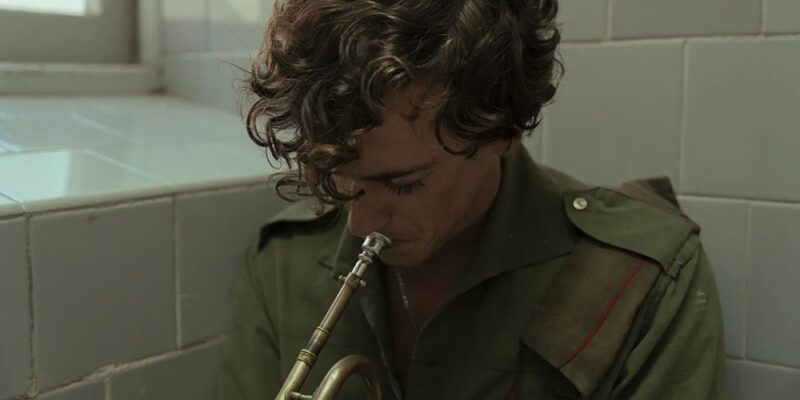
In 1937, Sebastián (Guitarricadelafuente) emerges from the destruction of his hometown with virtually nothing, eventually finding himself absorbed into the fascist army. When Rafael (Miguel Bernardeau), a wounded enemy soldier, is taken prisoner, Sebastián is tasked with gaining his confidence and extracting whatever information he possesses before his execution. But Sebastián’s fascination with Rafael soon becomes something far more dangerous: a connection between two men for whom tenderness itself can be an act of defiance.
Five years earlier, Carlos (Milo Quifes) experiences a different form of violence. Attempting to gain membership to his local casino, he is rejected through the titular black ball because of whispers surrounding his sexuality. He can challenge the accusation, distance himself from the truth and potentially earn his way back into respectable society, or accept what that society has already decided makes him unacceptable.
Then, in 2017, Alberto (Carlos González) receives word that the grandfather he never knew has died and left something behind for him. His mother, Teresa (Lola Dueñas), wants nothing to do with either the man or his legacy, but Alberto’s curiosity leads him towards a history that has remained buried for decades.
Calvo and Ambrossi, working with co-writer Alberto Conejero and drawing inspiration from the surviving pages of Federico García Lorca’s unfinished 1936 work, resist neatly compartmentalising these narratives. The film moves between them instinctively, sometimes through an emotional or visual association rather than an obvious narrative one. Sebastián, Carlos and Alberto may occupy vastly different versions of Spain, but each is negotiating the distance between who he knows himself to be and who his surroundings permit him to become.
That tension is particularly devastating in the historical strands. Carlos still has a community around him, even if its acceptance is conditional, forcing him to confront the humiliating proposition that belonging may require the denial of himself. Sebastián has already watched his world disappear. What remains is the unexpected intimacy he discovers with Rafael, a man he has ostensibly been ordered to betray. Their connection is handled with remarkable restraint, allowing glances, silences and proximity to carry the weight of desires neither can safely articulate.
Guitarricadelafuente, making his acting debut, is magnificent in that restraint. There is a softness to Sebastián that never reads as weakness, and the musician-turned-actor has an extraordinary ability to communicate the character’s shifting emotions without announcing them. Opposite him, Bernardeau imbues Rafael with an alluring confidence that gradually gives way to something considerably more vulnerable. Together, they create the film’s aching emotional centre.
The supporting cast is equally rich. Penélope Cruz makes spectacular use of comparatively limited screen time as Nené, an entertainer whose presence provides a brief eruption of glamour, sensuality and escapism amid the ugliness of war, whilst Dueñas gives Alberto’s contemporary storyline a bruising emotional volatility. Glenn Close, too, appears in the modern-day narrative without the film ever treating her arrival as the celebrity event it easily could have been. Such performers are embellishments rather than crutches in a film confident enough in its younger cast to let them carry its enormous emotional burden.
Visually, La Bola Negra frequently borders on overwhelming. Gris Jordana’s cinematography gives each period its own texture without reducing the film to an obvious collection of aesthetic tricks, moving between the brutality of war, the intimacy of hidden spaces and moments of almost intoxicating beauty. Raül Refree’s thunderous score similarly understands when to overwhelm and when to retreat, complementing a film that can shift from enormous historical spectacle to the smallest movement between two bodies.
And yet, for all its visual grandeur, La Bola Negra ultimately derives its power from something far simpler: the human need to be known.
That is what makes its final stretch so overwhelming.
For more than two hours, Calvo and Ambrossi scatter fragments across nearly a century. Names, objects, memories, relationships and pieces of art pass between people who may never understand the significance they will eventually hold. Then those fragments begin finding one another. The film doesn’t merely connect its narratives; it recontextualises them, turning what initially appeared to be narrative detours into pieces of an inheritance that has been travelling through generations.
The resulting emotional crescendo is staggering. What began as a distinctly Spanish story, rooted in the Civil War, fascism, Lorca and the historical persecution of homosexuality, expands into something both unapologetically queer and unexpectedly universal. La Bola Negra understands that identity is shaped not only by who we are, but by how much of ourselves the world around us permits us to reveal. Sebastián and Carlos live in periods where being seen can carry devastating consequences. Alberto exists in a world transformed by the people who endured those consequences, whether their names survived alongside their sacrifices or not.
There is something deeply moving in the film’s refusal to reduce queer history exclusively to suffering, too. Repression and violence are unavoidable parts of these stories, but so are lust, humour, art, friendship, desire and those fleeting instances when another person looks at you and understands exactly who you are. Its characters aren’t presented merely as victims of their eras; they are people attempting to live fully within them.
That distinction is crucial. La Bola Negra is ultimately as much about preservation as persecution. Art becomes a means through which lives denied permanence can speak to people they will never meet. Stories survive their authors. Desire survives attempts to eradicate it. Someone can be erased from the official record and nevertheless leave behind something capable of changing another person decades later.
Suddenly, 155 minutes doesn’t feel indulgent. It feels necessary.
Calvo and Ambrossi have created a film whose apparent disjointedness proves integral to its eventual power. We aren’t supposed to immediately understand how these men fit together because they don’t understand it either. They are simply living their lives, unaware that their choices, loves, compromises and acts of courage are becoming part of something much larger than themselves.
By the time La Bola Negra assembles those lives into its final, breathtaking form, it feels less like watching three stories converge than witnessing almost a century of queer history reach across time to touch itself.
Sweeping, romantic, devastating and defiantly alive, La Bola Negra is a film about what happens when people are told they must disappear – and the extraordinary ways they find to remain.


FOUR AND A HALF STARS (OUT OF FIVE)
La Bola Negra screened as part of this year’s Toronto International Film Festival, running between September 10th and 20th, 2026. For more information, head to the official site here.
