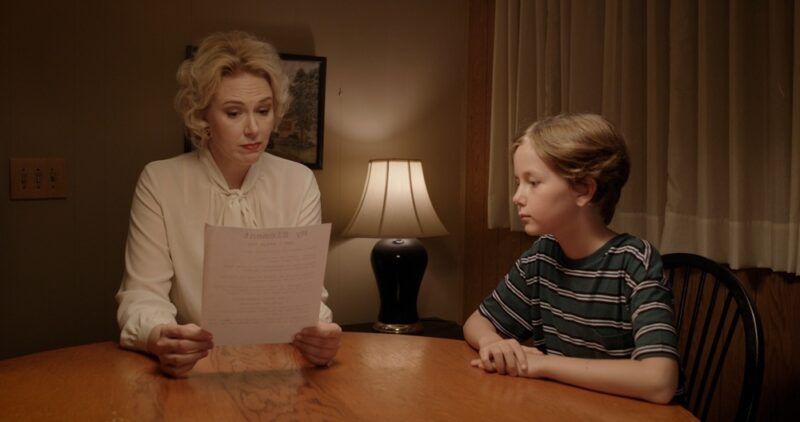

What begins as a simple story about a kid leaving his homework until the very last minute becomes something far more poignant in Last Minute. Set in 1989, before smartphones, Google, and instant answers, writer-director Michael Cusumano‘s charming short follows a single mother racing against the clock to help her son complete a major school assignment. But beneath the laughs and relatable procrastination panic lies a thoughtful reflection on self-reliance, community, and the small everyday experiences that have quietly disappeared from modern life.
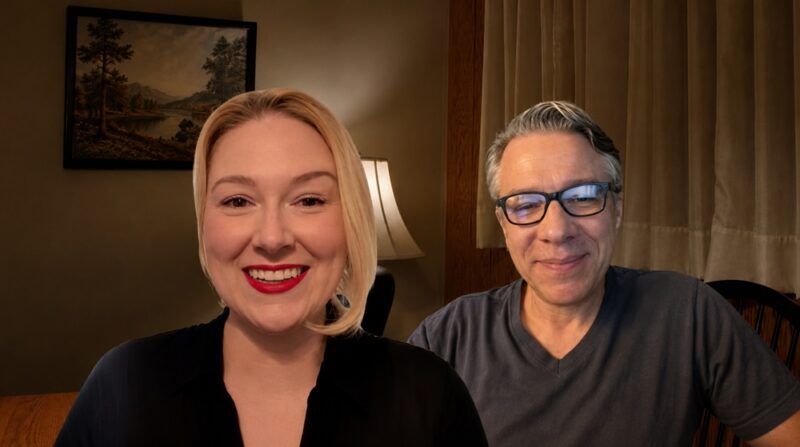
As the short screens at this year’s Tribeca Film Festival, our Peter Gray spoke with Cusumano and star Charity Schubert to discuss the real-life childhood disaster that inspired the film, the surprising emotional power of White-Out and landline phones, the connections we’ve traded for convenience, and why a frantic overnight homework assignment might be the perfect lens through which to examine what we’ve gained – and lost – in the digital age.
I wanted to ask about this premise, because it feels incredibly specific and universal at the same time. For both of you, was there a real “Oh no,” homework moment from your childhood that became the emotional seed for this story?
Michael Cusumano: It’s funny – I just had lunch with one of my friends from grade school, who still lives in Astoria, Queens, and we were talking about the film. Without me even mentioning it, he immediately recognised the assignment that partly inspired the story.
In the film, it’s one element off the periodic table, but when we were kids, we had to make an entire periodic table. Looking back, that’s kind of insane to ask of a kid. So I thought, “That’s too much for the movie.” Instead, I used it as inspiration. I made the kid a little younger and a little more dependent on his mum coming to the rescue, and I found a sweet spot with a project that you could realistically finish in one night.
Because with the actual assignment, if you hadn’t started early, you were completely screwed. I let it slide and ended up having to come up with a fact for every single element on the periodic table.
What actually happened is one of those things that would seem completely contrived if I put it in the film. I was up all night working on it and ended up being rescued by a snow delay. School was delayed by two hours, and that gave me just enough time to frantically finish this absurdly difficult project.
Charity Schubert: Yeah. For me, I don’t really remember having any huge last-minute panic projects. I was definitely a procrastinator, but I think I was also a little too much of a goody two-shoes to ask my parents to do the work for me. So I mostly just hustled and kept the panic to myself.
I do have one story, though, that today feels completely insane and hilarious. I had to do a science project – I think I was in seventh grade – and my dad helped me build it. It wasn’t a last-minute thing, but I ended up making a weather vane out of balsa wood. Because it was so lightweight, we needed to add some weight to the tip so it would actually turn properly.
And this really tells you how long ago this was: my father hot-glued an actual live .22 bullet onto the weather vane as a counterweight. Then I took it to school.
Looking back now, it’s unbelievable. Nobody thought twice about it. It was just, “Yep, that’s a science project.” Today, of course, there would be an emergency response team waiting for you at the front gate. But at the time, it seemed completely normal.
Really the epitome of “It was a different time.” I know that, Michael, you’ve described reaching an age where your memories started to feel historical. Was there a particular detail from 1989 that suddenly hit you emotionally while writing this? Something that younger audiences might not even recognise now?
Michael Cusumano: While writing it, I kept coming back to that feeling of being completely stranded. That panic of realising you don’t have the book you need, the library is closed, you waited too long, the bookstore is shut, or they don’t even have the book you’re looking for. You’re completely out of options and somehow have to find a way through it. Now, there’s always something you can look up online. There’s always another avenue. But back then, there really were moments when you hit a wall.
I tried to capture that in the opening anxiety nightmare that kicks off the film – that feeling of, “I am beyond screwed. There is no hope for me. All is lost.” It’s exaggerated, of course, but it’s rooted in a very real emotion. Procrastination is universal. It’s never going away, and I’m sure kids today can absolutely relate to that part of it. What I’m not sure they can fully relate to is that pure dread of having no fallback option. No internet, no instant answer, no backup plan. Just the sinking feeling that you’ve run out of time and you’re on your own.
It really wasn’t that long ago that we just didn’t have access to mobile phones at school. It really does feel like a whole other world though. That’s why watching this made me really happy, because it was just a reminder of that time. Charity, Jackie could have so easily been played as this frazzled chaos, but the film is rooted in love and resilience. How did you balance the comedy with the quiet panic of a parent who’s basically trying not to fail her child?
Charity Schubert: So Michael was very clear in his direction that Jackie should never yell at or scold her son. From the beginning, we envisioned a mother-son relationship that wasn’t entirely traditional. She’s a single mum, so she’s effectively both mum and dad, and she speaks to him more like a little adult than someone she talks down to as a child.
She can be upset with him and disappointed in him, but having a mother simply scold a child isn’t particularly interesting to watch, and it wasn’t the strongest choice for the character. So I was very careful not to lean too heavily into her anger or frustration.
I think one of the keys to finding Jackie was discovering the moments where she actually starts to enjoy the situation. She’s frustrated with Jason, she’s disappointed in him, and she certainly doesn’t want to spend her evening dealing with this project. But once she gets drawn into it and starts taking ownership of the challenge, she begins to have a little fun. She relaxes into the moment.
And that’s how life often works. Even in moments of panic and stress – when it feels like everything is falling apart and you’re convinced you’re going to fail – you still find ways through it. Through your community, through the people around you. Jackie reaches out to her friend, she reconnects with an old flame, and despite everything that’s going wrong, she manages to stay present and find some joy in the experience.
I think that says a lot about who she is as a person and the kind of mother she wants to be.
With setting the film before Google, smartphones and instant answers, do you think of this as being secretly about problem solving as a lost art as well?