


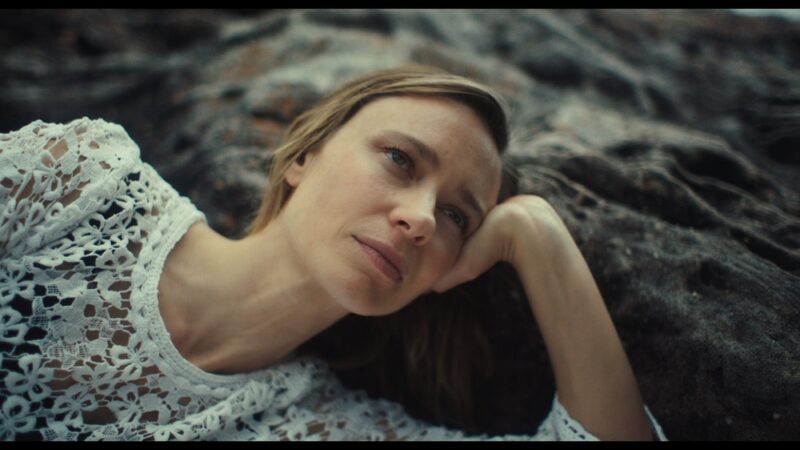
There’s a haunting contradiction at the centre of Life Could Be A Dream. On the surface, Sarah has everything: beauty, privilege, a handsome husband, an elegant home, and the kind of curated life that resembles a glossy magazine spread. But beneath the designer clothes and glass walls sits something far more fragile – a woman trapped inside the mythology of what love and success are supposed to look like.
Directed by Jasmin Tarasin and written by Courtney Collins, the film unfolds like a fractured fairytale, following Sarah (Maeve Dermody) as she attempts to break free from a coercive marriage while protecting her teenage son, Otis. Drawing heavily from the romantic conditioning of Pride and Prejudice, the film interrogates the dangerous fantasy that love alone can transform people, while exploring the invisible cage of control that can exist inside even the most picture-perfect domestic spaces.
When our Peter Gray spoke with Tarasin and Collins, their conversation moved through the emotional architecture of the film – from the glass-walled house that became a metaphor for Sarah’s exposed inner life, to the restrained dialogue designed to make audiences feel rather than simply observe. We also discussed romantic mythology, inherited cycles of behaviour, and the deliberate use of costume to chart Sarah’s psychological unraveling and rebirth.
I wanted to ask you both about mythology and romantic conditioning, because there’s something fascinating about how the film engages with Pride and Prejudice as both comfort and constraint. How did you, as a director and a writer respectively, approach unpacking the mythology without dismissing its emotional pull? Especially for a character like Sarah, whose sense of love has been shaped by it?
Jasmin Tarasin: I know Courtney has a lot to say about that, but we set up the story as a fractured fairy tale and then breaking those myths about what those love stories are about. We’ve been told growing up that “this is what a family looks like,” or that “this is what happiness looks like,” and you literally can’t do anything about it. It’s a curse on us all. I think the resilience and agency to break those patterns is what we are exploring.
Courtney Collins: In terms of the stories that you know, I would be vulnerable to a Mr. Darcy. I’m definitely a Mr. Darcy type of literary gal, in terms of the enduring phenomenon of that story, and that character as a recurring romantic hero. For me, it’s this fascination with a character who changes. I think many people go into a relationship and come up against someone’s limitations, and there’s a fantasy that we can change them. And in Pride and Prejudice, Elizabeth Bennett does. She’s successful. He turns from this kind of arrogant creature, handsome but arrogant, into a better person. So, for the character of Sarah, it’s kind of locking her into that fantasy that she’s hoping her partner will change. We know not everyone can change though.
Going off that, that leads into cycles and inheritance. The film feels so deeply invested in the idea that we inherit not just trauma, but also narratives about love and power and identity. When you’re shaping Sarah and Otis’ relationship, what did “breaking the cycle” actually look like to you in practice? Were there moments where it felt ambiguous or incomplete at all?
Jasmin Tarasin: I think that struggle – that push and pull between the visual markers of what success and love are supposed to look like, and what they actually feel like in the body – is really what Sarah’s character is grappling with. On the surface, things can look one way, but internally they can feel completely different, and she’s battling that tension throughout the film, almost underwater, trying to make sense of it all.
Because it doesn’t always make sense, right? You can have this feeling in your body that clashes with what your day-to-day life looks like. For her, it was about finding the resilience and agency to keep swimming through those emotions. She literally swims through that feeling. I saw her as flawed too. She goes back, she hesitates, she has second thoughts – all of those very human reactions. But I think there’s a real strength in continuing to move through those moments, whether that’s walking, swimming, or however you want to frame it. That’s really what we were trying to portray in the story.
Courtney Collins: And it’s also about the difference between the story as it presents from the outside and the reality underneath it. To an outsider – even to her own mother – Sarah looks like a woman who has everything. They appear to be the perfect, privileged family. But within that, Sarah has no agency. She has no real connection to her own life.
We often talk about the invisible cage of coercive control, and that was something we really wanted to explore. You can’t show that in just one scene because it’s built through moments over time – moments that, in what we’d call polite society, might even pass as normal. But when you look closely, within that domestic space, you start to see the cage both Sarah and Otis are trapped in. And it’s important not to forget that the child is a victim in all of this as well.
Mentioning visual markers, I wanted to ask about the house in the film, because it’s striking. It’s all glass and openness. It’s beautiful in how exposed it is. Did you, Jasmin, think of that space as an emotional metaphor? There’s something about being in a place where you can see everything and be seen at all times that feels liberating, yet deeply unsettling. It’s vulnerability without protection. How did you use that environment to reflect Sarah’s internal state?
Jasmin Tarasin: It’s 100% (that). The house actually belongs to a friend of mine. I went there and immediately thought, “Oh my God, can I use this house?” They’d removed so many of the walls and replaced them with glass, so the whole place felt completely exposed. That worked on two levels. From the outside, everyone can look in and see what appears to be the perfect life. But when you’re inside looking out, you’re constantly confronted by your own reflection. It becomes this transparent cage – the image of the perfect family, the perfect life, the perfect woman – but still a cage nonetheless. Even the wooden structure of the house felt cage-like to me. So while the space was incredibly beautiful and aspirational, those metaphors were absolutely something I leaned into visually.
One of my favourite scenes in the film is when Jake locks her out and she’s knocking on the window while he ignores her. She’s standing outside in the cold, looking in at her own life and being shut out of it. For me, that’s one of the saddest moments in the film. And then the other major location – the deceased estate – had this timeless beauty to it, almost like something out of a fairy tale or a castle. I really loved that quality because it made the story feel universal. That architecture could exist almost anywhere in the world, and it gave the film this dreamlike, fairy tale atmosphere that really suited the themes we were exploring.
And Courtney, there’s a restraint to the dialogue that feels very intentional. People aren’t always saying what they mean or what they feel. How did you find that balance between what’s spoken and what’s withheld?
Courtney Collins: I think so much of the film as it exists on the page is in action and description, and really approaching it in that painterly way – understanding and knowing (Jasmin’s) cinematic language. So knowing how it would be translated was really helpful. Jas and I have worked together for a long time, so in a sense, I know her palette. I know her brushstrokes. So that was delightful, actually.
And the restraint in terms of dialogue – it was more about really hooking into the interior lives of the characters and feeling the truth and untruth of the words they would speak to each other. I’m not going to say writing a screenplay is ever easy, but we had the fast track of already having a language together. We knew the setting. We knew that Maeve Dermody was cast as Sarah. All of those things meant I could sink into the world of it and really feel it. Going into the feeling is everything in this film.
It’s about creating a container for people – not to tell them what to think, but to get them to feel. That was the intention.
In crafting Sarah, she’s dressed in all these designer outfits. It’s like there’s a sense of her trying on different versions of herself. Did you both see costume as part of her psychological evolution? Almost as she’s stepping into a life that she’s not sure she’s allowed to live…
Jasmin Tarasin: I think that she paints this picture perfect painting. She’s educated, she’s privileged, she’s beautiful, she’s got this elegant taste. It’s all of those things that are markers of perfection and success. When she becomes authentic and real, she’s just in a white t-shirt. And she’s looking pretty tired. I think that’s the beautiful thing with Maeve is that she really leans into exposing herself through that beauty. She leaned into the different faces of what courage can look like. It was absolutely deliberate. We worked with a whole lot of designers. It was 100% thought of throughout.
Courtney Collins: When she’s in that moment where she’s in her T-shirt and underwear and locked outside, I was really grateful that Jas didn’t give it a designer tilt because it is such a pared-back moment. I do remember getting one script note from Jas (though). I had Sarah going to the shops in a hoodie, and she was like, “Oh no, no. That is not our Sarah.” And she was absolutely correct. It really is about knowing how much our costumes communicate about our inner world.
Life Could Be A Dream is screening in Australian theatres from May 14th, 2026. A donation of $1.00 from every ticket sold across the Palace Cinemas circuit during the release of the film will be made to The Man Cave – Australia’s leading preventative mental health charity for boys and young men that run workshops to help them build healthier relationships with themselves and those around them.
