

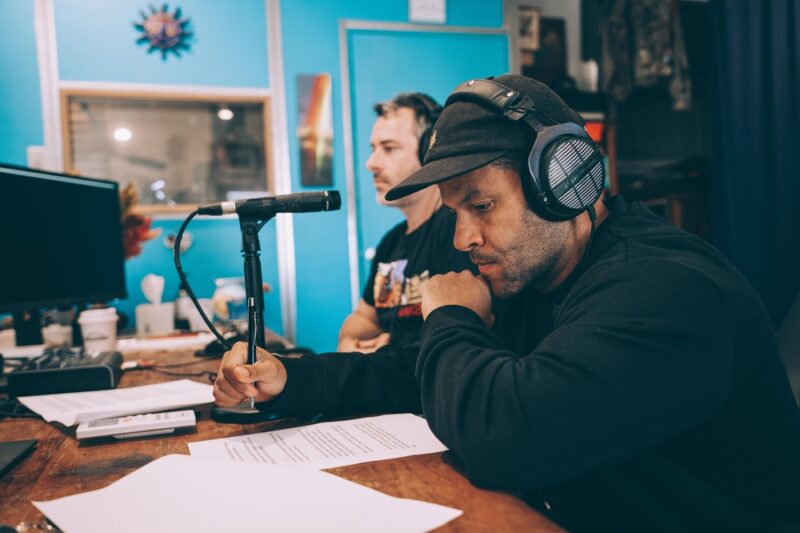
There’s a moment in In Pieces Together where the scale of what Blake Johnston is attempting stops feeling physical and starts feeling deeply emotional. On paper, surfing continuously for 40 hours to break a world record sounds almost impossible. But beneath the exhaustion, saltwater and spectacle lies something far more personal: a son trying to honour his father, a community grieving together, and a filmmaker determined to create a conversation around mental health that feels raw, honest and accessible.
Directed by two-time AACTA Award-winning filmmaker Macario de Souza (Bra Boys, Fighting Fear), the documentary follows Johnston’s extraordinary endurance challenge marking the 10-year anniversary of his father’s death by suicide. Narrated by Luke Hemsworth and featuring voices including Braith Anasta, Matt Ford, Jack Steele, Connor Watson and Professor Pat McGorry, the film expands beyond one man’s story into a broader reflection on vulnerability, resilience and the importance of connection.
Speaking with our Peter Gray, the filmmaker opened up about channeling his own experiences with depression, anxiety and losing friends to suicide into the documentary, why he wanted tough public figures to be emotionally exposed on screen, and how In Pieces Together evolved from a story about one family into something much larger – a communal conversation about the importance of purpose, openness and finding strength in vulnerability.
You’ve obviously made films before, but this feels like a different kind of responsibility. Did you ever feel a weight in telling a story that touches on suicide so directly?
Yeah. I mean, just having gone through a lot of suicides with a lot of friends over the years, and never quite either processing it or understanding it, and then going through my own traumas – heavily battling depression and anxiety over the years – I thought I had gotten through that, and then at an older age it sort of came back pretty violently. Going through medication and therapy and all that stuff, I was still trying to understand: how do other people cope? That’s where it started.
When the Johnstons reached out to me and asked if I’d be interested in telling the story, I was instantly hooked based on what they’d been through, and particularly the way Blakey carries himself. His positivity is so infectious. There was something I was really drawn to. I wanted to spend time with this guy and actually learn how he goes about his life, because I could probably use a couple of pages out of his book. Selfishly, that’s kind of where it started.
Then I started thinking this was a way for me to probably explore a topic that I should have explored deeper with my friends after losing them to suicide. For me, it became an exploration into something I wanted to learn for myself, and try to create a film that I feel like my friends could watch and also get something out of. Knowing how much men struggle to communicate, I wanted to get tough men – people you know from TV – and have them be very raw and open, so people could look at Blakey or those guys and think, “If that person can do it, maybe I can do it with my friends.”
That was the nucleus of it all. We wanted to do it in a very raw manner, like you’re just in a room with a bunch of your friends and there’s no filter. Everyone can speak openly and get to a solution quicker. I feel like some films in the past haven’t quite hit that mark. It’s been clinical or fluffy and dancing around the topic. We just wanted to hit it head-first and show people there are practical tools available to absolutely everybody. You can walk out of this film and implement one or two things that’ll really help your life. The importance of community. Finding purpose. Getting out of your comfort zone a little bit. Those are probably the three main things.
Yeah, because when you see people like Braith Anasta and Connor Watson – guys who, to so many people, represent that “tough guy” mentality – opening up and breaking down in this, it really shows men that it’s okay to be vulnerable. There’s strength in not always holding it together.
Absolutely. I think there’s been a shift in recent years where it’s becoming more acceptable, which is great. It certainly wasn’t like that when I was growing up. But yeah, strength is in vulnerability. That’s where it starts. If we keep this facade of toughness forever, it doesn’t solve anything.
You mentioned connecting with Blake during your own struggles. How did that personal connection shape what you chose to show in the film – and just as importantly, what you chose to leave out?
Seeing how a lot of what helped him get through things were actually quite simple – very practical tools that are accessible – that really shaped the film. I think there are two sides to mental health and depression. Sometimes it is a chemical imbalance and severe enough that medication is necessary. But other times, happiness is a choice, and that choice is based on your environment.
When the chips are down, it’s very easy to choose anger or sadness, but it’s also a habit to choose happiness. That’s what I saw in Blake. He chose that route over the other route based on what he’d been through. I thought that was something achievable for myself and for a lot of people around me. So I chose to put a lot of that in the film.
A lot of the people in the film – outside of Blake – are everyday people. They’re from diverse cultures and backgrounds. That was important too. This is a broad spectrum of society dealing with these issues, and this is how they cope. Perhaps you can do it too.
What I left out – and this is only my personal take – is that while I think there’s a time and place for medication, I also think doctors can be very trigger-happy with prescriptions. The focus of the film was natural, practical remedies first. The other stuff we left out because it’s not really for me to speak on. I’m not a professional in that space.
We purposely focused on what’s accessible to you right now before going down the route of GP, psychologist, medication. I think there’s definitely a place for those things in severe cases, but I also think the world could really benefit from using what’s around them first and foremost.
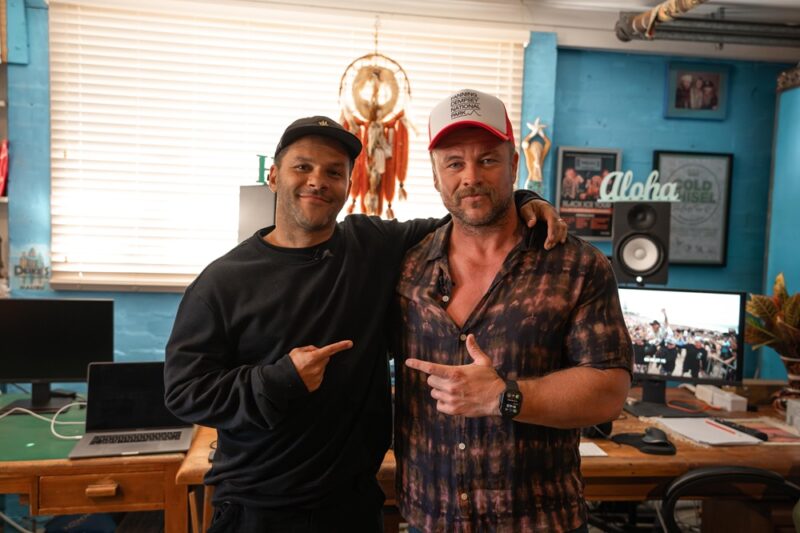
From a filmmaker’s perspective, was there a moment in the edit where the film surprised you? Where it became something different from what you originally thought you were making?
Yeah. I started by focusing on the Johnstons first and the world record, but as powerful as their story was, they were also very big on the idea that this wasn’t just about them – it was a community conversation. So I made the decision to reach out to a bunch of people I knew who’d been impacted.
That’s what became fascinating about the way the film was put together. None of these people were random. They were all connected to the same community. Once I started talking to those guys and bringing that footage into the edit, working out a mechanism that fed between them and Blake’s family story, it really started to go to another level for me. It felt like a much bigger conversation. It felt inclusive. Instead of being just an observational documentary about one family that you may or may not connect to, it became something intended to include everybody.
There were a lot of goosebumps moments in the edit where things really synced together emotionally. Then there’s the “In Pieces” tattoo segment at the end. That was probably the most surprising moment for all of us. I’ve got a tattoo as well, and it just felt like such a beautiful way to celebrate community coming together.
That ending with the tattoos is really powerful – seeing all the individual pieces and then realising what they create together. Was there a catalyst for that? Did someone first say, “We should all do this”?
Well, Blake’s brother, Ben, heads up the In Pieces charity, so the tattoos and that concept already existed before the film. I was part of that, and a lot of these people already were too. There was already this built-in community who were willing to speak on the topic.
When I started making Blake’s story, that was the first protocol – I went to that community first and said, “Hey, we’ve all done this thing already. We all have these tattoos. How about we join the conversation together?” It made sense to keep it within this community first and foremost.
What I didn’t want to do was make just another surf film. Because this community isn’t just surfers. It’s musicians, artists, athletes, mums, dads, everyday kids. But they’re all still connected to that action-sport core world – punk, music, tattoos, surfing, skating. That’s the world I grew up in. That’s Blake’s world.
Unfortunately, it’s also the world that’s chewed up and spat out a lot of our friends. We had opportunities to interview much bigger global celebrities who had been impacted and were keen to be involved, but I didn’t go there. It didn’t feel authentic to the community we were talking about. It would’ve felt like adding names for the sake of adding names.
Looking at the legacy of the film, what would success actually look like for you? Not in terms of numbers, but in real human terms.
We set out for this project to be a conversation starter and hopefully shift the way people approach mental health in this country. Everyone involved wanted to be part of it for that greater good. I want to make it clear that this film isn’t about me or accolades or chasing numbers and eyeballs. It’s genuinely a passion project from a community that’s fed up with how the mental health sector is often approached. We wanted to tell the story ourselves in a way that we felt could genuinely connect with people.
So success is as many of the right eyeballs seeing it as possible – people who then start conversations within their own communities and begin shifting how they live their lives. Even through the social marketing campaign, the engagement has gone nuts. I’ve received hundreds of DMs, mostly from young men, thanking us for the film and for the timing of it all. A lot of them are struggling. A lot of them feel like this is the sign they’ve been waiting for – the kick up the ass to change how they’re living their lives.
In Pieces Together will premiere on Fox Sports available on Kayo Sports and Foxtel, as well as BINGE, at 8.30pm AEST on May 13th.
